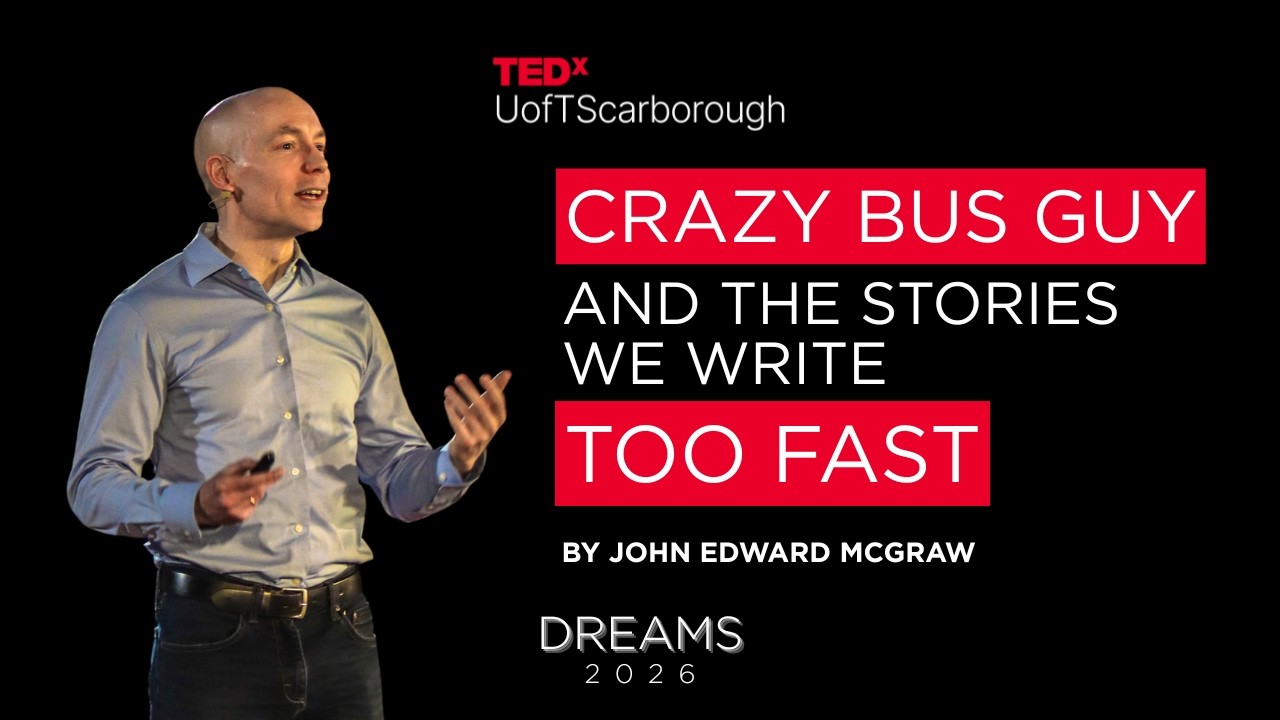
Crazy Bus Guy and the Stories We Write Too Fast | John Edward McGraw | TEDxUofTScarborough
Keywords
Summary
185 words
Critical Evaluation
Value of the Information & Strength of the Argument
The talk provides practical value by translating psychological research into actionable frameworks (LEAP and SPEAK) that individuals and organizations can apply. The argumentation is solid, blending personal narrative with aggregated research findings. The speaker effectively uses the ‘iceberg’ metaphor (behavior vs. intent) to explain why snap judgments occur, and supports his claims with statistics on student retention and workplace engagement. However, the evidence is presented at a high level without deep methodological detail, and the lack of specific citations weakens the capacity to independently verify the claims. The logical flow is clear, moving from problem to solution, with the Maya case study making the concepts tangible.
Scientific Rigor, Source Quality, Title Accuracy
The scientific rigor is moderate: the talk references real studies (e.g., Princeton research on trustworthiness in 0.1 seconds, national surveys on student belonging) but does not name authors, journals, or provide direct links. The speaker’s credentials as a multicultural workplace expert add some authority, but the lack of source transparency limits the ability to assess reliability. The title accurately captures the central theme of rapid story-writing and snap judgments, and the content directly aligns with this title. The description provides a link to TEDx general information, which serves as a platform reference but not as a source for the specific claims. No contradictory sources are mentioned, and the talk stays internally consistent.
233 words
Title / Content Match
The title accurately reflects the core theme: the tendency to form rapid, oversimplified narratives about others (the 'crazy bus guy') and the consequences of such snap judgments. It aligns well with the content.
Quality & Reliability
7/10
The talk references multiple studies (Princeton, national surveys) and personal anecdotes, but does not provide specific citations or links to the underlying research. The claims are plausible and align with established literature, though the lack of direct references reduces verifiability. Overall, the information is credible but presented in a popularized format.
Key Moments
Markers derived by PSI from the transcript: the creator did not define chapters.
- Introduction and the bus shelter anecdote in Mississauga.
- Japan train story and the 'crazy train guy' mirror.
- Statistics on international students considering leaving and mental health risks.
- Princeton study on forming judgments in 0.1 second.
- Introduction of LEAP framework with the iceberg metaphor.
- Maya's story and application of LEAP in a group project.
- Introduction of SPEAK framework and its five practices.
- Mike's example and the impact of SPEAK on workplace retention.
- Final call to question assumptions and protect dreams.
Cited Sources
- TEDx Official Page — Platform for independently organized TED-like events; the talk was given under this format.
Contribution & Novelties
The talk’s original contribution lies in synthesizing known psychological phenomena into two memorable frameworks (LEAP and SPEAK) that offer a step-by-step approach to counteracting snap judgments and fostering inclusive communication. While the underlying research (e.g., implicit bias, belonging studies) is not new, the packaging into actionable practices for both individuals and leaders provides a fresh applied perspective. The personal anecdotes add authenticity and make the concepts relatable.
Pour aller plus loin :
- Implicit bias — Cross-reference for the automatic nature of snap judgments.
- Belongingness — Theoretical background on the human need to belong, relevant to the talk’s core theme.
- Intercultural communication — Context for the SPEAK framework and workplace diversity issues.
111 words
Radar Profile
The radar profile shows moderate scores across all dimensions, with the highest being quantite and fiabilite (7), and the lowest being niveau technique (4). This indicates a talk that is rich in accessible information and generally reliable, but lacks technical depth, making it more suitable for a general audience than for specialists. The balance between practical value and scientific grounding is acceptable for a TEDx presentation.