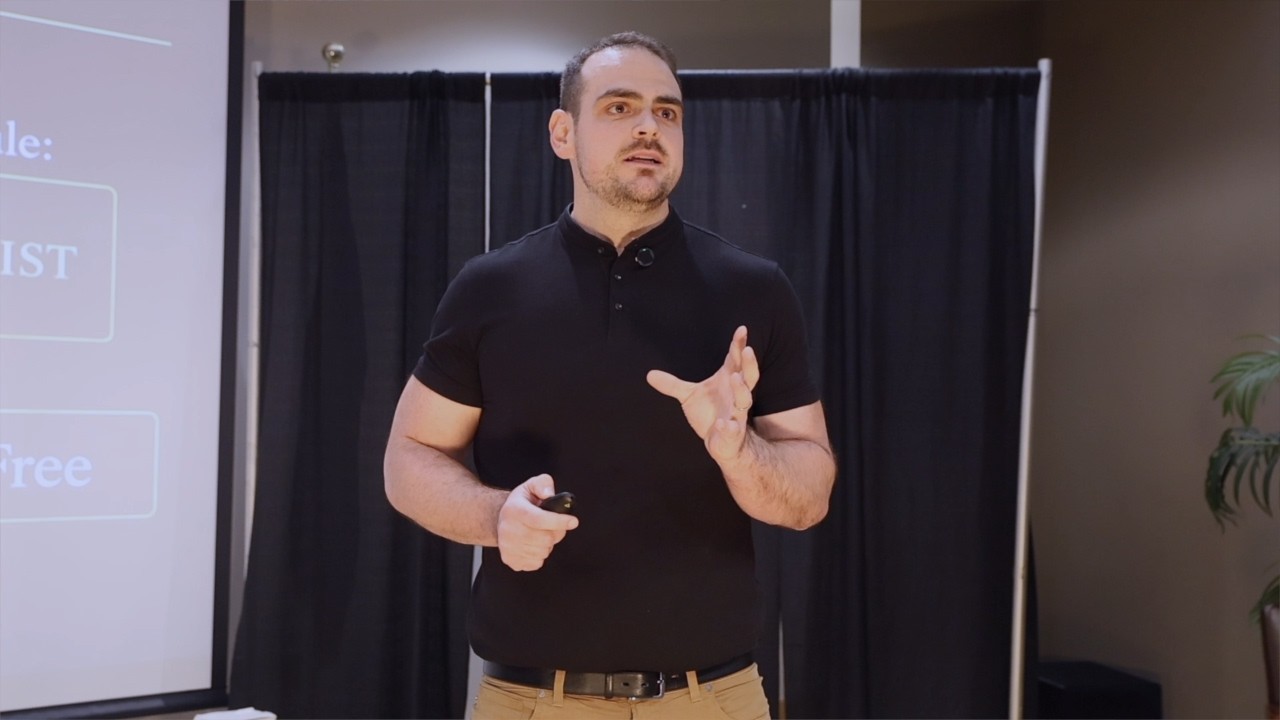
Freedom is Not Getting What You Want | Noah McMillan | TEDxGary
Title history
- Freedom is Not Getting What You Want | Noah McMillan | TEDxGary — observed on 20261117-0331 UTC (YouTube)
Keywords
Summary
156 words
Critical Evaluation
Value of the Information & Strength of the Argument
The talk offers a valuable philosophical perspective on freedom, moving beyond simplistic notions of desire fulfillment. The argument is well-structured: the initial thought experiment about the billionaire is effectively deconstructed, and the distinction between acting from desire and acting from reason is clearly articulated. The use of concrete examples (pizza, promise, dog) makes abstract ideas accessible. However, the argument relies heavily on the authority of Kant and Hegel without deep engagement with their texts or counterarguments. The reasoning is solid but not groundbreaking; it is a synthesis of classic ideas applied to everyday life. The persuasive strength lies in the vivid storytelling and logical progression.
Scientific Rigor, Source Quality, Title Accuracy
The talk references Kant and Hegel but does not cite specific works, which limits its scholarly rigor. The only external source mentioned is the TEDx platform itself. The title accurately reflects the content: it precisely captures the central thesis that freedom is not about getting what we want. The argument is internally consistent, but the lack of citations and alternative perspectives weakens its scientific weight. The absence of data or empirical evidence makes it a purely philosophical exploration, which is fine but not empirically grounded.
205 words
Title / Content Match
Excellent fit: the title questions the common conception of freedom as getting what you want, which is the central thesis.
Quality & Reliability
7/10
The talk presents a coherent philosophical argument grounded in Kant and Hegel, but the sources are not explicitly cited in detail. The reasoning is sound and examples are clear.
Key Moments
Markers derived by PSI from the transcript: the creator did not define chapters.
- Introduction with the story of being with his dog in the rain and the Eureka moment.
- Thought experiment of the freest possible life: a man with unlimited money and health.
- Introduction of the pizza example and the distinction between desire and choice.
- The council of reason analogy and the promise-breaking scenario.
- Hegel's perspective on limitations and the experience of freedom.
- Analysis of the billionaire's life and the conclusion that freedom is not about maximizing desires.
Cited Sources
- TEDx Program — The talk is part of the TEDx series, and the description provides this link for more information about TEDx events.
Contribution & Novelties
The talk contributes by translating abstract Kantian and Hegelian concepts of freedom into relatable, tangible examples, making a compelling case that freedom is found in rational self-legislation rather than in the satisfaction of desires. It offers a practical framework for examining one’s own life and choices. The novelty lies in the accessible application of these ideas to modern life, particularly the critique of consumerist notions of freedom.
Pour aller plus loin :
- Kant’s Moral Philosophy — Overview of Kant’s ethical framework, including the categorical imperative, which underpins the talk’s ‘council of reason’.
- Georg Wilhelm Friedrich Hegel — Hegel’s views on freedom and spirit, useful for understanding the social dimension of freedom discussed.
- Categorical Imperative — Specific explanation of the categorical imperative and its formulation, central to the talk’s argument.
129 words
Radar Profile
The radar profile is strong on information quality and global reliability, moderate on information quantity, and lower on technical level. This reflects a thought-provoking philosophical talk that is well-argued but not highly technical or data-heavy.