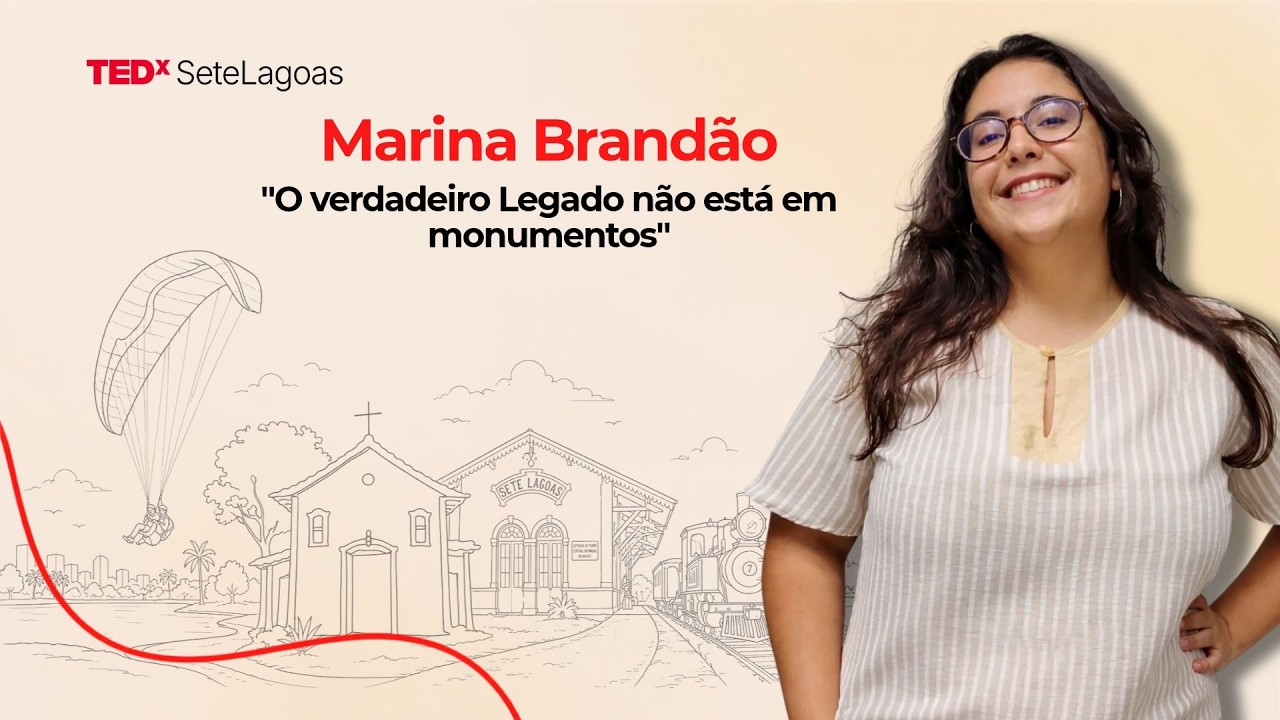
O Verdadeiro Legado Não Está em Monumentos | Marina França Brandão | TEDxSete Lagoas
Title history
- O Verdadeiro Legado Não Está em Monumentos | Marina França Brandão | TEDxSete Lagoas (PSI archive)
- O Verdadeiro Legado Não Está em Monumentos | Marina França Brandão | TEDxSete Lagoas — observed on 20261109-1737 UTC (YouTube)
Keywords
Summary
222 words
Critical Evaluation
Value of the Information & Strength of the Argument
The talk’s value lies in its accessible framing of complex concepts like collective memory and critical heritage, grounded in local examples that resonate emotionally. The argumentation is strong: it uses a clear analogy (individual maturity vs. community maturity), a concrete historical case (Juvenil Lanza), and a philosophical warning (Pierre Nora) to build a persuasive case for active engagement with the past. The speaker effectively moves from descriptive to prescriptive, offering practical questions for critical curation. However, the argument relies heavily on rhetorical appeal and personal conviction rather than empirical evidence or citations, which weakens its scholarly weight but may enhance its motivational impact.
Scientific Rigor, Source Quality, Title Accuracy
Scientific rigor is moderate: the speaker cites neurodevelopmental facts (prefrontal cortex) without references, and mentions Pierre Nora’s work qualitatively but provides no specific publications. The local historical examples are presented as common knowledge, but no archival sources or studies are referenced. The talk’s strength is its coherence and the way it integrates personal experience with theoretical concepts, but for a strictly academic audience it would need more precise citations. The title and content are well aligned, accurately representing the central thesis that true legacy is not in monuments but in active community building. No viewer comments were provided, so public reception cannot be assessed.
222 words
Title / Content Match
The title perfectly matches the core message: the true legacy lies in active community choices, not static monuments. The talk elaborates on this idea throughout.
Quality & Reliability
6/10
The talk offers a thoughtful perspective on collective memory and heritage, but relies primarily on personal anecdotes and a few widely known concepts (e.g., Pierre Nora) without citing specific studies or data. The reasoning is coherent and accessible, but the factual basis is limited.
Key Moments
Markers derived by PSI from the transcript: the creator did not define chapters.
- Introduction to the analogy between individual maturation and community memory.
- Personal story of leaving Sete Lagoas and returning during the pandemic for research.
- Presentation of local landmarks as layers of memory: Serra Santa Helena, Gruta Rei do Mato, railway, Embrapa.
- Story of Juvenil Lanza and his role in reshaping the city's historical narrative.
- Introduction of Pierre Nora's concept of places of memory and the call for critical curation.
- Closing appeal: the future is shaped by daily choices, not by past monuments.
Cited Sources
- TEDx Talks official page — The talk was given at a TEDx event; the link provides general information about TEDx events.
Contribution & Novelties
The talk contributes a localized perspective on collective memory, applying academic concepts to a specific Brazilian city. It bridges neuroscience, history, and civic engagement in an accessible way, emphasizing the active role of citizens in curating heritage. It also offers a model for other communities to critically assess their own narratives.
Pour aller plus loin :
- Pierre Nora — Nora’s concept of ’lieux de mémoire’ is central to the talk’s argument.
- Collective memory — Theoretical background on how groups construct shared memories.
- Critical heritage studies — A field that questions how heritage is selected and managed, relevant to the talk’s call for critical curation.
104 words
Radar Profile
The radar profile shows strong scores in information quantity and quality, but lower in technical level and reliability. This reflects a talk that is rich in ideas and engaging but lacks deep academic rigor and precise citations. The balance suggests an approachable yet thoughtful discussion suitable for a broad audience rather than a specialist.