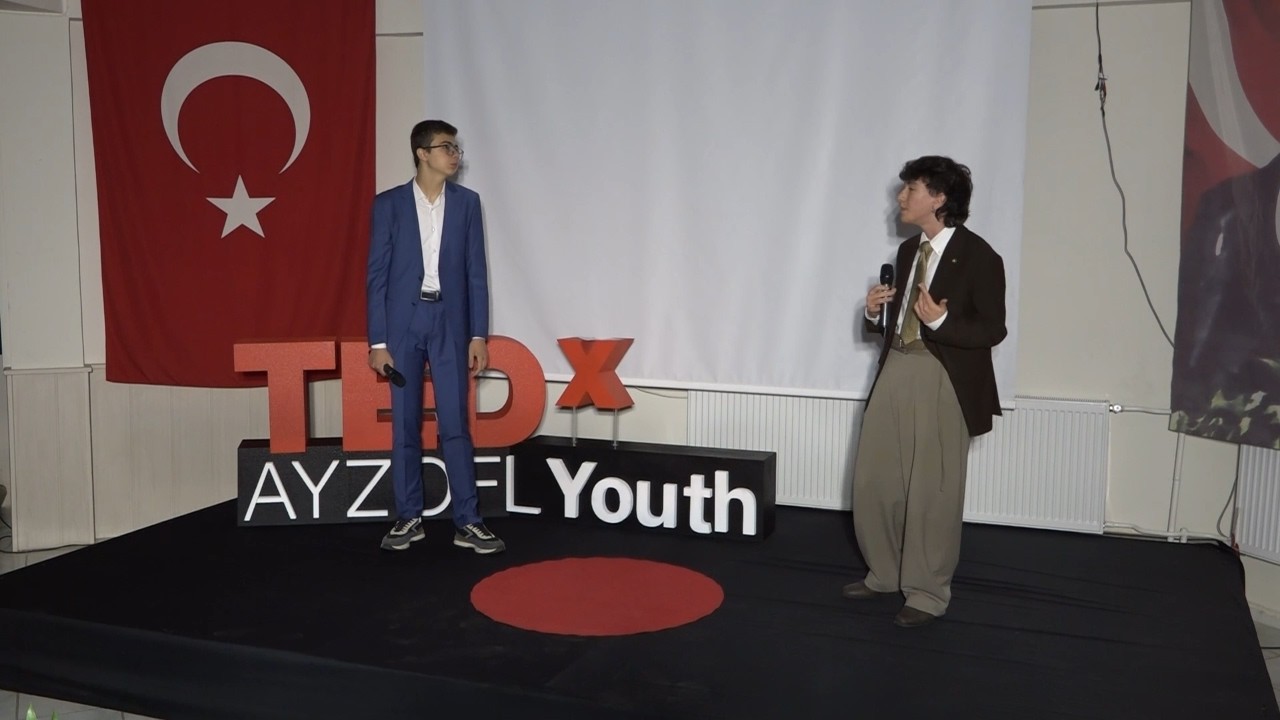
Are We Really Free? Or Are We Meant To Belive We Are | Göktuğ Güler & Veysel Dinç | TEDxAYZOFL Youth
Title history
- Are We Really Free? Or Are We Meant To Belive We Are | Göktuğ Güler & Veysel Dinç | TEDxAYZOFL Youth — observed on 20261114-0306 UTC (YouTube)
Keywords
Summary
152 words
Critical Evaluation
Value of the Information & Strength of the Argument
The value of the information is moderate; the speakers present a clear, accessible overview of the free will versus determinism debate without delving into sophisticated arguments. The argumentation relies on intuitive examples and personal beliefs rather than rigorous philosophical analysis. The soldier anecdote is engaging but oversimplifies the moral and psychological complexities. The debate shows genuine engagement but lacks citations or systematic evaluation of counterarguments. The speakers do show an attempt to address each other’s points, but the reasoning often remains superficial.
Scientific Rigor, Source Quality, Title Accuracy
There is a conspicuous lack of scholarly sources cited. The only provided link is the generic TEDx page, not specific research or philosophical texts. This significantly undermines the scientific rigor of the talk. The title is appropriate and matches content, though the typo ‘Belive’ is a minor flaw. No audience comments were provided, so no public reception can be analyzed.
157 words
Title / Content Match
The title accurately reflects the central question of the debate about free will, though the phrase 'Belive' is a typo for 'Believe'.
Quality & Reliability
5/10
The talk is a student-led debate with informal reasoning, lacking academic references and expert authority. The arguments are accessible but oversimplified, and the speakers do not engage with established philosophical or neuroscientific literature.
Key Moments
Markers derived by PSI from the transcript: the creator did not define chapters.
- Introduction: Speaker asks why the audience came, framing the question of motivation and free will.
- First speaker defines free will as the ability to choose otherwise and asserts its reality.
- Second speaker counters by emphasizing genetic, environmental, and biological factors influencing decisions, comparing humans to physical objects.
- Example of a soldier jumping on a grenade is discussed to question survival-driven determinism.
- Debate shifts to love and emotions: whether they are purely chemical or involve free choice.
- Historical consequences of free will are examined, referencing the Industrial Revolution's negative impacts.
- Concluding statements: one speaker affirms free will, the other denies it, leaving the audience with the open question.
Cited Sources
- TEDx Program Overview — Mentioned as the framework for the talk and generic resource for TEDx events.
Contribution & Novelties
The talk offers a student-level perspective on the free will debate, but lacks novel contributions. It primarily rehearses well-known arguments without advancing new concepts. The value lies in its pedagogical potential for introducing the topic to a young audience.
Pour aller plus loin :
- Free Will - Wikipedia — Foundational overview of philosophical positions on free will.
- Determinism - Wikipedia — Explains the concept of causal necessity central to the debate.
- Neuroscience of free will - Wikipedia — Discusses empirical findings that challenge or support free will from a brain science perspective.
92 words
Radar Profile
The radar profile shows balanced but modest scores across information quantity and quality, with a notably lower level of technical depth and reliability. This suggests a talk that is accessible and engaging but lacks scientific rigor and depth.