Last Things Worth Learning | Manohar Swaminathan | TEDxGWH School Bannerghatta
Keywords
Summary
156 words
Critical Evaluation
Value of the Information & Strength of the Argument
The talk offers a compelling, well-structured argument that AI’s disruption of memorization and test-taking skills is a positive catalyst for educational reform. It advocates for shifting focus from standardized proxies to authentic human competencies like empathy, collaboration, and civic engagement, using the existing NEP 2020 as a policy foundation. The speaker grounds his vision with concrete examples, such as analyzing the local neighborhood to integrate subjects like history, geography, and economics, and by referencing historical context like the Vur Lake. However, the argument is somewhat idealistic, with limited practical detail on implementation or addressing systemic inertia, but the core reasoning is solid and persuasive.
Scientific Rigor, Source Quality, Title Accuracy
The speaker’s background in technology and education lends credibility. He cites the NEP 2020 as a policy anchor and references his own work on accessibility and AI. The description links to the official TEDx page, but no specific academic sources are cited. The title matches the content well, as the talk directly addresses what is worth learning in an AI-driven world. The talk is not heavily source-based but relies on expert opinion and real-world examples. The reasoning is coherent and aligns with contemporary educational debates, though it would benefit from more empirical evidence.
212 words
Title / Content Match
The title aptly frames the central question of what knowledge remains valuable in the AI era; the talk directly addresses this by advocating for human-centric skills.
Quality & Reliability
8/10
Speaker is a Senior Principal Researcher at Microsoft Research India with strong technical and educational background; arguments are coherent and reference recognized policy frameworks like NEP 2020, though some claims are idealized.
Key Moments
Markers derived by PSI from the transcript: the creator did not define chapters.
- Introduction: India's large education system and the claim that AI makes current skills obsolete.
- The good news: AI makes traditional proxies like multiple-choice tests irrelevant.
- Extracurricular activities are what students actually enjoy and learn from.
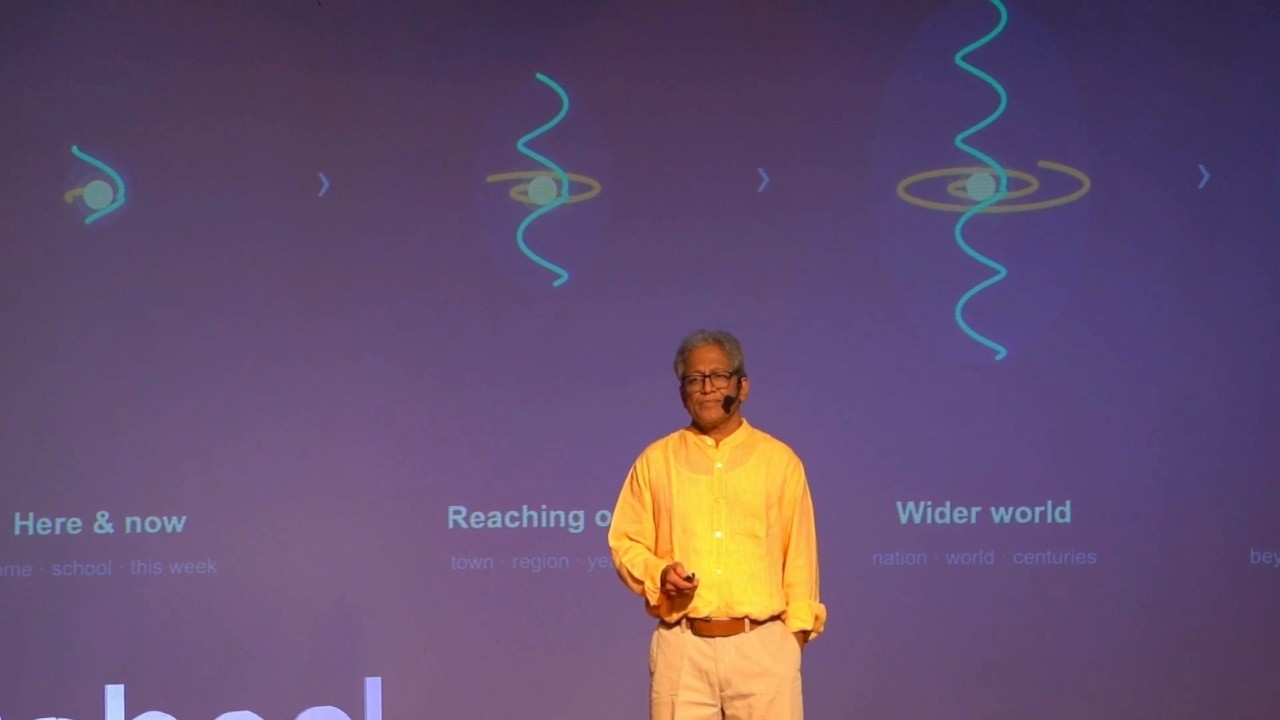
- Proposing the 'double helix' learning model: expanding from child to community and time.
- Example of exploring the local area, like Vur Lake, to integrate curricular subjects.
- Agentic AI as a scaffold for learning and the evolving role of teachers as co-explorers.
- Conclusion: decentralized model could transform students into active citizens.
Cited Sources
- TEDx Talks — The official TEDx platform where this talk was hosted, providing context for the event format.
Contribution & Novelties
The talk introduces a concrete framework (the double helix model) for integrating curricular and extracurricular learning in the age of AI, emphasizing the importance of local and temporal contexts. It proposes using agentic AI as a supportive infrastructure rather than a threat. This perspective aligns with ongoing debates about educational reform and the role of AI in society.
Pour aller plus loin :
- National Education Policy 2020 — The policy framework referenced by the speaker, central to his argument.
- Intelligent agent — Relevant concept for understanding agentic AI and how it can scaffold learning.
- Simputer — An earlier initiative by the speaker to bridge the digital divide, demonstrating his ongoing commitment to technology for marginalized groups.
116 words
Radar Profile
The profile shows high scores in quality of information and global reliability, reflecting the speaker's expertise and coherent argumentation. The moderate technical level and quantity of information indicate an accessible yet substantive talk. The emphasis on reliable and high-quality content suggests a trustworthy perspective, albeit one that is more opinion-driven than empirical.