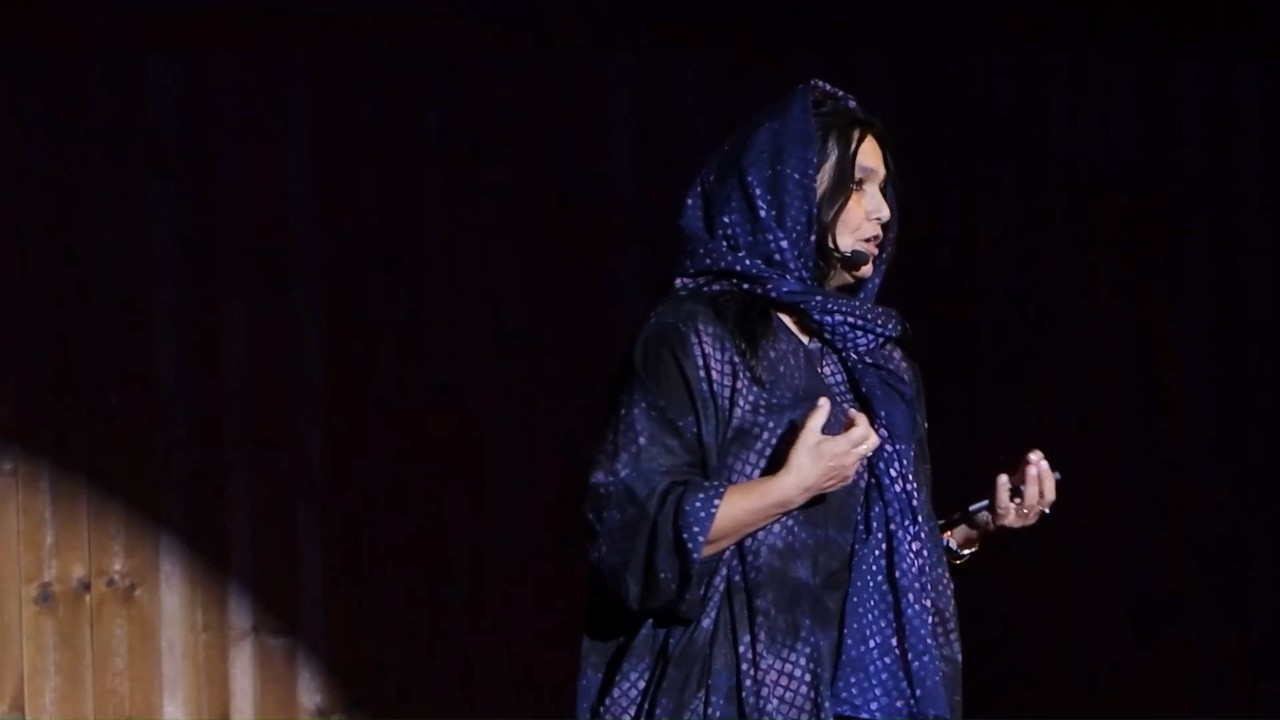
The Unchosen Choice | Mehrnoosh Shah Hosseini | TEDxAlef Salon
Keywords
Summary
336 words
Critical Evaluation
Value of the Information & Strength of the Argument
The informational value is that of a testimony rather than a demonstration: the viewer receives a detailed account of how one designer’s professional vocabulary was assembled, with concrete and specific detail — the all-white watch, the silver stripe on a street sweeper’s orange uniform, the beads moved from a drawer onto a coat, the patterned fabric inverted into a lining, the gold-thread wedding dress reworked in twelve days. These are genuinely informative particulars about a working method: the consistent move is to take an ordinary or hidden element and relocate it where it becomes visible, first as a personal gesture, later as a design proposition. The account is also informative about a specific social context, describing clothing constraints, the narrow palette of the period, and the gap between tribal and urban women’s dress. What it does not supply is anything transferable as knowledge: no figures, no comparative cases, no account of how the work was received commercially or critically, and no assessment of its results beyond the speaker’s own satisfaction.
The argumentation is associative rather than demonstrative, and this is deliberate. The narrative is organised as a chain of causally linked episodes — exclusion produces shame, shame produces paralysis, acceptance of the worst removes fear, the removal of fear permits courage, courage permits expression, expression requires a language, the language is found in clothing — and this chain is asserted rather than tested. The central psychological claim, that accepting the worst lifts the weight of fear, is stated as personal discovery and no alternative explanation is considered. The link between childhood exclusion and adult aesthetic choices is the most interesting but also the least substantiated: it rests entirely on retrospective interpretation, and the speaker does not address the obvious objection that the connection may be constructed in hindsight rather than causal. Several strands are introduced and then dropped — the university episode is explicitly said not to have continued, the plan for a children’s clothing factory is said to have failed — which is honest but leaves the argument without a completed arc. The talk’s strength is coherence of tone and the precision of its images; its weakness is that every claim is validated only by the narrator’s own memory and satisfaction.
Scientific Rigor, Source Quality, Title Accuracy
There is no scientific apparatus of any kind: no study, no data, no citation, no named external authority, and none is claimed or needed for the genre. The only reference point supplied is the TEDx programme page, which documents the event format rather than any claim in the talk. Judged as what it is — an experiential account — the sourcing standard is the speaker’s own life, and within that standard the talk is disciplined: it distinguishes what she wanted from what happened, admits failures (the factory that never materialised, the happiness that ‘went out’), and does not generalise her experience into advice about what others should do. The weakness is verifiability: dates, places and events are given in passing (the 22 Bahram wartime period, the Isfahan bazaar at eleven in the morning, a film festival commission) without any means for the viewer to situate them, and the psychological narrative cannot be cross-checked. Rhetorically the talk relies on a repeated device — the ‘alphabet’ metaphor — which is evocative but is never defined, so it functions as a label for an unanalysed process of finding a personal visual language.
On the relationship between title and content: the title announces a reflection on unchosen paths and missed possibilities, and the first third of the talk delivers exactly that, with the report card, the team selections and the unassigned lead role. The middle and later sections shift register toward a designer’s autobiography, and the theme of the unchosen becomes implicit rather than stated; the final return to the report card repairs the framing but arrives late. The title is therefore accurate about the talk’s emotional premise and only partially accurate about its substance.
668 words
Title / Content Match
The title matches the content well: the talk is built on never being picked for teams, roles or groups, and on the paths that were therefore never opened to her. It drifts toward a broader story of a designer assembling her own visual language, but the closing return to the kindergarten report card re-anchors the 'unchosen' frame explicitly.
Quality & Reliability
4/10
The talk is a first-person memoir: its substance is the speaker's own remembered experience, aesthetic decisions and the meaning she gives them. No statistical, experimental or historical claims are advanced that could be checked against an external record, so there is almost nothing that could be factually wrong, but equally nothing that can be independently verified. What can be assessed is internal coherence and honesty of self-description, both of which hold up: the narrative is chronologically consistent, self-critical rather than self-congratulatory, and avoids unsupported generalisations about other people. The score reflects a sincere but strictly anecdotal testimony, not an evidence-based account.
Key Moments
Markers derived by PSI from the transcript: the creator did not define chapters.
- Opening: the kindergarten report card, the friend's card full of stars, and the shame of not knowing what she had or had not done to earn one.
- Schoolyard team selection — always added last, unable to enter the group of the class's popular children.
- Wartime school theatre: wanting the lead role because the lead was the martyr, being cast instead behind the sandbank with the radio.
- Adolescence: the accumulated conviction of being insufficient, unattractive and ignorant, until she sits down at the bottom of the darkness and accepts it.
- Acceptance removes the weight of fear and leaves room for courage; the all-white watch nobody else would choose as a first deliberate act of daring.
- University museum project: asking why a museum cannot be heard as well as seen, and receiving what she calls her first star.
- Searching for her own 'alphabet': forty braids, a grandmother's trousers tucked into socks, refusing to pluck her eyebrows, wanting a centre parting.
- Clothing as the first interface with the outside world: the street sweeper's orange uniform with its silver stripe, beads moved from a drawer onto a coat.
- Learning to read street signs letter by letter as a child, and later decoding the city's signs into a language of her own.
- The Isfahan bazaar, tribal women's dress, and the ambition to translate that vocabulary into clothing for an urban woman; the twelve-day film festival commission built on a grandmother's gold-thread wedding dress.
Cited Sources
- TEDx — programme and event format — The only reference given in the video description; it documents the independently organised TEDx format under which the talk was given, not any factual claim made in the talk.
Contribution & Novelties
The original contribution is not a finding but a documented creative method, described from the inside by the practitioner. The recurring operation she describes — taking an ordinary or deliberately hidden element and relocating it where it becomes visible — is stated with unusual precision: a patterned tribal fabric is moved from the body of a garment to its lining so that a colour previously unavailable in the street becomes legible; beads are moved out of a drawer onto a coat lapel; a street sweeper’s uniform trim becomes a design motif; a grandmother’s wedding dress, kept in a trunk, is brought out and reworked in twelve days for an actress. She also articulates a design principle that goes beyond personal anecdote: a wish to let children, rather than adults, decide what they wear, which she frames as transferring her own hard-won ‘alphabet’ to another generation without instructing it. The talk is also of documentary value on a specific context, describing a period in which women’s clothing options were narrow and colour was difficult to introduce into public dress, and describing the translation problem between the dress vocabulary of tribal women and that of city women.
Pour aller plus loin :
- Self-efficacy — Bandura’s construct on belief in one’s capacity to act, which maps closely onto the shift the speaker describes between paralysis and the small acts of courage that follow acceptance.
- Narrative identity — The psychological literature on how people construct a continuous self through the stories they tell about their past; directly relevant to a talk built entirely on retrospective reinterpretation of childhood episodes.
- Qashqai people — Background on the tribal groups whose dress and ornamentation she describes seeing in the Isfahan bazaar and wishes to translate into urban clothing.
- Zardozi — The metal-thread embroidery tradition relevant to the gold-thread wedding dress she reworks for a film-festival commission.
- Brené Brown’s work on shame and vulnerability, cited here by name only — the closest well-known body of work to the talk’s central claim that acknowledged inadequacy, rather than concealed inadequacy, is what allows action.
- The concept of ‘decoding’ the urban environment — her account of reading shop signs letter by letter to assemble a private vocabulary — has clear affinities with visual and environmental literacy research, cited by concept rather than by a specific reference.
385 words
Radar Profile
The profile is low and flat, which is characteristic of a personal narrative rather than a knowledge-bearing talk: information density and technical level sit near the floor because there is no data, method or specialist content to transmit. Quality and reliability score higher, not because the claims are verifiable but because the account is internally coherent, specific and free of overreach. The shape of the radar describes a well-told testimony, not a weak version of a scientific presentation.