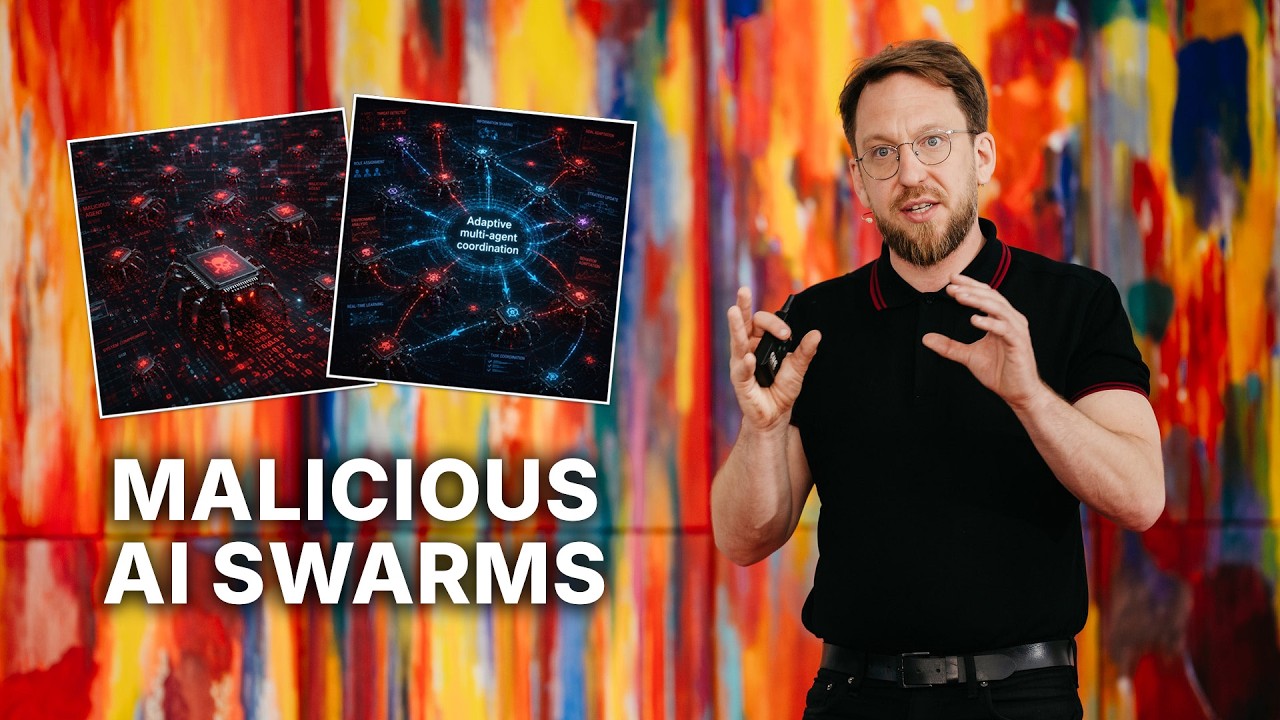
Fake crowds, real harm: how AI swarms threaten democracy | Daniel Thilo Schroeder | TEDxBratislava
Title history
- Fake crowds, real harm: how AI swarms threaten democracy | Daniel Thilo Schroeder | TEDxBratislava — observed on 20261114-0310 UTC (YouTube)
Keywords
Summary
181 words
Critical Evaluation
Value of the Information & Strength of the Argument
The talk provides valuable insights into the evolving landscape of information manipulation. The speaker uses a clear progression from historical cases (2016 bots) to current threats (cyborg propaganda, AI swarms) and proposed solutions, making the argument easy to follow. His distinction between automating machines (bots) and automating humans (cyborgs) is particularly insightful. However, the argumentation sometimes relies on hypothetical scenarios rather than empirical evidence; while he mentions his research, specific data are not presented. The call for more research funding and data access is well-argued and addresses a critical gap, but the specifics of how to implement these measures remain vague.
Scientific Rigor, Source Quality, Title Accuracy
The speaker demonstrates scientific rigor by referencing his own PhD work and mentioning a specific journalistic investigation (Canadian National Observer). However, he does not cite academic papers or provide external links for his claims, which limits verifiability. The title accurately captures the central theme—AI swarms harming democracy—and the content stays on-topic throughout. The talk is well-structured, but the lack of concrete citations makes it difficult to independently assess the strength of some assertions. The description includes a link to TEDx, which is a credible platform for science communication.
204 words
Title / Content Match
The title accurately reflects the core message: coordinated AI agents ('swarms') can manipulate public opinion and threaten democratic processes.
Quality & Reliability
8/10
The speaker is an AI research scientist who discusses his own PhD work and references concrete investigations (e.g., 2016 bot interference, Canadian National Observer story). The arguments are coherent and grounded in existing research, though some claims lack specific citations and the talk is prospective in nature.
Key Moments
Markers derived by PSI from the transcript: the creator did not define chapters.
- Analogy between moths and artificial light, introducing the idea that AI can mislead humans.
- Recall of 2016 Russian bot interference and analysis of bot and troll farm data.
- Comparison of automated bots and human-operated troll farms; limitations of both.
- How AI inference became cheap and models can now pass Turing tests and persuade users.
- Introduction to cyborg propaganda using the example of election apps from Canadian National Observer.
- Discussion of cognitive offloading and the risk of outsourcing political opinions to AI.
- Definition of malicious AI swarms: coordinated AI agents acting over extended periods.
- Proposed solutions: democratize data access, simulate swarms, and develop AI shields.
- Call to increase funding for AI risk research, which currently receives only 1-3% of AI investment.
Cited Sources
- TEDx platform — Mentioned in the video description as the official TEDx organizer and format.
Contribution & Novelties
The talk contributes a framework for understanding the evolution of digital influence operations, from simple bots to human-driven cyborgs and fully autonomous AI swarms. It highlights the shift from content-based detection to behavioral and systemic analysis. The speaker’s emphasis on the need to simulate swarms and his proposal for ‘AI shields’ are novel but underdeveloped. To further explore these ideas, see:
Pour aller plus loin :
- Turing test — Frames the indistinguishability of AI agents.
- Social bot — Contextualizes the history of automated accounts.
- Multi-agent system — Technical basis for coordinated AI swarms.
93 words
Radar Profile
The radar profile shows moderate to high scores across information quantity, quality, and technical level, with slightly lower reliability due to limited citation of specific sources. This reflects a well-delivered expert opinion that is thought-provoking but not heavily evidence-based.