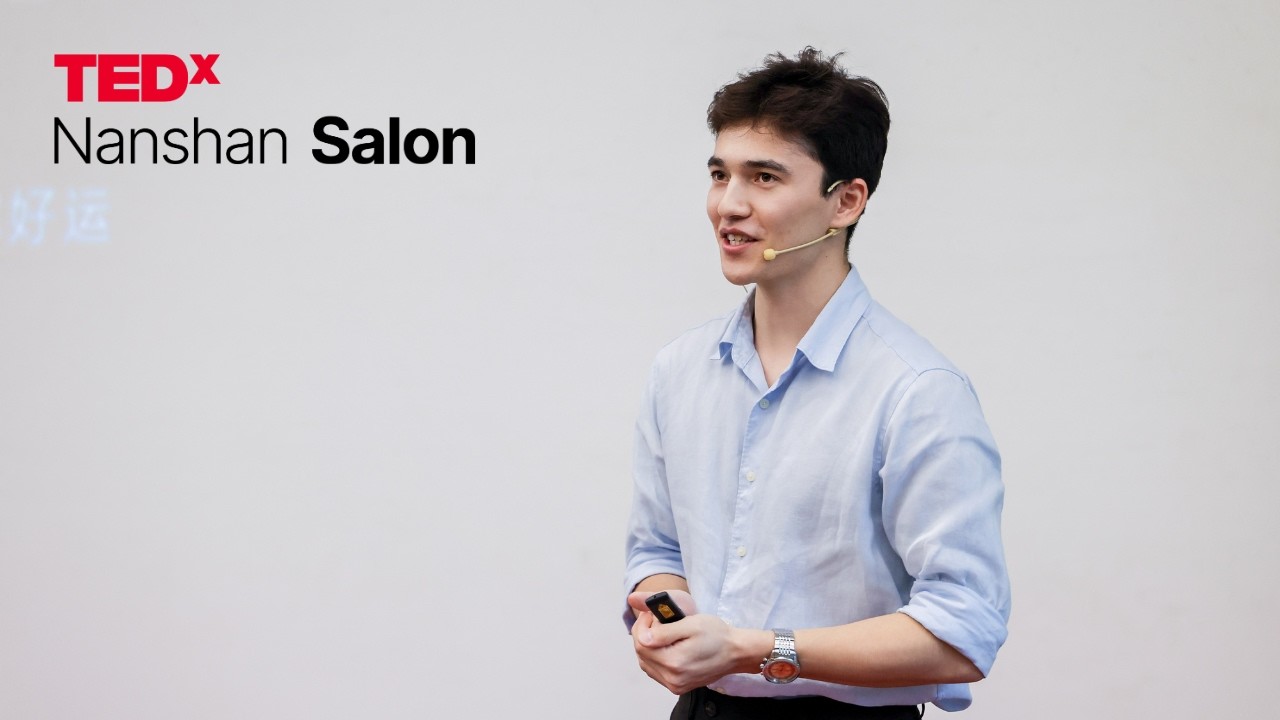
What It Really Means to Speak Six Languages? | Leon Lin | TEDxNanshan Salon
Title history
- What It Really Means to Speak Six Languages? | Leon Lin | TEDxNanshan Salon — observed on 20261027-0210 UTC (YouTube)
Keywords
Summary
170 words
Critical Evaluation
Value of the Information & Strength of the Argument
The talk offers a valuable reframing of language learning as a personalized and purposeful process. It argues effectively that the question ‘How many languages do you speak?’ is less meaningful than ‘What can you do with each language?’ This shift in perspective is practically useful. The argumentation is coherent and built on personal anecdotes, clearly distinguishing between passive and active skills and between studying and using a language. While not empirically substantiated, the recommendations (e.g., focusing on usable expressions, spaced practice, gradual confidence building) are consistent with mainstream language-learning advice and resonate with learners. The speaker’s warm, relatable tone strengthens the message, though the lack of concrete data or scientific references limits the depth of proof.
Scientific Rigor, Source Quality, Title Accuracy
The scientific rigor is low; the talk is based on personal experience with no citations or references to research. The quality of sources is therefore minimal, with only a generic link to TEDx.com provided in the description. The title accurately reflects the content—the speaker directly confronts the meaning behind the claim of speaking six languages. No source evaluation is possible beyond the anecdotal evidence presented. The talk is more inspirational than research-based, which is acceptable for a TEDx format but not for a rigorous scientific exposition.
217 words
Title / Content Match
The title directly matches the content, which critically explores the meaning of speaking six languages beyond mere numbers.
Quality & Reliability
5/10
The talk presents personal experience and advocacy rather than scientific research. No empirical evidence or citable sources are provided, relying solely on anecdotal insights and common techniques.
Key Moments
Markers derived by PSI from the transcript: the creator did not define chapters.
- Introduction: Leon introduces himself and his love for languages, noting he learns a new language every two years.
- Challenging the question: 'How many languages do you speak?' vs. 'What can you do with them?'
- Discussion: Different languages enter life via different paths (childhood, education, living abroad) and develop unequally.
- Impact of environment: Two learners of the same language develop different strengths based on usage contexts.
- Introduction of two techniques: ritual practice (retrieving before checking) and spaced practice (reviewing over time).
- Live example: Teaching the Uzbek word for 'good luck' and emphasizing that knowing a word on screen differs from using it.
- Addressing fear of mistakes: Confidence develops through speaking, not before; meaningful progress comes from small consistent actions.
- Closing challenge: Apply one learned expression within a week; reframing language learning as expanding communicative ability, not perfection.
Cited Sources
- TEDx program information — The talk was given at a TEDx event, organized independently; this link is provided in the video description for context.
Contribution & Novelties
The talk contributes a personal, humanistic perspective on multilingualism, shifting the focus from quantitative achievement (how many languages) to qualitative communication (what you can do). It offers simple, actionable techniques (ritual practice and spaced practice) and emphasizes psychological factors such as confidence and the fear of mistakes. While not scientifically original, it synthesizes common wisdom in an engaging narrative.
Pour aller plus loin :
- Spaced repetition — A well-documented learning technique that aligns with Leon’s spaced practice suggestion.
- Communicative language teaching — An educational approach emphasizing real-life communication, consistent with the talk’s core philosophy.
- Language proficiency — Conceptualizes proficiency as multi-faceted, supporting Leon’s argument that abilities vary across contexts.
109 words
Radar Profile
The profile shows moderate quantity and quality of information, low technical depth, and low reliability due to lack of citations. The talk is engaging and practical but not research-oriented, reflecting its personal-experience nature.