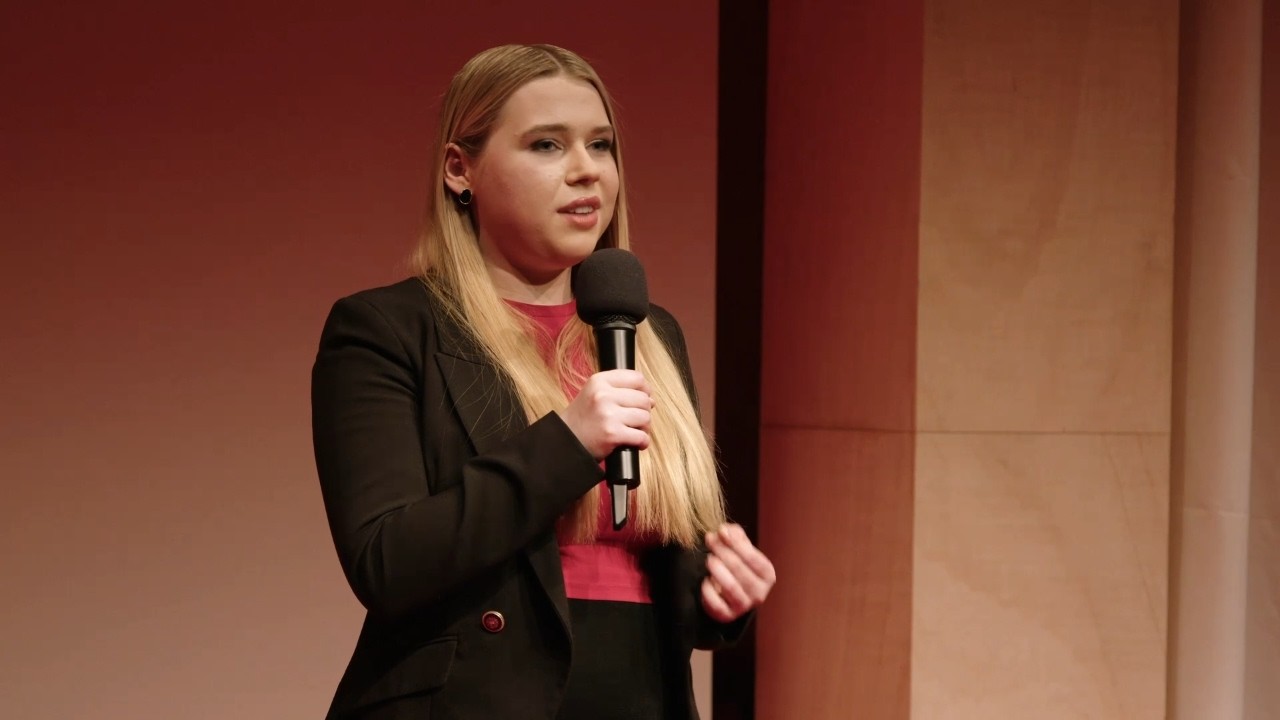
FOMO jako motywacja, by nie odkładać życia na później | Anastazja Rybakiewicz | TEDxWarsaw Youth
Title history
- FOMO jako motywacja, by nie odkładać życia na później | Anastazja Rybakiewicz | TEDxWarsaw Youth (PSI archive)
- FOMO jako motywacja, by nie odkładać życia na później | Anastazja Rybakiewicz | TEDxWarsaw Youth — observed on 20261117-0330 UTC (YouTube)
Keywords
Summary
269 words
Critical Evaluation
Value of the Information & Strength of the Argument
The talk’s value lies in its accessible synthesis of well-known psychological ideas linked to personal narrative. The speaker effectively argues that FOMO can be reinterpreted as a productive urgency, supported by references to Burkeman, Kurtz, and Kahneman. Her argumentation is coherent: she first establishes the finite nature of time, then illustrates the common trap of postponement, provides empirical evidence for reframing, and finally applies the reasoning to her own life decision, making the abstract concrete. The reasoning is sound, though it remains personal rather than universally prescriptive.
Scientific Rigor, Source Quality, Title Accuracy
The speaker mentions specific sources: Olivier Burkeman’s ‘4000 Weeks’, a study by psychologist Jamie Kurtz (likely referring to ’the last 1/10 year’ experiment), and Daniel Kahneman’s day reconstruction method. These are accurately presented and add credibility. However, no direct references or links are provided in the description beyond the general TEDx URL, limiting verifiability. The title ‘FOMO jako motywacja…’ accurately captures the talk’s essence, and the content stays on point throughout.
173 words
Title / Content Match
The title directly reflects the central argument: reframing FOMO as a positive motivator to avoid procrastination. The content consistently supports this thesis.
Quality & Reliability
6/10
The talk combines personal experience with references to known psychological concepts and studies (Burkeman, Kurtz, Kahneman). It is not peer-reviewed or exhaustive, but the claims are presented accurately and align with established research on time perception and decision-making.
Key Moments
Markers derived by PSI from the transcript: the creator did not define chapters.
- Opening: 'We will all die' – introducing the theme of mortality and time
- Personal story about obsessive time-saving habits as a child
- Introduction of Burkeman's 4000 weeks and the psychological impact of quantifying life
- Discussion of subjective time perception and the ZUS reference
- Common pattern of postponement (school, work, family) and the risk of regret
- Jamie Kurtz study on time perception and its effect on happiness
- Daniel Kahneman's day reconstruction method explained
- Personal dilemma: accepting professional karting offer, opportunity cost analysis
- Conclusion: embracing FOMO as motivation to live fully in the present
Cited Sources
- TEDx Talks – official site — Link to TEDx program, the umbrella under which this talk was produced.
- 4000 Weeks: Time Management for Mortals – Olivier Burkeman — Book mentioned as the source for the '4000 weeks' concept.
- Study by Jamie Kurtz (2008) — Described as an experiment on time framing and its effects on engagement and happiness.
- Daniel Kahneman's Day Reconstruction Method — Referenced as a tool to assess emotional experience of daily activities.
Contribution & Novelties
The talk offers a fresh, youth-oriented perspective on a common concept (FOMO), reframing it from a negative anxiety to a potential positive driver. While the core ideas (finite time, opportunity cost, mindful choices) are not novel, the personal narrative and practical application to a life decision give it an engaging and relatable twist. The speaker does not merely recite existing research but integrates it into her own story, making abstract concepts tangible.
Pour aller plus loin :
- Fear of missing out - Wikipedia — Provides an overview of FOMO, its psychological underpinnings, and related research.
- Day Reconstruction Method - Wikipedia — Explains Kahneman’s method in detail, including its origins and applications.
- Opportunity cost - Wikipedia — Core economic concept applied to life choices, directly relevant to the speaker’s decision-making.
- 4000 Weeks by Olivier Burkeman - Wikipedia — Offers context on the book’s central thesis about time management and mortality.
149 words
Radar Profile
The profile shows moderate scores across all dimensions, with slightly higher quality information compared to quantity and technical depth. This reflects a balanced but not deeply rigorous presentation, suitable for a general audience interested in personal development.