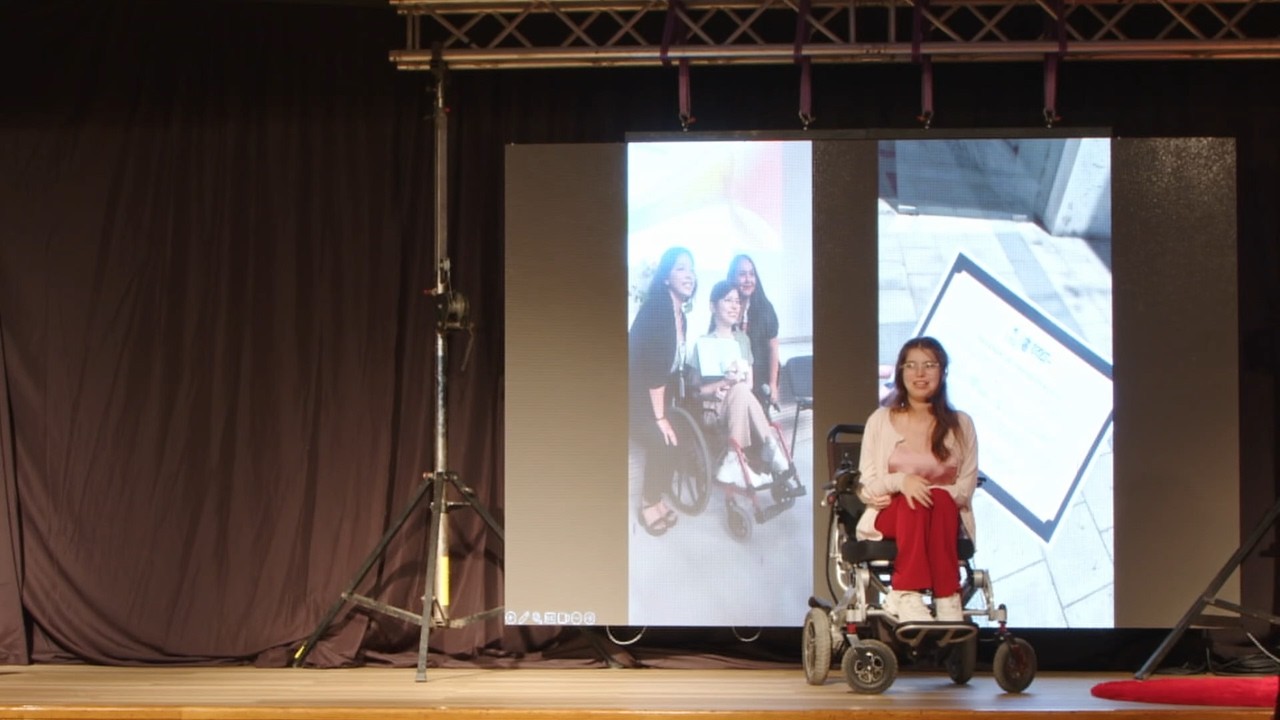
No es mi cuerpo el que tenía límites, era el concepto | Kathleen Reinike | TEDxAntofagasta
It wasn't my body that had limits, it was the concept | Kathleen Reinike | TEDxAntofagasta
Keywords
Summary
196 words
Critical Evaluation
Value of the Information & Strength of the Argument
The talk’s value lies in its first-person testimony, offering an authentic and poignant insight into the lived experience of disability discrimination in education and employment. The argumentation is built on personal anecdotes and emotional appeals rather than systematic evidence, which is appropriate for a personal narrative but limits its generalizable scientific claims. The speaker effectively challenges common assumptions about ability and potential, but does not provide data or external studies to support her broader assertions. Her advocacy for inclusion and societal change is compelling and well-structured, moving from individual struggle to a call for collective action.
Scientific Rigor, Source Quality, Title Accuracy
The talk is not scientifically rigorous in the traditional sense; it relies on personal experience and anecdote rather than empirical research. The only source mentioned is the TEDx platform itself, with no citations to studies or reports. The title aligns well with the content, as the speaker repeatedly emphasizes that the concept of disability, not the body, imposes limits. The talk would benefit from referencing statistics or research on disability inclusion to strengthen its claims, but as an expert opinion and personal appeal, it serves its purpose in raising awareness and inspiring change.
204 words
Title / Content Match
The title accurately reflects the talk's central idea that societal concepts, not physical limitations, define boundaries.
Quality & Reliability
5/10
Personal testimony with limited external sources; provides an authentic perspective but lacks rigorous empirical evidence for general claims.
Key Moments
Markers derived by PSI from the transcript: the creator did not define chapters.
- Introduction: question about disability and profession
- Cites statistic: only 1% of disabled people in Chile have higher education
- Childhood story: falls, therapy, and medical visits
- Rejection from schools and bullying experience
- Father's death and determination to continue
- University rejection and secret enrollment
- COVID online learning and academic success
- Self-development: leadership course, Chinese, and projects
- Award for institution, inclusion reforms, and volunteering
- Mother's illness, graduation, and teaching
- 2025 viral story and call for action
Cited Sources
- TEDx Talks — Platform hosting the talk, mentioned in the description.
Contribution & Novelties
The talk offers a deeply personal and emotional perspective on disability, emphasizing that societal concepts—not physical bodies—impose limits. It highlights systemic barriers in education and employment for people with disabilities, and advocates for a shift in narrative from individual incapacity to environmental and social change. The originality lies in the speaker’s dual role as engineer and activist, using personal achievement to challenge stereotypes.
Pour aller plus loin :
- Social model of disability — This framework contrasts with the medical model, aligning with the talk’s argument that environments and attitudes are the main barriers.
- Inclusion (disability rights) — Discusses the right of people with disabilities to participate fully in society, relevant to the talk’s call for systemic change.
- Universal design — Design of products and environments to be usable by all people, which supports the idea of removing environmental barriers.
139 words
Radar Profile
The radar chart shows a profile with low technicality and moderate information quantity and quality, reflecting the talk's personal and non-scientific nature. The fiabilité score is moderate, appropriate for a first-person testimony. The overall shape indicates a communication-focused talk rather than a rigorous scientific exposition.