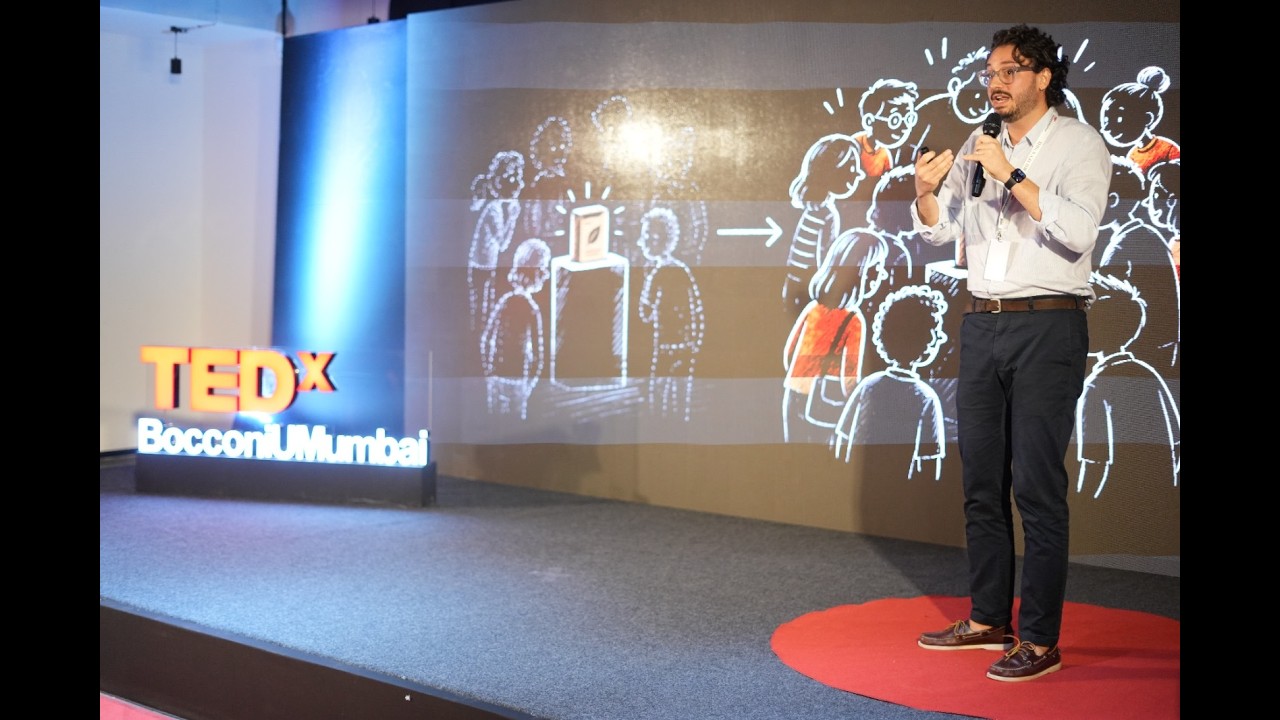
Building People Who Don't Exist | Michele Russo | TEDxBocconiUMumbai
Keywords
Summary
159 words
Critical Evaluation
Value of the Information & Strength of the Argument
The talk provides a valuable contribution by demonstrating through concrete experiments that LLMs can be prompted to behave like humans in economic decision-making contexts. The argumentation is logically structured: it moves from a simple role-play example to a systematic investigation of three human dimensions (personality, rationality, irrationality). The speaker supports his claims with data visualizations and comparative benchmarks against human behavior, which strengthens the persuasiveness. However, the lack of detailed statistical methodology and the small sample size (only a few personas per experiment) limit the robustness of the conclusions. Nevertheless, the talk offers an original perspective on AI’s ability to simulate human behavior, which is both insightful and thought-provoking for both business and academic audiences.
Scientific Rigor, Source Quality, Title Accuracy
The scientific rigor is moderate. The speaker references the Stanford AI Index report to support claims of AI superhuman performance in specific tasks, but does not provide a direct citation or URL. He also mentions the Big Five personality model and framing effects from behavioral economics without specific references. The experiments are described informally, without reporting confidence intervals or statistical tests. The title ‘Building People Who Don’t Exist’ is apt and creates interest, while the content aligns well with the title. No user comments were provided, so public feedback cannot be analyzed.
222 words
Title / Content Match
The title accurately reflects the content: it explains how AI can create synthetic personas and questions their degree of humanity.
Quality & Reliability
7/10
The speaker is a professor at SDA Bocconi with relevant expertise in AI and business analytics. He presents three original experiments, but the methodology is described at a high level without full statistical details, limiting reproducibility. The talk is informative and credible but relies on the author's own assertions rather than peer-reviewed results.
Key Moments
Markers derived by PSI from the transcript: the creator did not define chapters.
- Introduction to the concept of building synthetic personas with AI
- Example of prompting AI to act as a consumer for a product
- First experiment: Big Five personality traits in synthetic personas
- Second experiment: rational pricing and budget constraints
- Third experiment: irrational behavior and framing effects
- Conclusion: redefining the question from 'how intelligent' to 'how human'
Cited Sources
- TEDx Talks — Official TEDx program page, where the talk was published under the TEDx event format.
Concurring Sources
- Stanford AI Index Report — Referenced by the speaker to show AI superhuman performance in benchmarks; aligns with the idea that AI can outperform humans in specific tasks.
Contribution & Novelties
The talk’s original contribution lies in its systematic comparison of synthetic personas generated by LLMs against human behavioral benchmarks along three dimensions: personality, rationality, and irrationality. While prior work has explored individual aspects, Russo’s integrated approach and his emphasis on the ‘irrational’ component as the key differentiator offer a fresh perspective. The talk also challenges conventional AI evaluation criteria by proposing ‘how human’ as a metric.
Pour aller plus loin :
- Big Five personality traits — Relevant to the first experiment on personality simulation.
- Framing effect (psychology) — Central to the third experiment on irrational behavior.
- Large language model — Provides background on the technology used.
- Stanford AI Index Report — The speaker references this report to support claims of AI surpassing human performance in specific tasks.
127 words
Radar Profile
The radar profile shows high scores in quantity and quality of information, reflecting the rich content and clear presentation. Technical level is moderate, making it accessible, while global reliability is slightly lower due to unverified methodology. The low 'niveau_technique' score (7) indicates the talk is not overly technical, which suits a general audience.