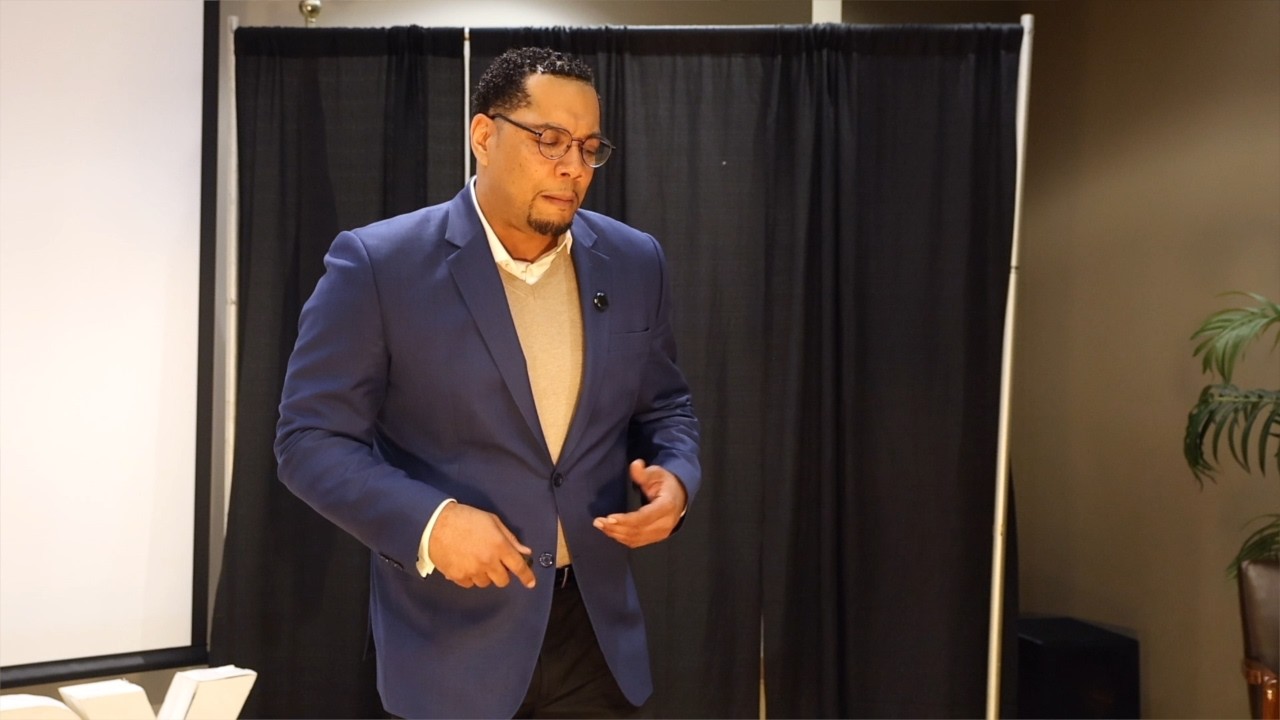
Why Your Brain Won't Let Go | Derrick Loyd | TEDxGary
Title history
- Why Your Brain Won't Let Go | Derrick Loyd | TEDxGary — observed on 20261117-0330 UTC (YouTube)
Keywords
Summary
168 words
Critical Evaluation
Value of the Information & Strength of the Argument
The talk’s value lies in its authentic personal narrative and the concrete, actionable framework for approaching forgiveness. Loyd effectively argues that forgiveness is a self-directed process rather than a transaction dependent on the offender’s actions. His argument is strengthened by a clear logical progression: from the initial trauma, to the discovery of scientific research, to the confrontation with his aunt, and finally to his own healing steps. The reasoning is coherent and emotionally compelling, though it relies heavily on anecdotal evidence rather than systematic empirical demonstration.
Scientific Rigor, Source Quality, Title Accuracy
The speaker references scientific studies (Stanford Northern Ireland Project, James Kimmel Jr. of Yale) but does not provide specific publication details or direct quotations. The only link in the description is the generic TEDx page, which does not substantiate the claims. The title aligns well with the content, as it foregrounds the brain’s difficulty in releasing traumatic memories. No viewer comments were provided, so no public reception analysis is possible.
171 words
Title / Content Match
The title effectively captures the central theme of mental loops and the struggle to let go, though it focuses more on the brain's tendency to replay trauma rather than the forgiveness solution presented.
Quality & Reliability
5/10
The talk relies primarily on personal anecdote and references to studies without providing detailed source verification. While the speaker cites Stanford and Yale research, the absence of specific citations or data reduces the overall reliability.
Key Moments
Markers derived by PSI from the transcript: the creator did not define chapters.
- Speaker introduces the Stanford research on forgiveness training and its effects on hurt and stress.
- Recounts the murder of his grandfather and cousin at age eight and his subsequent migraines and inability to eat.
- Explains the replay-reward-return loop and cites psychiatrist James Kimmel Jr.
- Describes the Stanford Northern Ireland Project with 17 murder victims' relatives and its positive outcomes.
- Recounts his confrontation with his aunt and her 'probably' reply, leading to clarity that forgiveness must come from within.
- Details six steps of his forgiveness journey: pausing, feeling pain, identifying lies, self-compassion, owning comeback, sharing wisdom.
- Describes his mother's letter campaign and SEAL reentry program, then leads audience in a self-forgiveness exercise.
Cited Sources
- TEDx Talks - Official Site — Referenced in the video description as the platform for independently organized TEDx events.
Concurring Sources
- Stanford Forgiveness Project — General concept of forgiveness and its psychological benefits, aligning with the talk's claims.
Dissenting Sources
- No directly contradictory sources found — No specific contradictions were raised; the talk is anecdotal and not empirically contested.
Contribution & Novelties
This talk contributes a personal testimony that bridges clinical research on forgiveness with practical, lived experience. It offers a distilled six-step method for breaking the rumination loop, emphasizing self-forgiveness as a crucial final step. The innovative angle is the combination of scientific references with an intimate narrative that makes the concept of forgiveness tangible.
Pour aller plus loin :
- Forgiveness - American Psychological Association — Pertinent for understanding psychological definitions and research on forgiveness.
- Post-traumatic stress disorder - Wikipedia — Relevant to the trauma and symptoms described in the talk.
- Rumination (psychology) - Wikipedia — Directly relates to the ‘replay loop’ concept discussed.
- Northern Ireland conflict and forgiveness studies — Context for the Stanford project’s mission, though not directly cited.
120 words
Radar Profile
The radar profile shows low to moderate scores across all dimensions, reflecting a talk that is emotionally rich but technically shallow. The relatively higher score on 'qualite_information' suggests strong narrative quality, while 'niveau_technique' and 'fiabilite_globale' lag due to limited empirical detail.