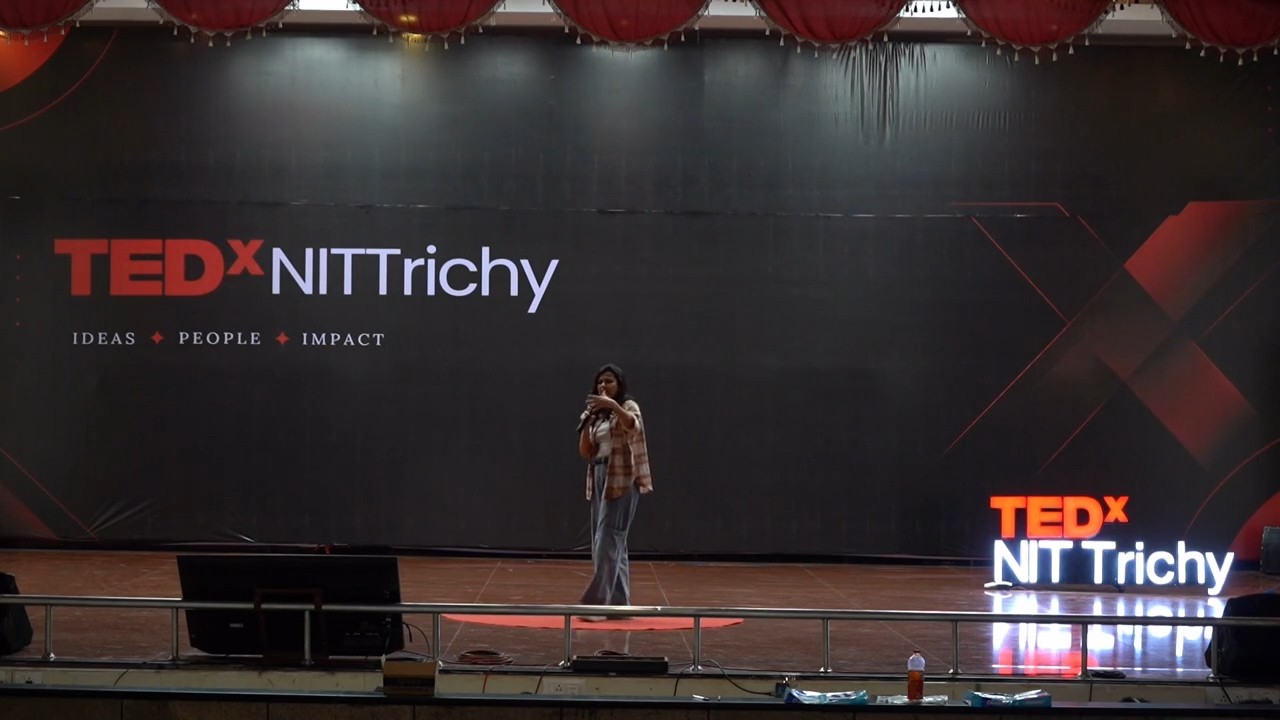
The Future Won't be Any Better | Iswaryaa G P | TEDxNIT Trichy
Title history
- The Future Won't be Any Better | Iswaryaa G P | TEDxNIT Trichy — observed on 20261104-2229 UTC (YouTube)
Keywords
Summary
184 words
Critical Evaluation
Value of the Information & Strength of the Argument
The value of the talk lies in its relatable metaphors and honest personal anecdotes, making abstract concepts like career satisfaction tangible. The argument is built on the contrast between ’exam me’ (working to meet external expectations) and ‘competition me’ (engaging in activities for intrinsic joy), effectively illustrating the difference between renting and owning one’s path. The speaker’s decision to resign and pursue content creation provides a concrete example of the principles she advocates. However, the argumentation is largely emotional and anecdotal, lacking robust logical structure or empirical evidence. The reliance on personal experience, while engaging, limits its generalizability and scientific rigor.
Scientific Rigor, Source Quality, Title Accuracy
The talk is a personal testimony rather than a scientific exposition; it cites no research or expert opinions, relying solely on the speaker’s experiences. The only source mentioned is the TEDx platform itself, which does not substantiate the claims. The title ‘The Future Won’t be Any Better’ aligns well with the content, as the speaker explicitly reflects on her fear that the future would not improve, and resolves to change her present circumstances. The adequacy is strong: the title succinctly encapsulates the core message. No external sources are used, so the reliability of the information is based entirely on the speaker’s credibility, which is not established beyond personal narrative.
225 words
Title / Content Match
The title effectively captures the core message: the future will not improve by itself, so one must actively build it.
Quality & Reliability
4/10
The talk is a personal narrative with anecdotal evidence, not based on scientific research. It offers a motivational perspective but lacks empirical support.
Key Moments
Markers derived by PSI from the transcript: the creator did not define chapters.
- Opening with a family function anecdote, introducing the awkwardness of career questions.
- Rented house analogy: explaining why owning a home feels different, leading to the concept of 'maki'.
- Fancy dress competition story and the first experience of feeling personally invested in an endeavor.
- Resigning from a corporate job and the realization that the future would not improve without change.
- Discovering content creation as a way to leave 'fingerprints' on work and feeling alive again.
Cited Sources
- TEDx Talks — The talk was given at a TEDx event, and the description includes this link to the TEDx platform.
Contribution & Novelties
The talk offers a unique personal narrative that reframes career dissatisfaction through the metaphors of rented vs owned housing and the concept of ‘maki.’ Its originality lies in connecting these metaphors to a concrete career pivot, illustrating how one can transform work from an impersonal transaction into an expression of self. The speaker’s concept of the ‘crooked nail’ provides a memorable image for finding personal meaning in one’s contributions.
Pour aller plus loin :
- Ikigai — Japanese concept of a reason for being, similar to finding one’s passion.
- Flow (psychology) — state of immersion in activities, aligning with the joy of creating.
- Job crafting — adjusting one’s job to increase meaning, related to making work your own.
117 words
Radar Profile
The radar profile shows moderate scores in information quantity and quality, indicating a rich personal account but limited objective content. The low technicality score reflects the accessible, non-scientific nature of the talk, while the low reliability score underscores the subjective basis of the information. Overall, the talk is engaging and insightful but not scientifically rigorous.