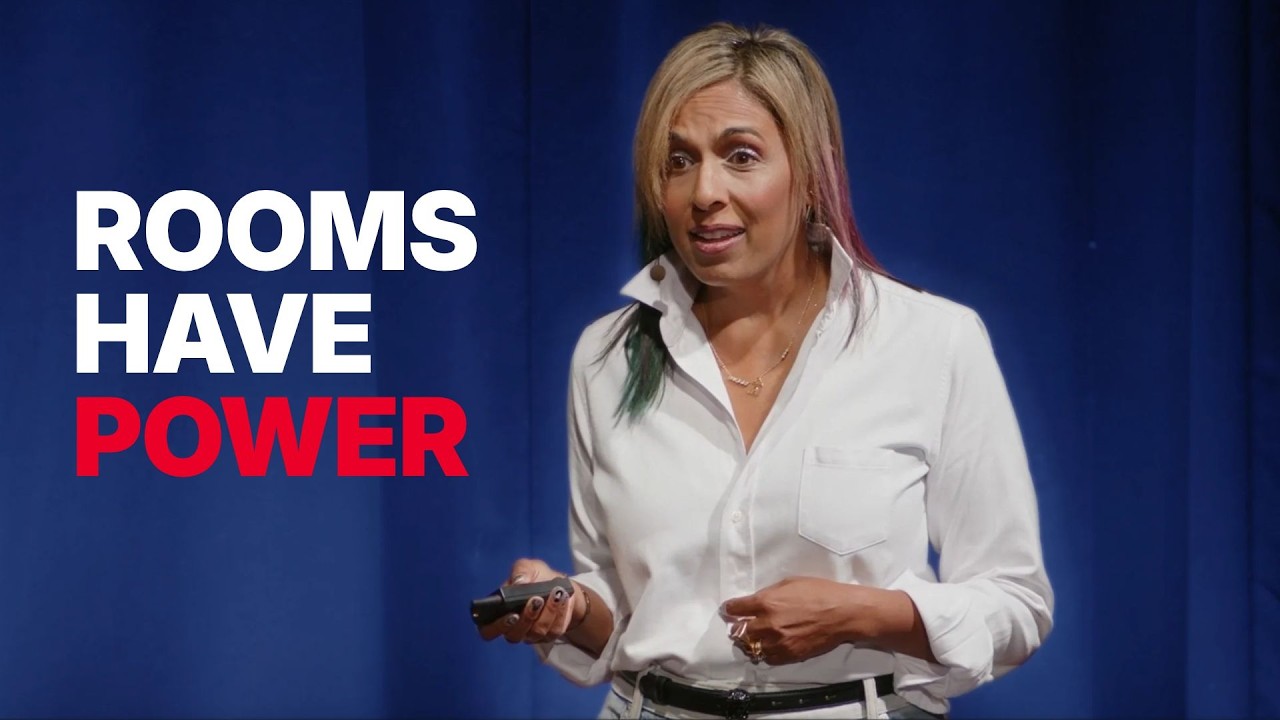
What is your room telling you? | Meena Krenek | TEDxAtlanta
Title history
- What is your room telling you? | Meena Krenek | TEDxAtlanta — observed on 20261111-1900 UTC (YouTube)
Keywords
Summary
166 words
Critical Evaluation
Value of the Information & Strength of the Argument
The talk provides valuable insights into the often-overlooked influence of interior design on human psychology and performance. Krenek’s argumentation is persuasive, built on a strong foundation of practical examples and professional anecdotes from her career. She effectively demonstrates how subtle design choices—like lighting temperature, material texture, spatial layout, and personal objects—can alter mood, confidence, and even workplace culture. The progression from the childhood fort to professional case studies creates a compelling narrative that makes the abstract concept of environmental psychology tangible. However, while the reasoning is coherent and appealing, it lacks rigorous empirical evidence; the examples are drawn from her own observations and not supported by controlled studies, which weakens the scientific robustness of her claims.
Scientific Rigor, Source Quality, Title Accuracy
The talk is an expert opinion piece rather than a scientific presentation; Krenek does not cite academic research or external sources. The only link provided in the description is the generic TEDx page, which offers no specific references. The title is well-aligned with the content, summarizing the central question of the talk. While Krenek’s professional credibility is evident, the lack of verifiable sources limits the scientific rigor. The argument is based on personal testimony and design principles rather than published research, which may be acceptable for a TEDx talk but reduces its standalone reliability for evidence-based decision-making. There are no comments provided to analyze public reception.
237 words
Title / Content Match
The title accurately reflects the core theme of the talk, which is the psychological and behavioral impact of room design on individuals.
Quality & Reliability
7/10
The talk offers a coherent and experienced-based perspective on how architectural and interior design influences human behavior and well-being. However, it relies primarily on anecdotal evidence and personal observations rather than rigorous scientific studies, limiting its generalizability and empirical robustness.
Key Moments
Markers derived by PSI from the transcript: the creator did not define chapters.
- Introduction: Krenek describes her profession and the childhood fort that sparked her interest in room design.
- The cold meeting room story: how an intimidating room made her feel nervous and how she transformed it before the interview.
- Introduction of the four voices of rooms: light, texture, movement, and objects.
- Explanation of light as the first language of a room, with the stadium lighting example.
- Texture as 'memory you can touch' and its effect on comfort and belonging.
- Movement and choreography of space; how rooms guide our choices subconsciously.
- Objects tell the truth about a room's inhabitants; the sports agency example with turf walls and pigskin leather.
Cited Sources
- TEDx Program — The talk is part of TEDx events, and the description links to the general TEDx page for more information about the program.
Concurring Sources
- TEDx Program — The talk is affiliated with TEDx, a platform known for sharing expert opinions and ideas worth spreading, which aligns with the non-scientific but experience-based content.
Contribution & Novelties
The talk contributes a fresh, accessible perspective on environmental psychology, emphasizing the agency of interior design in shaping personal identity and professional performance. Krenek’s framework of ‘four voices’ (light, texture, movement, objects) offers a memorable and practical heuristic for evaluating and improving spaces. The anecdote about the sports agency and the stadium lighting provides concrete, real-world applications that are easy to grasp. While the ideas are not entirely novel—environmental psychology has long studied these effects—Krenek’s communication style and professional lens make them actionable for designers and laypeople alike.
Pour aller plus loin :
- Environmental psychology — Provides a scientific overview of how physical environments influence behavior and well-being.
- Lighting design — Explores the technical and aesthetic aspects of lighting, including color temperature and its psychological impact.
- Proxemics — The study of spatial relationships and how they affect communication and comfort.
- Biophilic design — An approach that integrates natural elements into built environments to enhance well-being.
155 words
Radar Profile
The radar profile shows moderate scores across all dimensions, with quality of information and fiabilité globale being the highest, while technical level is lower, reflecting the talk's accessible and non-specialized nature. The balanced profile suggests a well-rounded presentation that is informative but not deeply technical or rigorous.