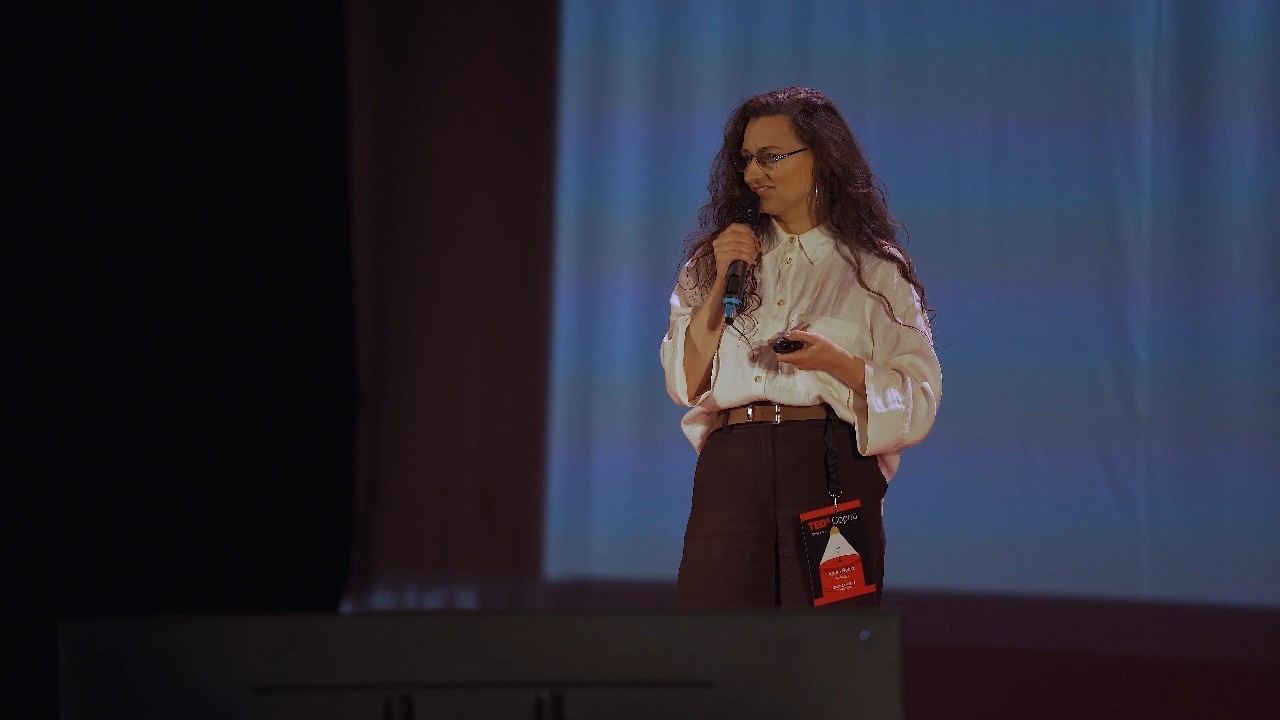
Vocea - abilitate sau magie? | Andra Botez | TEDxCopou
The Voice - skill or magic? | Andra Botez | TEDxCopou
Keywords
Summary
207 words
Critical Evaluation
Value of the Information & Strength of the Argument
The value of the talk lies in its accessible demystification of vocal technique, backed by the speaker’s extensive professional experience. Botez successfully bridges the gap between technical vocal training and personal identity, arguing that the voice is not only a musical instrument but a mirror of one’s deepest self. Her argumentation is largely anecdotal and demonstrative, relying on live audience participation to substantiate her claims. While this approach is engaging and tangible, it lacks empirical evidence or external citations, making the scientific foundation relatively weak. Nevertheless, the motivational and practical aspect is strong, offering actionable insights for anyone seeking to improve their vocal presence or self-expression.
Scientific Rigor, Source Quality, Title Accuracy
The talk demonstrates moderate scientific rigor: Botez references anatomical and acoustic principles (e.g., larynx elevation, epiglottis narrowing, rib expansion) but does not provide specific sources or studies. The description links only to the general TEDx website, which does not contain detailed references. The title accurately reflects the content’s core question, and the speaker’s credibility as a professional vocal coach lends some weight to her claims, though the lack of verifiable references limits its academic reliability. The title is well-suited to the message, as it frames a philosophical yet practical exploration of vocal ability.
214 words
Title / Content Match
The title is appropriate and intriguing, as it questions whether voice is an innate ability or a learned skill, and the talk answers this by emphasizing both trainability and personal authenticity.
Quality & Reliability
6/10
The talk is based on personal experience and practical knowledge as a vocal coach, but lacks deep scientific referencing; some anatomical and acoustic claims are presented without explicit citations.
Key Moments
Markers derived by PSI from the transcript: the creator did not define chapters.
- Introduction to the many sounds we make daily and their emotional meaning
- Demonstration of audience participation: making various expressive sounds
- Introduction of Complete Vocal Technique (CVT) and its principle of coordination and muscle memory
- Explanation of anatomical elements (larynx, epiglottis, ribs) affecting vocal power and resonance
- Personal anecdotes and encouragement about finding one's authentic voice
- Final collective singing and closing message of courage and self-acceptance
Cited Sources
- TEDx program — The talk was given at a TEDx event using the TED conference format but independently organized by a local community.
Contribution & Novelties
The talk contributes to the field by framing vocal training as a path to personal authenticity, going beyond pure musical performance. It emphasizes that the voice is a flexible, trainable instrument deeply connected to identity and emotion, and it demystifies technical vocal concepts for a general audience.
Pour aller plus loin :
- Human voice — Overview of the physiology and acoustics of the human voice.
- Vocal pedagogy — Methods and principles of voice instruction.
- Complete Vocal Technique (CVT) — A specific method referenced in the talk, but without a stable URL; further reading can be found by searching for ‘Complete Vocal Technique’.
- Acoustic resonance — Physical principles underlying vocal resonance and tone production.
113 words
Radar Profile
The radar profile shows moderate scores across information quantity, quality, technical level, and reliability, reflecting a talk that is engaging and partially informative but lacks deep scientific rigor and explicit sourcing. The balance between technical depth and accessibility tilts toward motivational content rather than exhaustive analysis.