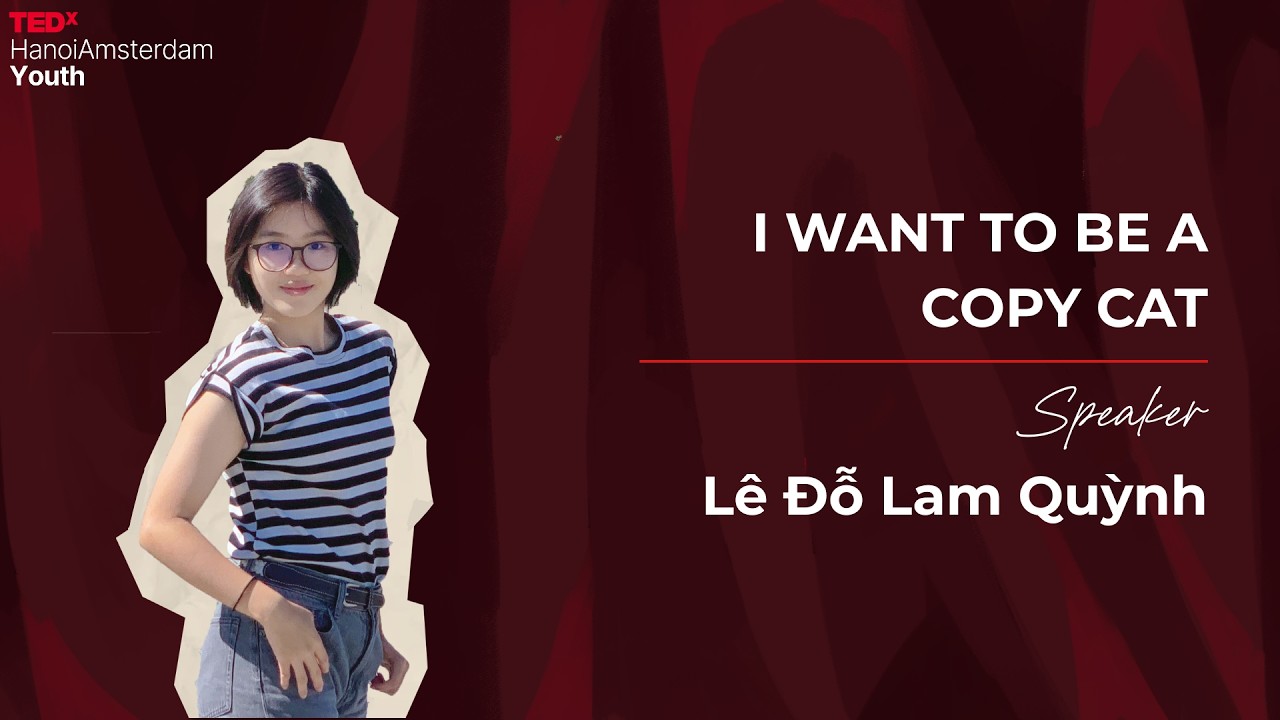
I Want to be a Copy Cat | Do Lam Quynh Le | TEDxHanoi Amsterdam Youth
Title history
- I Want to be a Copy Cat | Do Lam Quynh Le | TEDxHanoi Amsterdam Youth — observed on 20261114-0306 UTC (YouTube)
Keywords
Summary
173 words
Critical Evaluation
Value of the Information & Strength of the Argument
The talk offers a valuable reframing of copying as a constructive learning tool, countering the common negative connotation. The argumentation is built on personal anecdotes that make the concept relatable, and the inclusion of Bloom’s taxonomy adds a theoretical anchor. However, the reasoning is mostly narrative and lacks empirical evidence or deep analysis. The speaker’s progression from specific examples (hair, martial arts, academic competitions) to a broader philosophy is coherent, but the ‘copycat’ metaphor is perhaps oversimplified, and the connection to creativity could be more rigorously explored. The argument is persuasive on an emotional level but not strongly grounded, limiting its scientific depth.
Scientific Rigor, Source Quality, Title Accuracy
The talk is a TEDx presentation, known for personal storytelling rather than strict academic rigor. The only external source explicitly mentioned is Bloom’s taxonomy, with no citation given. The provided link to ted.com is generic to the TEDx platform, not to specific research. The title aligns well with the content, and the anecdotal approach is consistent with the TEDx format. No comments were available to gauge public reception, so this assessment is based solely on the transcript.
195 words
Title / Content Match
The title directly captures the central metaphor of the talk—embracing copying as a learning strategy—and the content consistently elaborates on this idea, making it highly appropriate.
Quality & Reliability
6/10
The talk is a personal narrative supported by a reference to Bloom's taxonomy, but relies on anecdotal evidence and minimal scientific grounding. The credibility is moderate, as it offers a relatable perspective rather than rigorous research.
Key Moments
Markers derived by PSI from the transcript: the creator did not define chapters.
- Speaker asks about the worst advice for standing out and introduces the concept of copying, referencing her first martial arts class.
- She shares the story of her short hair and how being observed by others made her feel honored, linking to her early identity.
- Realization that being unique is not enough; she recounts her martial arts competition failure and questions her uniqueness.
- Introduction of Bloom's taxonomy and the role of copying in the learning process, using the classroom analogy.
- Reflection on success icons and her personal confusion about her future, leading to the epiphany about copying as a method.
- Conclusion: embracing the copycat mindset to build a unique self by learning from others, closing with a call to action.
Cited Sources
- TEDx Talks - Official Page — Mentioned at the end of the description as the platform for independently organized TED events.
Contribution & Novelties
The talk’s originality lies in flipping the negative stigma of copying into a positive learning strategy. While many works discuss imitation in education, the speaker’s personal narrative makes it accessible and relatable. She integrates Bloom’s taxonomy to ground her argument in an established educational framework, but adds a fresh perspective by emphasizing selective copying as a route to self-actualization rather than mere reproduction.
Pour aller plus loin :
- Bloom’s taxonomy - Wikipedia — The educational framework referenced in the talk, useful for understanding the learning hierarchy.
- Social learning theory - Wikipedia — Bandura’s theory on learning through observation and imitation, directly relevant to the ‘copycat’ concept.
- Deliberate practice - Wikipedia — Ericsson’s concept of purposeful practice, which complements the idea of learning from others to improve skills.
127 words
Radar Profile
The profile shows moderate quantity and quality of information, with a low technical level and average reliability. This reflects the personal, anecdotal nature of the talk, which is more about inspiration than rigorous scientific content, yet it manages to present a coherent and thought-provoking message.