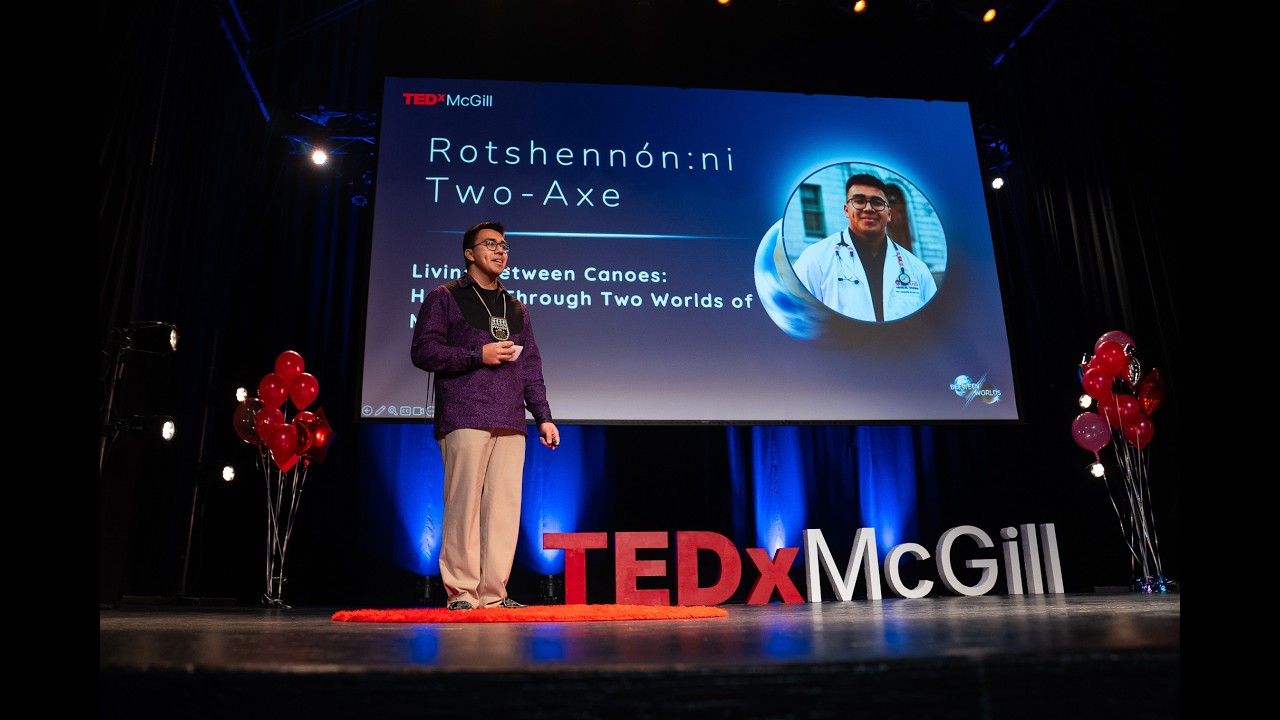
Healing through two worlds of medicine | Rotshennon:ni Two-Axe | TEDxMcGill
Keywords
Summary
171 words
Critical Evaluation
Value of the Information & Strength of the Argument
The talk provides valuable personal insights into the meaning of healing and the role of culture in healthcare. Argumentation is built on narrative and emotional examples rather than systematic evidence, but it effectively conveys the emotional and psychological impact of language and identity in medical settings. The speaker’s dual roles as a medical student and paramedic lend credibility to his observations, though the arguments would be stronger with explicit references to research on cultural safety and Indigenous health outcomes. The value lies in highlighting a systemic gap and offering a grounded perspective on how integrating Indigenous knowledge can humanize care.
Scientific Rigor, Source Quality, Title Accuracy
The talk relies on personal experience, cultural teachings, and historical claims without providing formal citations. It references undeniable historical events (e.g., forced sterilization, Indian Act) but does not point to specific sources. The title is well-aligned with the content, accurately capturing the central theme of navigating two medical worlds. The presentation is coherent and well-structured, though it lacks empirical grounding. No external sources are mentioned beyond the TEDx platform itself, limiting verifiability.
187 words
Title / Content Match
The title accurately reflects the content, which compares and integrates Western and Indigenous medical approaches.
Quality & Reliability
6/10
Personal narrative and cultural insights without empirical data; reliable as an expert perspective but not rigorously sourced.
Key Moments
Markers derived by PSI from the transcript: the creator did not define chapters.
- Introduction and explanation of the Two-Row Wampum belt representing coexistence of Indigenous and European ways.
- Description of a typical day balancing medical classes, anatomy lab, paramedic work, and language class.
- Reflection on historical harms of Western medicine, including forced sterilization and residential schools, and personal complicity.
- Story of speaking Kanien’kéha to a child patient, illustrating language as a calming and healing tool.
- Story of an elder in palliative care who found peace hearing his language; connects to seven generations principle.
Cited Sources
- TEDx Talks — The talk was given at a TEDx event, and the description links to the TEDx main page.
Contribution & Novelties
This talk offers an original perspective by blending first-hand clinical experience with Indigenous teachings, advocating for a ’two-eyed seeing’ approach in healthcare. It emphasizes language as an unrecognized form of medicine and calls for decolonial practices in medical systems. The speaker’s personal anecdotes provide a humanizing narrative often missing from academic discussions.
Pour aller plus loin :
- Traditional medicine — Overview of traditional medicine systems, including Indigenous practices.
- Cultural safety — Concept of creating an environment free of racism and discrimination in healthcare.
- Language revitalization — Efforts to preserve and revive endangered languages, relevant to the speaker’s work.
98 words
Radar Profile
The radar profile shows moderate scores in information quantity and quality, but low technical level and moderate reliability. This reflects a personal and cultural talk rather than a rigorous scientific presentation, yet it offers valuable qualitative insights into healthcare integration.