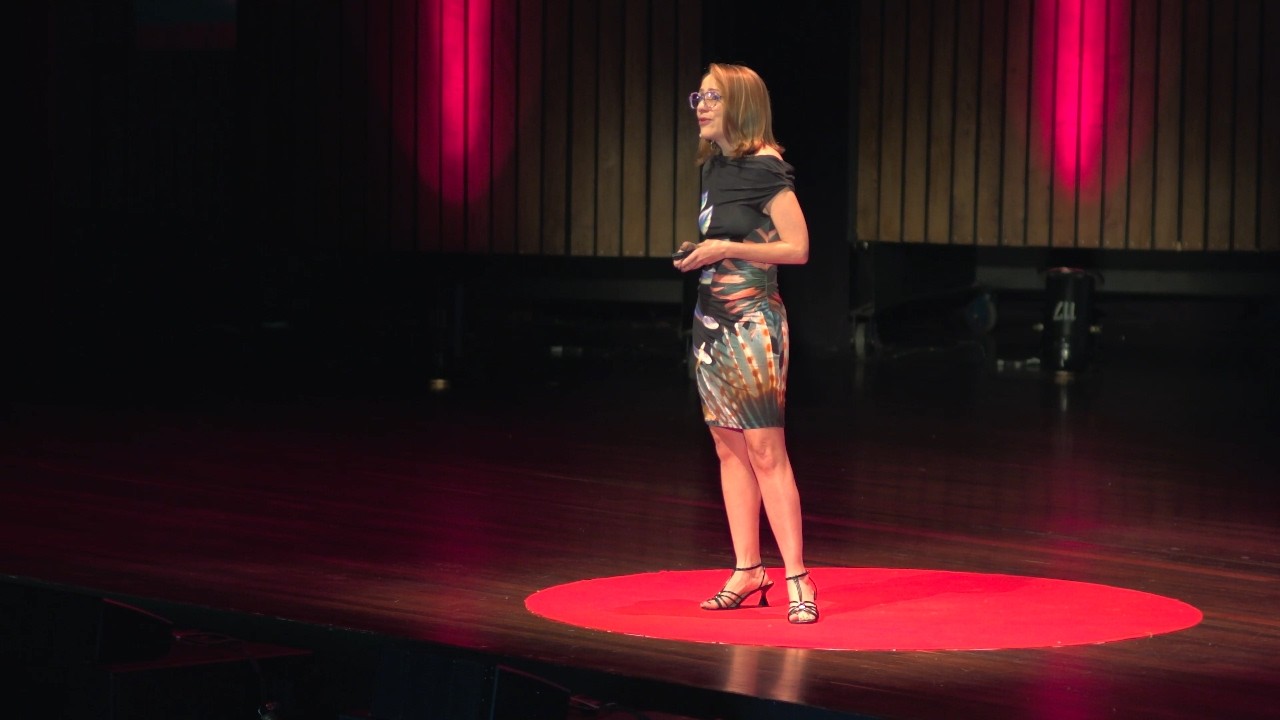
Romper las reglas del sistema | Claudia Aparicio | TEDxMedellin
Breaking the Rules of the System | Claudia Aparicio | TEDxMedellin
Title history
- Romper las reglas del sistema | Claudia Aparicio | TEDxMedellin — observed on 20261105-1655 UTC (YouTube)
Keywords
Summary
162 words
Critical Evaluation
Value of the Information & Strength of the Argument
The value lies in the speaker’s personal experience and the relatable metaphor of turtles, which creatively illustrates the danger of clinging to outdated success formulas. The argumentation is primarily anecdotal, relying on narrative rather than data. The claim that ‘we only know 19%’ is presented without supporting evidence, weakening its persuasive power. However, the emotional resonance and clear structure (three steps) make the message accessible and memorable. The speaker effectively connects personal vulnerability to broader systemic critiques, though the lack of empirical backing limits its scientific contribution.
Scientific Rigor, Source Quality, Title Accuracy
The scientific rigor is low; no citations or references are provided beyond the generic TEDx link. The speaker’s affiliation with Singularity University lends some authority, but the talk is more inspirational than evidence-based. The title appropriately captures the central thesis, and the content stays on topic. The turtle story is used as an analogy, not as a scientific reference. No conflicting sources are mentioned, but the audience is not provided with means to verify the stats.
178 words
Title / Content Match
The title accurately reflects the core theme of questioning and breaking systemic rules for personal and organizational transformation.
Quality & Reliability
6/10
The talk offers a personal narrative and motivational insights rather than empirical evidence. Some claims (e.g., 90% turtle mortality, 19% vs 81% learning) are presented without sources, limiting scientific rigor. The speaker's authority (Singularity University) adds credibility, but the content remains anecdotal.
Key Moments
Markers derived by PSI from the transcript: the creator did not define chapters.
- Introduction: Three fundamental steps for breaking system rules (risk-taking, accelerated learning, inner transformation).
- Turtle metaphor: 90% of turtles die in first year, eggshell becomes a trap; humans avoid risk.
- Personal story: Leaders resist change due to fear of losing past rewards; example from educational lab.
- Entrepreneurial leap: quitting job, selling house, moving to Silicon Valley; learning effect of being behind.
- Pandemic pivot to virtual education; confronting ego and health scare (thrombosis); mantra 'I won't die for this'.
- Conclusion: Cognitive dissonance as sign of transformation; 19% knowledge, 81% self-management; turtles that reach the sea.
Cited Sources
- TEDx Talks official page — The talk was given at a TEDx event, following TED format; link provided in description.
Concurring Sources
- TEDx Talks official page — General context of the talk's platform, not supporting specific claims.
Contribution & Novelties
The talk’s original contribution is the application of the turtle metaphor to organizational and personal change, arguing that past success becomes the greatest obstacle. It synthesizes concepts like cognitive dissonance and the ’learning season’ (i.e., being behind as an advantage) into an actionable framework of three steps. While not scientifically novel, it integrates known ideas in a compelling narrative.
Pour aller plus loin :
- Cognitive dissonance — Central concept in the talk; explains discomfort when actions conflict with beliefs.
- Growth mindset — Carol Dweck’s theory relevant to embracing challenges and learning from failure.
- Exponential technologies — Context of Singularity University and the speaker’s expertise; implications for future education and work.
- Learning agility — The ability to learn from experience and apply it to new situations; directly links to the ‘accelerated learning’ step.
132 words
Radar Profile
The radar profile shows high scores on 'valeur' and 'argumentation' due to the engaging narrative, but lower on 'rigueur' and 'fiabilité' as no external evidence is provided. The talk is more motivational than scientific, with a strong emphasis on personal experience and a clear framework, yet lacking empirical backing.