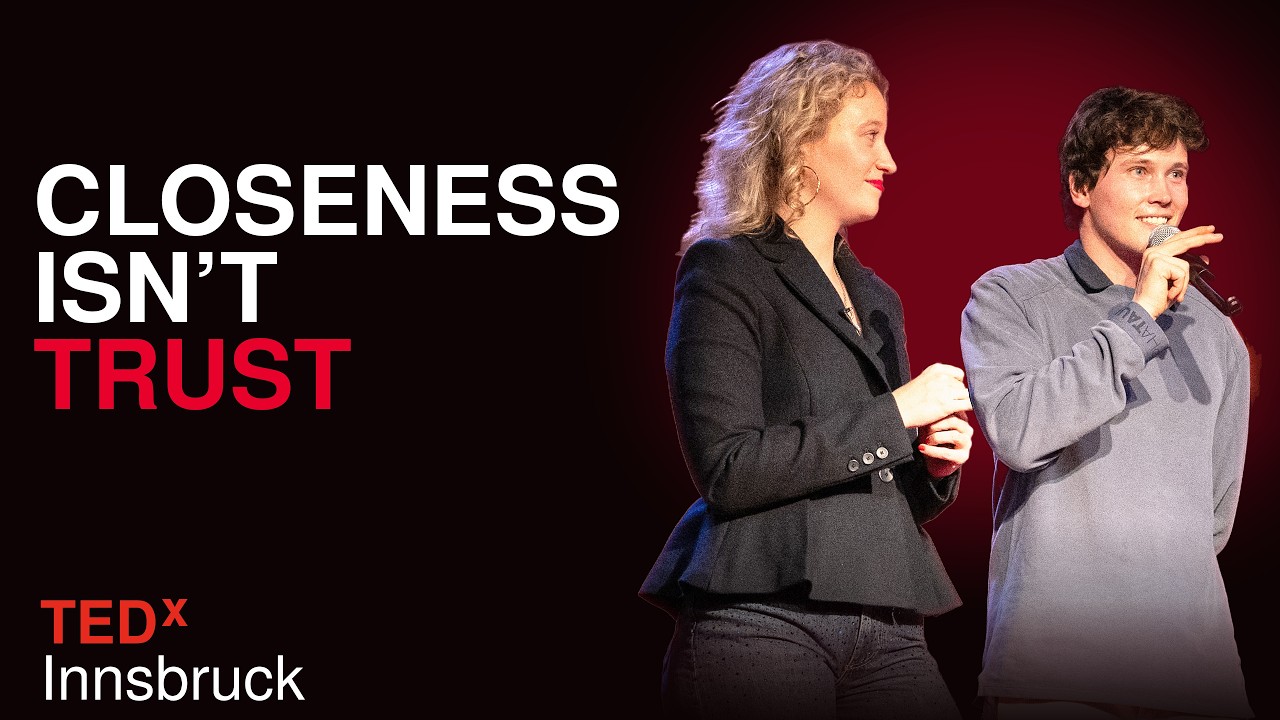
Why closeness doesn't build trust | Ben & Nadine Glowacz | TEDxInnsbruck
Title history
- Why closeness doesn't build trust | Ben & Nadine Glowacz | TEDxInnsbruck — observed on 20261112-1654 UTC (YouTube)
Keywords
Summary
175 words
Critical Evaluation
Value of the Information & Strength of the Argument
The talk provides valuable, practical insights into the dynamics of trust and communication in close relationships. The argument is built on a compelling personal story that illustrates the distinction between closeness and trust effectively. The speakers use a clear narrative structure: they introduce their context, present a concrete failure, analyze the root cause, and offer a practical solution. Their reasoning is logical and supported by their own experience, which adds authenticity. However, the argument relies solely on anecdotal evidence; they do not reference psychological theories or research. While this limits the scientific depth, it makes the message accessible and relatable. The takeaway—that trust requires active, ongoing communication—is well-supported by the narrative and resonates beyond the hospitality industry.
Scientific Rigor, Source Quality, Title Accuracy
The talk is a personal testimony rather than a scientific review. The only external reference is the TEDx platform itself, which is linked. The speakers do not cite any studies or sources to underpin their claims, so the scientific rigor is low. However, the content is internally coherent, and they clearly separate their subjective experience from universal claims. The title correlates precisely with the content: the entire talk explains why closeness does not automatically build trust. The description also matches the talk’s message. No comments were provided to assess audience reception, so no public feedback analysis is possible.
230 words
Title / Content Match
The title accurately encapsulates the central thesis: that closeness (familiarity) does not automatically imply trust, and that active communication is required to build trust even with those we know well.
Quality & Reliability
6/10
The talk is based on personal experience and reflection, offering pragmatic insights but lacking empirical or scientific evidence. The speakers are transparent about their subjective perspective, which is honest but not methodologically rigorous.
Key Moments
Markers derived by PSI from the transcript: the creator did not define chapters.
- Ben and Nadine introduce themselves and the concept of 'soft skills can be hardcore'.
- They share their background and dream of earning a Michelin star, and the initial assumption that being family means no need for meetings.
- The anecdote begins: Ben changes the sauce without telling Nadine, and Nadine trusts her assumption that Ben never changes dishes.
- The failed pairing is served, the guest says 'interesting,' and Nadine discovers the sauce change.
- After-service confrontation leads to realization: 'I trusted the picture of Nadine/Ben'.
- They introduce their 'What changed?' ritual and conclude with the call to ask the people we know best what has changed.
Cited Sources
- TEDx official site — The talk was given at a TEDx event independently organized by a local community; the site provides general information about the TEDx format.
Contribution & Novelties
The talk offers a fresh perspective on trust in close relationships, especially within a family business. It reframes trust as a dynamic, daily communicative practice rather than a static given. The restaurant metaphor—the ‘pass’ as the point of handover—is a memorable and applicable concept for any collaborative environment. The proposed ‘What changed?’ ritual is a simple, actionable tool.
Pour aller plus loin :
- Trust (social science) - Wikipedia — Provides a theoretical foundation on trust and its dimensions.
- Soft skills - Wikipedia — Explores the definition and importance of soft skills in professional contexts.
- Communication in small groups - Wikipedia — Discusses effective communication practices that align with the talk’s recommendations.
- Family business - Wikipedia — Contextualizes the challenges and unique dynamics of family-run enterprises.
125 words
Radar Profile
The radar profile shows moderate scores across the board, with a slightly higher value in 'quality of information' relative to 'quantity' and 'technical level'. This reflects a talk that is insightful and well-structured but lacks empirical depth and technical complexity, fitting its role as an experience-based talk rather than a scientific review.