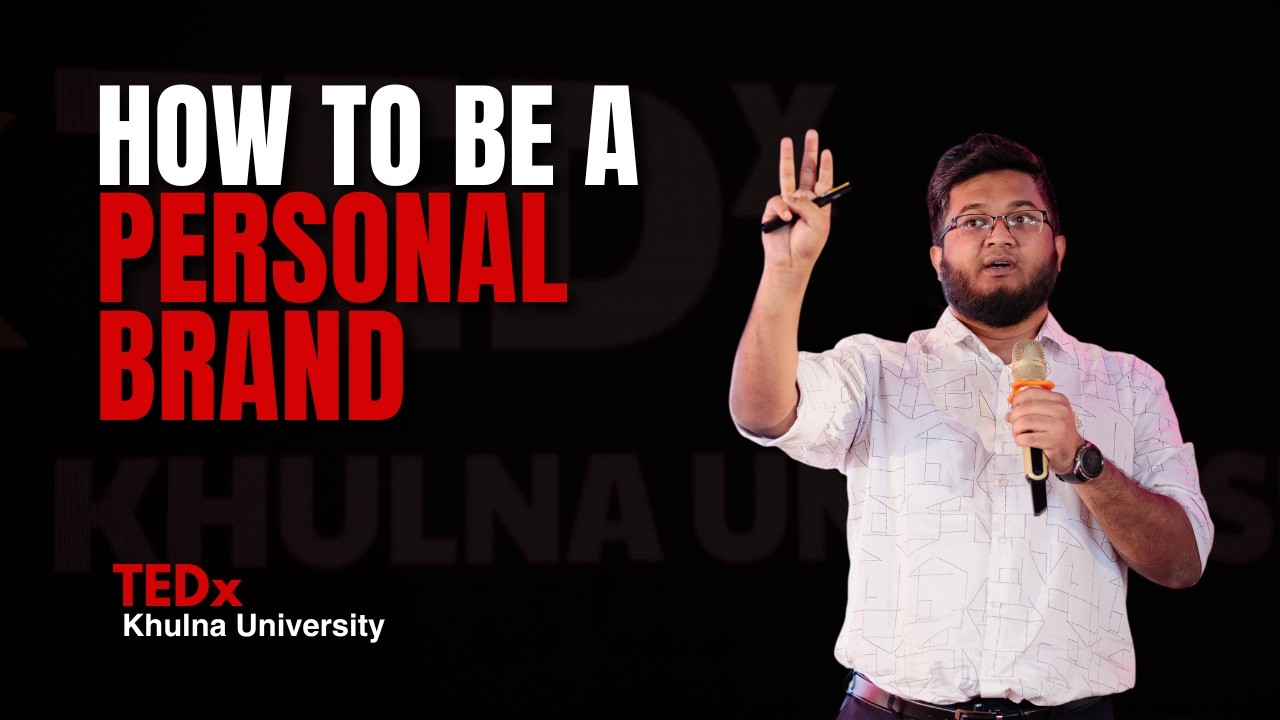
How to be a Personal Brand | Nafees Salim | TEDxKhulna University
Title history
- How to be a Personal Brand | Nafees Salim | TEDxKhulna University — observed on 20261112-0400 UTC (YouTube)
Keywords
Summary
191 words
Critical Evaluation
Value of the Information & Strength of the Argument
The talk provides actionable advice on building a personal brand, emphasizing authenticity and consistency. The argument is structured around personal anecdotes, a friendly game, and a clear narrative arc from failure to success. The speaker’s enthusiasm and relatable examples (e.g., the friend who was talented but invisible) make the message convincing. However, the argumentation relies on appeals to emotion and anecdote rather than empirical evidence. The claim about 85% of hiring managers is presented as a fact but lacks a reference, undermining its credibility. The speaker does offer a practical ‘3 steps’ approach, which adds value, but the lack of rigorous research weakens the overall argument.
Scientific Rigor, Source Quality, Title Accuracy
The talk is well-aligned with its title, delivering exactly what it promises on how to build a personal brand. Scientifically, the rigor is low: the speaker mentions studying thousands of brands but provides no methodology or citations. The only source mentioned is the TEDx platform itself. The statistic about hiring managers is unsourced, and no external references are given. The talk is more inspirational than evidence-based, and the speaker’s credentials (as a content creator and founder) lend some authority but do not compensate for the absence of verifiable data. The title is accurate and not misleading.
217 words
Title / Content Match
The title accurately reflects the content: a talk about how to build a personal brand through authenticity and storytelling.
Quality & Reliability
6/10
The talk is engaging and practical, but relies heavily on anecdotal evidence and a single unsubstantiated statistic (85% of hiring managers). The speaker claims research on 1000+ brands but provides no verifiable sources or methodology. Overall, the content is credible as personal advice but lacks scientific rigor.
Key Moments
Markers derived by PSI from the transcript: the creator did not define chapters.
- Interactive game: naming pizza brands to illustrate memorability
- Introduction of branding concept and question of what makes names memorable
- Personal story of failed dropshipping and realization of being a commodity
- Research on 1000+ personal brands and discovery of missing story and voice
- Definition of personal brand as reputation and associated feelings
- Example of best travel blogger in Bangladesh to show recall
- Story of friend Sabad who gained contracts after sharing his work
- Mention of 85% hiring managers statistic and importance of online presence
- Advice to start sharing passion and be authentic; personal experiences of being perceived as failure
- Conclusion: know you're a brand when no explanation needed; call to action
Cited Sources
- TEDx Talks - Official Website — Mentioned as the platform for this talk and how to learn more about TEDx events.
Concurring Sources
- TEDx Talks - Official Website — The talk itself is published on the TEDx platform, which supports the speaker's credibility as a recognized platform for sharing ideas.
Dissenting Sources
- No specific discordant sources — The talk does not reference any sources that contradict its claims; the main issue is a lack of verifiable citations.
Contribution & Novelties
The talk offers a fresh perspective on personal branding by emphasizing self-clarity over self-promotion, using interactive demonstrations and relatable stories. It distinguishes between visibility and reputation, pointing out that a small but high-quality audience can be more valuable than millions of casual followers. The actionable advice to consistently share one’s passion and authentic story is a practical takeaway, but the ideas are not novel and align with common personal branding advice found in business literature. The talk’s contribution is primarily motivational and delivery-focused rather than introducing new concepts.
Pour aller plus loin :
- Personal brand (Wikipedia) — Provides a comprehensive overview of the concept and its history.
- Authenticity in marketing (Wikipedia) — Explores the philosophical and practical aspects of authenticity relevant to branding.
- Storytelling in business (Wikipedia) — Discusses how narratives shape brand perception and audience engagement.
- Social proof (Wikipedia) — Relates to how people follow others’ actions, underpinning the importance of a visible online presence.
156 words
Radar Profile
The radar profile shows moderate scores across quantity and quality, with lower technical depth and reliability. This suggests a talk that is informative and engaging but not deeply scientific. The practical advice is accessible, but the lack of strong evidence makes it more persuasive than rigorous.