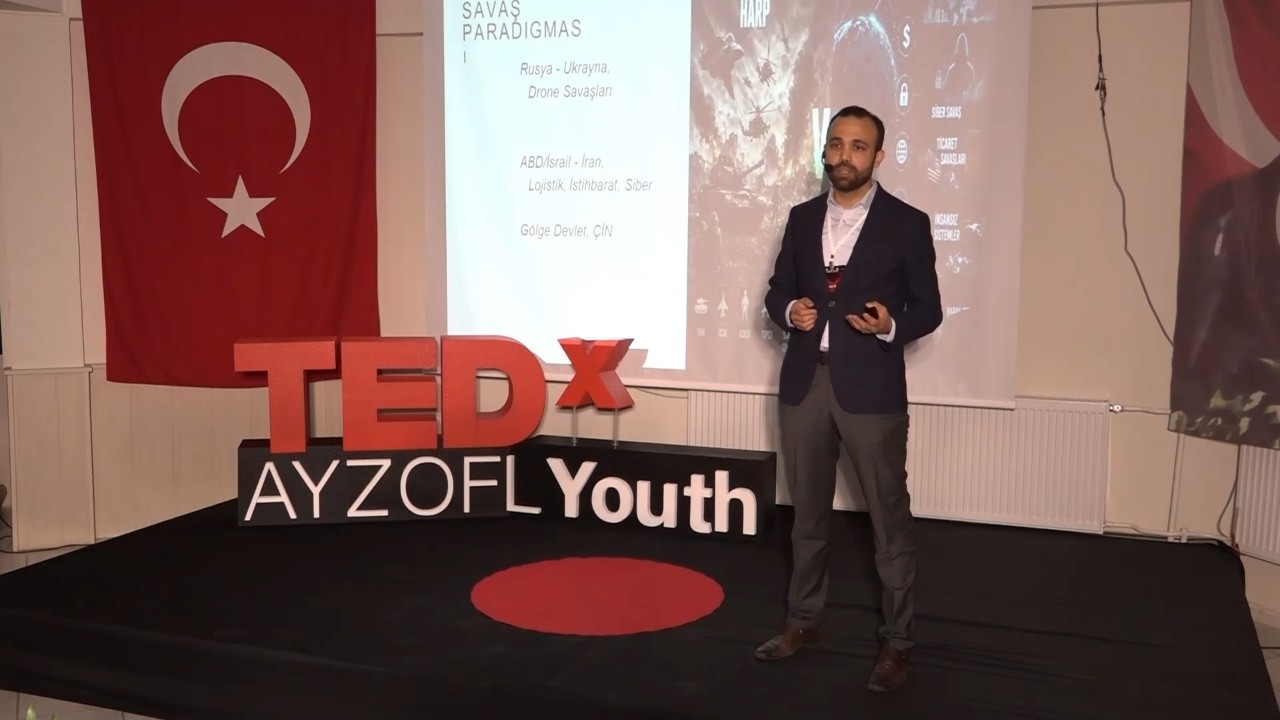
Değişen Dünya ve Biz: Nereye Gidiyor? Nasıl Adapte Olacağız? | Mustafa Özçelik | TEDxAYZOFL Youth
Changing World and Us: Where Are We Going? How Will We Adapt? | Mustafa Özçelik | TEDxAYZOFL Youth
Title history
- Değişen Dünya ve Biz: Nereye Gidiyor? Nasıl Adapte Olacağız? | Mustafa Özçelik | TEDxAYZOFL Youth — observed on 20261114-0303 UTC (YouTube)
Keywords
Summary
164 words
Critical Evaluation
Value of the Information & Strength of the Argument
The talk offers a valuable big-picture perspective on global trends, connecting geopolitics, technology, and personal responsibility in an accessible manner. The speaker’s personal experience in defense adds credibility to his analysis of military and technological shifts. His argumentation is primarily anecdotal and rhetorical, relying on historical references and metaphors rather than empirical data. The logical flow is clear, moving from macro-level issues to individual action, but some claims, such as the assertion that AI is making generations cognitively weaker, are presented without supporting evidence. The use of Sun Tzu and Plato provides evocative analogies, but the reasoning remains at a conceptual level rather than being rigorously substantiated.
Scientific Rigor, Source Quality, Title Accuracy
The talk does not cite specific sources in the video or description beyond the general TEDx channel. The speaker references Plato, Sun Tzu, and events like Stuxnet, but does not provide citations or evidence for his assertions. The title accurately mirrors the content, which is a broad discussion of change and adaptation. The scientific rigor is limited; the talk is more inspirational and opinion-driven than analytical. The speaker’s background lends some authority, but the lack of verifiable sources reduces the overall reliability. The video has very few views and no comments, providing no public feedback to further assess reception.
221 words
Title / Content Match
The title accurately reflects the content: the speaker discusses the changing world, technology's impact, and offers personal advice on adaptation.
Quality & Reliability
5/10
The talk is an opinion-driven presentation that mixes personal experience with broad historical and geopolitical observations. It makes claims about cognitive decline and global power shifts without citing specific studies or data, which limits its scientific reliability.
Key Moments
Markers derived by PSI from the transcript: the creator did not define chapters.
- Introduction: speaker's background and purpose of the talk.
- Personal career journey in defense and technology.
- Plato's Allegory of the Cave as a metaphor for digital reality and control.
- Geopolitical shifts: decline of globalism, rise of China, and new conflicts.
- Changing nature of warfare: cyber, intelligence, and AI in modern battles.
- Digital life and its paradoxes: access without ownership, cybersecurity threats.
- Advice on self-leadership, setting goals, and building atomic habits for the future.
Cited Sources
- TEDx Talks — Official TEDx page providing information about the TEDx format and event.
Contribution & Novelties
The talk synthesizes personal occupational experience in the Turkish defense industry with macro-historical narratives to argue for proactive adaptation to technological and geopolitical change. Its originality lies in connecting Plato’s cave allegory to contemporary digital dependence and AI-driven disorientation, framing personal development as a navigational problem. The speaker offers a motivational but not deeply novel perspective; the main contribution is in inspiring individuals to take ownership of their future in a volatile world.
Pour aller plus loin :
- Allegory of the Cave - Wikipedia — Context for Plato’s metaphor and its philosophical implications.
- The Art of War - Wikipedia — Referenced by the speaker; offers strategic principles applicable to personal and organizational challenges.
- Stuxnet - Wikipedia — An example of cyber-attack on nuclear facilities, illustrating the evolving nature of warfare mentioned in the talk.
- Artificial Intelligence - Wikipedia — Overview of AI technologies and their societal impacts, related to claims about cognitive effects and control.
155 words
Radar Profile
The radar profile shows moderate scores across most dimensions, with quantite_information relatively higher than qualite_information and fiabilite_globale, reflecting a talk that covers many topics but lacks rigorous sourcing. The niveau_technique is modest, indicating an accessible, non-technical presentation.