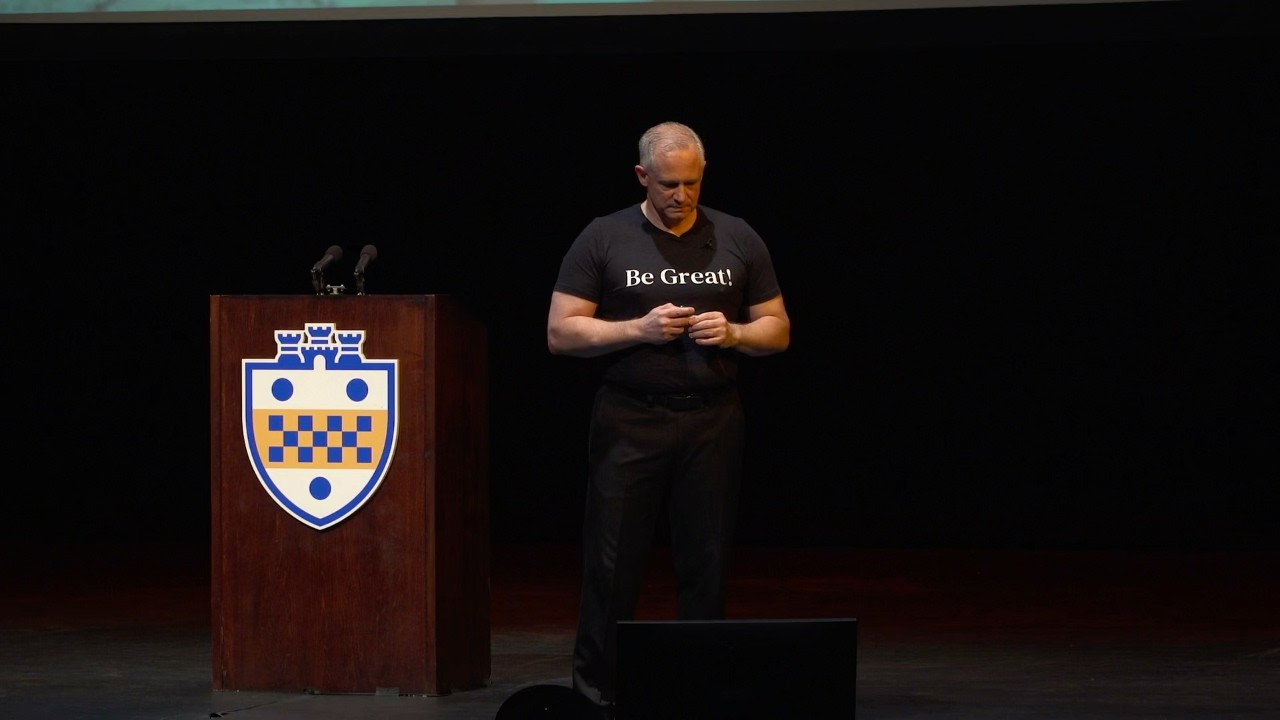
What we were taught to outgrow | Mark Papadas | TEDxU Pitt Johnstown
Keywords
Summary
133 words
Critical Evaluation
Value of the Information & Strength of the Argument
The value of the talk lies in its accessible framing of an important psychological insight: that cognitive openness and creativity can be deliberately retained even as one gains maturity. The argumentation is coherent, structured around a clear thesis supported by concrete examples. However, the reasoning is largely anecdotal and relies on appeals to common experience (like the child preferring the box over the toy) rather than empirical evidence. The speaker’s personal story about his anger is compelling and gives emotional weight but does not provide systematic proof. The argument is persuasive for a general audience, though not scientifically rigorous.
Scientific Rigor, Source Quality, Title Accuracy
The talk does not cite external scientific sources; its intellectual foundation is the speaker’s own coaching and leadership experience. The only link provided is to the TEDx program, which is an organizational reference, not a content source. The title is apt and aligns with the narrative, though it is somewhat broad. The lack of verifiable references lowers the scientific rigor. The discussion is a personal perspective rather than a literature review or empirical study. The speaker’s credibility stems from his professional background, but this does not substitute for evidence.
203 words
Title / Content Match
The title accurately reflects the core message about unlearning the loss of curiosity and imagination as we age.
Quality & Reliability
6/10
Content is based on personal experience and anecdotes, not on empirical research. The speaker is an author and coach with relevant experience, but claims are not backed by cited studies. The talk offers valuable reflective insights but lacks verifiable data.
Key Moments
Markers derived by PSI from the transcript: the creator did not define chapters.
- Opening: children prefer the box over the toy, illustrating imagination.
- Children persist when learning to walk, showing natural curiosity and 'why' questions.
- Growth adds boundaries and judgment, but also restrictive messages.
- Example of Louis Braille questioning an existing system to improve it.
- Personal story: daughter mimics his anger, revealing the impact of influence.
- Changemakers question walls; not all walls should be removed.
- Concluding call: wisdom should not cost wonder.
Cited Sources
- TEDx official site — Mentioned as the event organizer and description link.
Contribution & Novelties
The talk adds a memorable reframing of personal growth: instead of always adding skills, growth can involve recovering lost childlike qualities. It distinguishes between protective boundaries and limiting identity boundaries, a perspective that may resonate with audiences. The personal anecdote about modeling behavior is a concrete illustration of influence.
Pour aller plus loin :
- Growth mindset (Wikipedia) — Relevant to the idea that abilities can be developed, complements the talk’s message.
- Curiosity (Wikipedia) — Provides background on the psychological trait central to the talk.
- Imagination (Wikipedia) — Explores the concept of imaginative thinking and its role in innovation.
- Louis Braille (Wikipedia) — Historical figure cited in the talk as an example of questioning and improving.
115 words
Radar Profile
The profile is uneven: quality of information is moderate, reliability low, technical depth minimal, and quantity of hard information sparse. This is typical of a motivational talk that prioritizes emotional resonance over factual density.