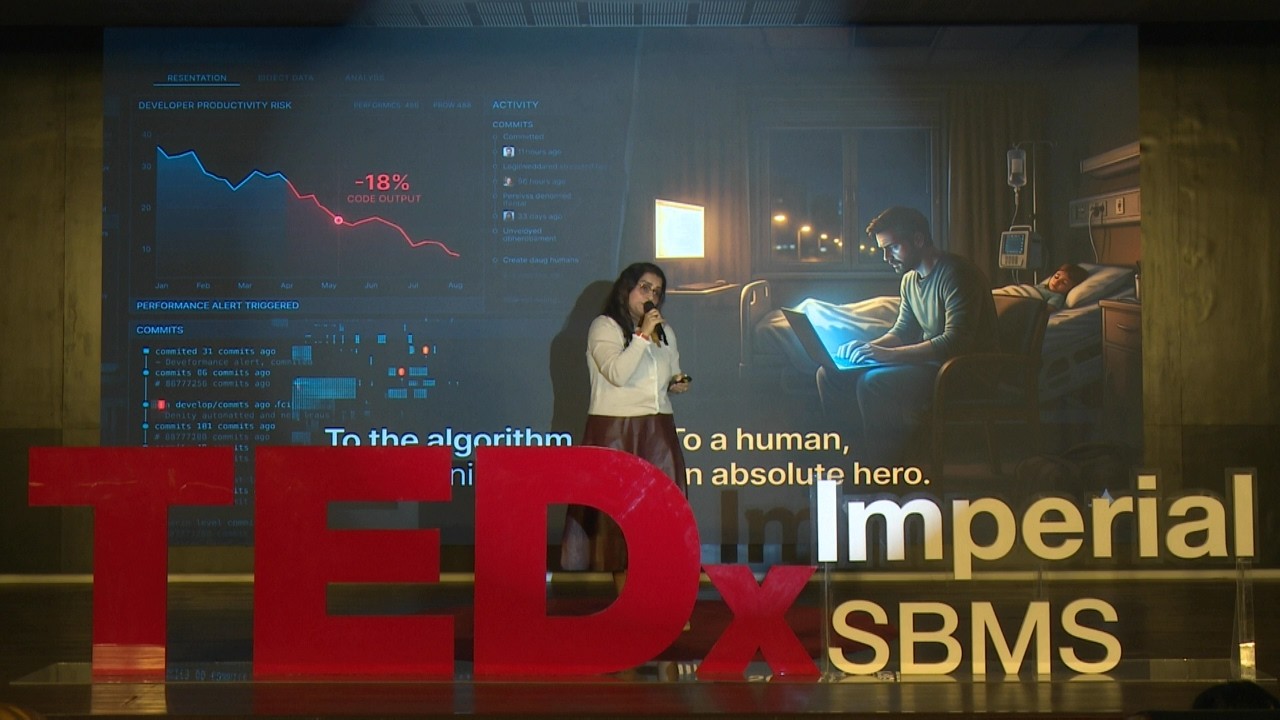
The Empathy Deficit | Sweety Rath | TEDxImperial SBMS
Keywords
Summary
161 words
Critical Evaluation
Value of the Information & Strength of the Argument
The talk provides valuable insights into the intersection of technology and human resource management. The speaker’s personal experience lends credibility to her arguments, and the illustrative story effectively humanizes the problem. The HUM framework offers a practical mental model for managers to integrate empathy without abandoning data. The argumentation is coherent, moving from problem identification to solution proposal. However, the evidence base is somewhat thin—she references broad statistics without specific sources, and her claims about algorithm-induced risks are presented as assertions rather than rigorously supported. The strength lies in her call for a balanced approach rather than a rejection of technology.
Scientific Rigor, Source Quality, Title Accuracy
The talk is more of an expert opinion narrative than a scientific presentation. The speaker cites an OECD study and mentions Geoffrey Hinton’s resignation and warnings, but no specific URLs or publication details are given. The lack of concrete references reduces the scientific rigor. The title-content fit is excellent, as the entire talk centers on the empathy deficit. The speaker does not claim to present original research, so the expectations for source quality are adjusted accordingly. While the discussion is thought-provoking, the absence of verifiable sources and the reliance on anecdotal evidence limit its scholarly value.
212 words
Title / Content Match
The title accurately captures the central theme: the empathy deficit arising from algorithm-driven management in the workplace.
Quality & Reliability
7/10
The talk is well-structured, offers a clear framework (HUM), and uses a compelling personal story. However, references to studies (OECD, etc.) are vague and not directly cited, and the speaker relies on anecdotal evidence rather than systematic research.
Key Moments
Markers derived by PSI from the transcript: the creator did not define chapters.
- Introduction: background as an engineer and transition to HR.
- The problem: algorithm management and the empathy deficit.
- Personal story of the developer and his son's illness.
- Statistics on automation usage and risks mentioned.
- Introduction of the 'Human Override' concept and HUM framework.
- Call to action: data should start conversations, not end them.
- Concluding quote and closing remarks.
Cited Sources
- TEDx Talks — General TEDx page mentioned in the description; no specific sources provided in the video.
Contribution & Novelties
The talk contributes a memorable framework (HUM) and a compelling call for a ‘Human Override’ in managerial decisions. It synthesizes existing concerns about algorithmic management into an accessible narrative, offering a practical approach for leaders. While not revolutionary, it adds a human-centric perspective to the ongoing debate on AI in the workplace.
Pour aller plus loin :
- Algorithmic management — Core concept of using algorithms to supervise and manage workers, central to the talk’s problem statement.
- Empathy — The psychological concept the talk argues is missing from automated decision-making.
- Human-centered design — A design philosophy that prioritizes human needs, relevant to creating more empathetic systems.
105 words
Radar Profile
The radar profile shows a balanced but moderate performance across all dimensions. The talk scores higher on information quality and argumentation, but slightly lower on technical depth and source reliability, reflecting its anecdotal and motivational nature.