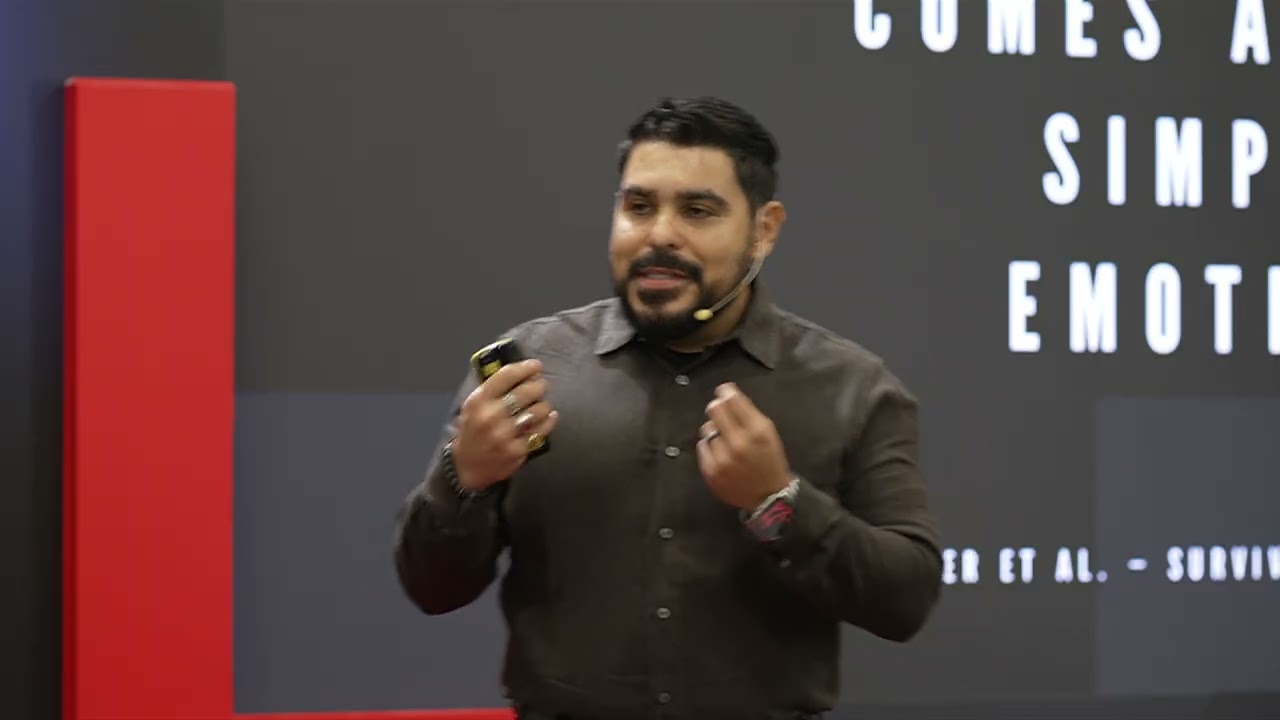
Can a City Change Without Losing Itself? | Marco Moreno | TEDxBrownsville
Keywords
Summary
160 words
Critical Evaluation
Value of the Information & Strength of the Argument
The value of the information lies in its accessible synthesis of psychological change concepts applied to urban development. Moreno skillfully weaves personal narrative with academic references, making complex ideas relatable. His argumentation is structured around a clear dichotomy and then proposes a synthesis, which is logically sound. However, the claims are largely anecdotal and lack empirical support, and the referenced authors are invoked more as metaphors than as substantive evidence. The emotional appeal is strong, but the intellectual grounding is thin, offering a compelling call to reflection rather than a rigorous analysis.
Scientific Rigor, Source Quality, Title Accuracy
The talk references John Carter, Carl Jung, and Bill Plotkin, but without specific works or citations, making source verification difficult. The only provided external link is the generic TEDx page, which does not substantiate the claims. The scientific rigor is limited; the talk is more inspirational than evidence-based. The title accurately reflects the central question, and the content stays on topic. No comments were provided to gauge audience reception, so no trend analysis could be performed.
183 words
Title / Content Match
The title asks a precise question that the talk directly answers, making it fully appropriate and well-matched to the content.
Quality & Reliability
7/10
The talk offers a personal perspective and references psychological concepts like Jung's transcendent function and Bill Plotkin's ideas on soul, but lacks detailed citations or empirical evidence, making it more persuasive than rigorously academic.
Key Moments
Markers derived by PSI from the transcript: the creator did not define chapters.
- Introduction to childhood memories in Brownsville and local legends like La Llorona.
- Explanation of leaving at age 19 to join the Army and the inability to envision a future at home.
- Return and observation of new developments like Chick-fil-A, triggering mixed emotions.
- Introduction of John Carter's 'survive and thrive' systems for coping with change.
- Application of Carl Jung's 'transcendent function' to growth vs. preservation tension.
- Discussion of the 'third way' and the importance of inclusive change.
- Reference to Bill Plotkin's idea of 'soul' and final reflection on carrying identity forward.
Cited Sources
- TEDx Program — General TEDx event information; the talk is part of the TEDx series.
- John Carter (mention) — Referenced in the talk as author of 'survive and thrive' systems in large-scale change.
- Carl Jung (mention) — Referenced for the concept of the 'transcendent function'.
- Bill Plotkin (mention) — Referenced for the psychological concept of 'soul' connected to identity and meaning.
Concurring Sources
- Transcendent function — Supports the idea that holding tension can lead to new integration, aligning with Moreno's 'third way'.
Contribution & Novelties
The talk offers a personal and emotional perspective on urban transformation, bridging individual memory with collective identity. It proposes a pragmatic ’third way’ beyond the binary of growth versus preservation, using psychological frameworks to suggest that tension can be generative. The novelty lies in applying Jung’s transcendent function to civic planning, encouraging residents to hold opposing forces rather than choosing one. The call for inclusive decision-making and measuring ‘better’ beyond economic metrics is a timely contribution.
Pour aller plus loin :
- Transcendent function (Wikipedia) — Explains Jung’s concept of resolving opposites through a new third element; directly relevant to the talk’s central argument.
- Bill Plotkin (Wikipedia) — Introduces the psychologist’s theories on soul and eco-psychology, supporting the notion of a ‘soul of a place’.
- Survive and thrive change model (no stable URL) — Concept — General change management frameworks incorporating survival and growth mindsets; useful for understanding John Carter’s references.
- Urban renewal and gentrification (Wikipedia) — Explores the impacts of development on local identity, providing concrete case studies relevant to Brownsville’s situation.
172 words
Radar Profile
The radar profile likely shows high scores in 'valeur' and 'argumentation' due to the engaging narrative, but lower scores in 'niveau technique' and 'fiabilite' because of the lack of hard data. The talk is a qualitative reflection, so it fills a niche of emotional and cultural insight rather than quantitative analysis.