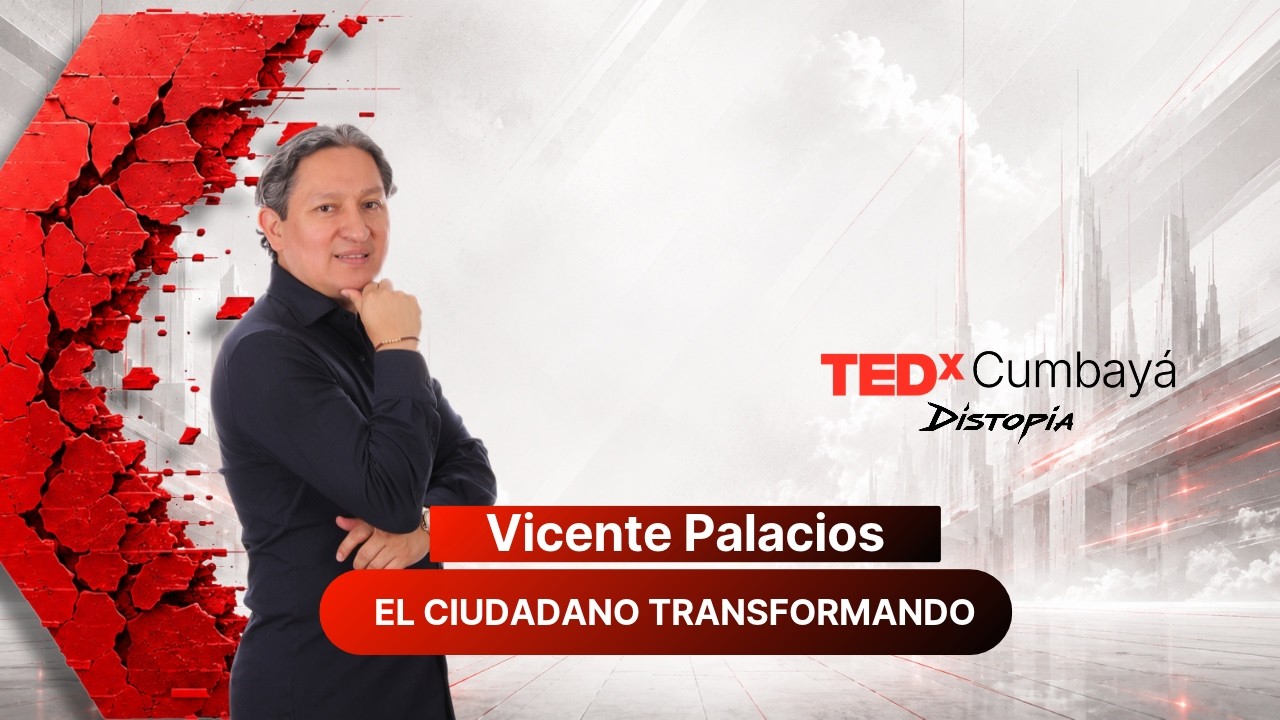
El Ciudadano Transformando | Vicente Palacios | TEDxCumbaya
The Citizen Transforming | Vicente Palacios | TEDxCumbaya
Title history
- El Ciudadano Transformando | Vicente Palacios | TEDxCumbaya — observed on 20261027-0221 UTC (YouTube)
Keywords
Summary
165 words
Critical Evaluation
Value of the Information & Strength of the Argument
The talk offers a coherent narrative linking urban isolation, public policy, and digital culture. It provides a compelling critique of how fear architecture and algorithm-driven information harm social cohesion. However, the argumentation is largely anecdotal and metaphorical, relying on selected citations without deep engagement with counterarguments. The speaker’s references to authors like Maslow and Byung-Chul Han are appropriate but glossed over, lacking rigorous explanation. The value lies in its accessible framing of complex issues, making it suitable for a general audience, but it lacks empirical grounding or novel policy proposals.
Scientific Rigor, Source Quality, Title Accuracy
The talk cites several scholars but often without specific works or dates beyond one mention of Maslow (1943). The use of ‘Suffolk y Flores’ appears to be a vague reference or mispronunciation, reducing credibility. The title ‘The Citizen Transforming’ aligns well with the content, as the speech is an exhortation for citizens to become active agents of change. The presentation style is persuasive but not heavily evidence-based, relying on anecdotal observations and rhetorical contrasts. There is no in-depth literature review or methodological transparency, typical of TEDx formats.
192 words
Title / Content Match
The title accurately reflects the talk's focus on citizens as active agents of transformation, matching the content well.
Quality & Reliability
6/10
The talk references several scholars (Maslow, Byung-Chul Han, Ostrom, etc.) but does so superficially, with no specific citations or empirical evidence. Claims like 'Suffolk y Flores' are unclear and potentially misattributed. The argumentation relies on metaphorical contrasts (glass cage, digital wounds) rather than data, reducing overall reliability.
Key Moments
Markers derived by PSI from the transcript: the creator did not define chapters.
- Opening: Cumbayá as a glass cage and dystopia of comfort.
- Discussion of Maslow's hierarchy and self-actualization.
- Critique of public policy and authoritarian capture.
- Introduction of three digital wounds.
- Explaining the death of public debate and tribalism.
- Call for a transformative citizen and social pact.
Cited Sources
- TEDx Talks — Official TEDx page linked in the description, providing context for the event.
- Maslow, A. (1943) — Referenced in the talk when discussing the hierarchy of needs.
- Byung-Chul Han, Infocracy — Mentioned as a source for the concept of psychopolitical control.
- Ostrom, E. — Cited along with Archon Fung on participatory governance and collective agreements.
- Archon Fung — Referenced on the role of participation in rule-making.
Contribution & Novelties
The talk’s original contribution lies in framing contemporary urban and digital alienation through the metaphor of a ‘glass cage’ and ‘digital wounds’, synthesizing ideas from urbanism, public policy, and media studies into a call for civic transformation. It popularizes concepts from thinkers like Byung-Chul Han and Ostrom for a general audience, though without offering new empirical data or concrete solutions.
Pour aller plus loin :
- Maslow’s hierarchy of needs — Foundational psychological framework referenced to discuss human motivation.
- Byung-Chul Han — Philosopher whose writings on digital control and infocracy underpin the talk’s critique of technology.
- Elinor Ostrom — Nobel laureate whose work on commons and participatory governance supports the call for collective agreements.
- Participatory democracy — Concept relevant to reviving public debate and involving citizens in policy-making.
127 words
Radar Profile
The radar profile suggests a talk that is moderate in information quantity and quality, with low technical depth and average reliability. It performs best on conceptual richness but lacks empirical rigor, typical of motivational TEDx talks.