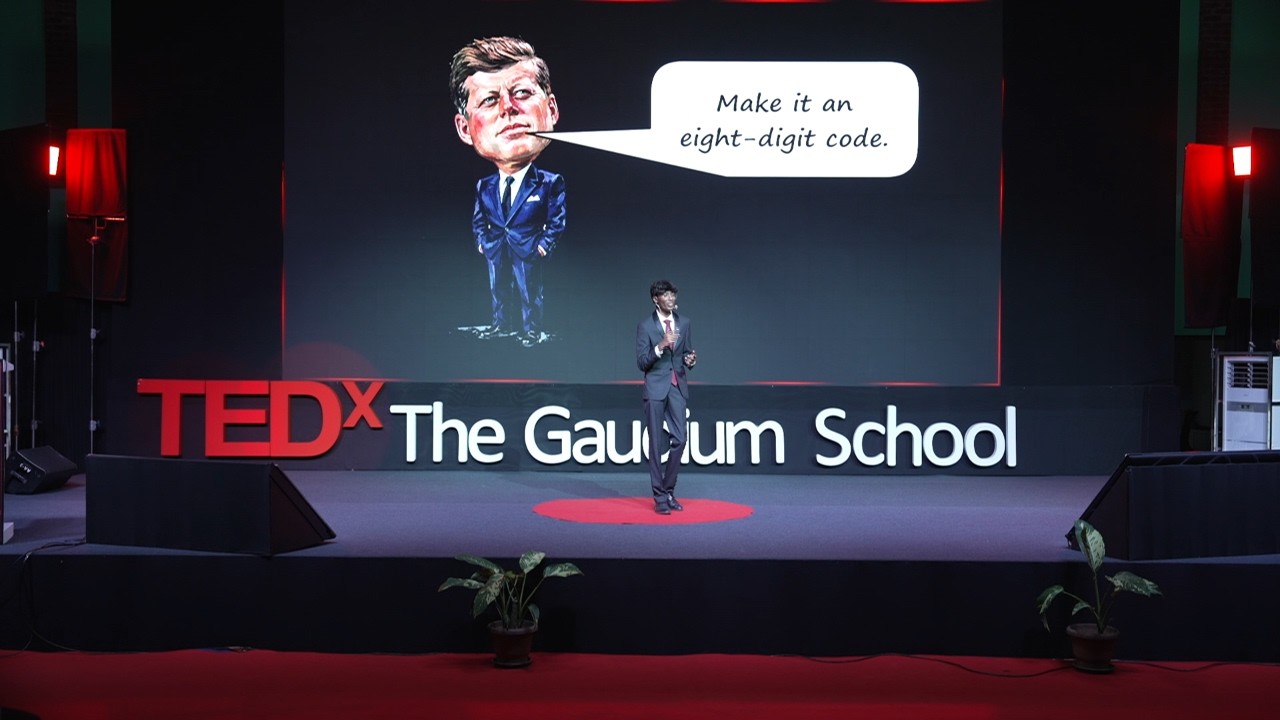
The Placebo Effect | Varun Lingamallu | TEDxThe Gaudium School
Title history
- The Placebo Effect | Varun Lingamallu | TEDxThe Gaudium School — observed on 20261027-1522 UTC (YouTube)
Keywords
Summary
197 words
Critical Evaluation
Value of the Information & Strength of the Argument
The talk’s value lies in its accessible and relatable framing of a deep psychological insight—that humans often seek external validation for decisions they are already capable of making. The use of vivid metaphors (crosswalk buttons, nuclear codes) effectively illustrates the gap between perceived and actual control. The argument is structured narratively, building from personal experience to broader societal examples, then to a philosophical reflection on free will. However, the argument is primarily anecdotal and lacks empirical evidence or references to psychological research; it relies on rhetorical strength rather than empirical rigor. The distinction between placebo and real gates is intuitive but not systematically developed, leaving room for oversimplification in real-world applications.
Scientific Rigor, Source Quality, Title Accuracy
The talk does not cite external sources beyond an implicit reference to Wikipedia or news stories; the only source link in the description is the general TEDx page. The facts mentioned (9% working crosswalk buttons, the eight zeros code) are presented without verification, though they are plausible and have been reported in media. The title ‘The Placebo Effect’ is somewhat broad and could be misleading, as the talk is more about perceived control and permission-seeking than the scientific placebo effect per se. The talk’s rigor is limited by its anecdotal nature, but it does acknowledge uncertainty (e.g., the urban legend about button removal is flagged as possibly untrue). No comments were provided for analysis.
240 words
Title / Content Match
The title refers to the placebo effect, which is used as a metaphor for perceived control. The content primarily explores how we often seek permission that is unnecessary, drawing parallels with placebo buttons and psychological reliance on external validation. There is a moderate alignment, though the term 'placebo' is not explicitly defined or scientifically detailed.
Quality & Reliability
5/10
The talk is an engaging personal narrative that uses anecdotal evidence and a few factual references (crosswalk button statistics, nuclear code history) without citing primary sources. The central metaphor is insightful but the scientific rigor is limited, and the speaker's expertise is not established.
Key Moments
Markers derived by PSI from the transcript: the creator did not define chapters.
- Introduction of the speaker and his background by the host.
- Varun begins by recounting the phone scam he encountered at age 10.
- Reveals the scam was fake and reflects on how easily he believed he was in control.
- Introduces the crosswalk buttons in New York City, stating only 9% work.
- Discusses the urban legend of removed buttons and people's complaints.
- Transitions to the story of nuclear codes set to eight zeros in 1962.
- Humorous speculation about the meeting where the code was chosen.
- Introduces the 'Nodder' metaphor as the inner voice seeking permission.
- Explains that the Nodder is not malicious but is obsolete.
- Discusses the connection to free will and decision-making.
- Adds a disclaimer to distinguish real gates from placebo ones.
- Concludes with encouragement to recognize that the light was always going to change.
Cited Sources
- TEDx Talks — General link to TEDx page mentioned in the description.
Contribution & Novelties
The talk offers a fresh metaphorical framework (’the Nodder’) to describe internalized permission-seeking, building on known concepts like placebo buttons and the illusion of control. It synthesizes disparate examples (scam calls, crosswalk buttons, nuclear security) to illustrate a universal psychological tendency. The originality lies in the accessible synthesis and the practical takeaway of distinguishing real from placebo gates.
Pour aller plus loin :
- Placebo effect — Comprehensive overview of the scientific concept.
- Permissive Action Link — Details on the nuclear weapon security system mentioned.
- Placebo button — Explains non-functional buttons that give an illusion of control.
- Locus of control — Psychological concept related to perceived control over outcomes.
108 words
Radar Profile
The radar profile shows moderate scores across all dimensions, with a slight emphasis on quantity of information (6) and lower technical level (4). This reflects a talk that is rich in anecdotes but lacks deep scientific depth, making it engaging for a general audience but less useful for specialists.