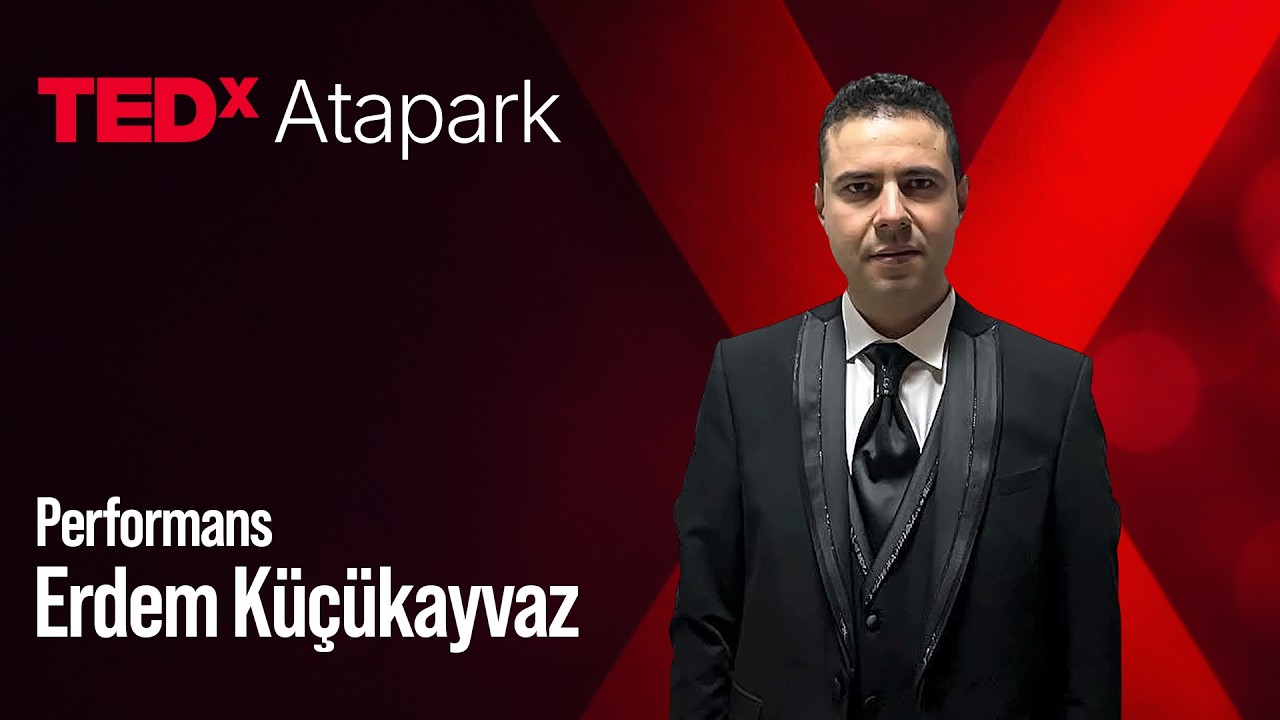
Piyano Dinletisi | Erdem Küçükayvaz | TEDxAtapark
Piano Recital | Erdem Küçükayvaz | TEDxAtapark
Keywords
Summary
221 words
Critical Evaluation
Value of the Information & Strength of the Argument
The informational value of this recording is almost entirely aesthetic and contextual rather than propositional. Nothing is asserted, defended or evidenced: there is no thesis, no causal reasoning, no comparison of interpretations and no explanation of the works performed. The spectator learns only that a piano teacher and accompanist affiliated with a municipal education and arts academy in Uşak performs a short programme of pieces, and that such a platform exists as part of a local cultural policy. Even the repertoire is left unidentified in the transcript and in the description, which limits the value for anyone seeking to use the video as a reference. The brief spoken passage functions as a courtesy introduction rather than as argumentation, and it is not developed into any reflection on music pedagogy, on the role of amateur or regional music education, or on the works chosen. The argumentative structure is therefore essentially absent, and the recording should be assessed as a documentary trace of a live performance rather than as a contribution to reasoning or debate. Its interest is real but local: it illustrates a practice and gives visibility to performers and institutions, which is a legitimate function of the TEDx format at the community level, but it does not construct or defend any position, and no claim in it can be evaluated for strength of support.
Scientific Rigor, Source Quality, Title Accuracy
On the question of scientific rigour, the recording makes no empirical or theoretical claims and therefore neither satisfies nor violates evidentiary standards; there is no methodology to assess, no data, no citation practice within the spoken content. The only external reference available is the generic TEDx link in the description, which documents the format under which the event was organised but does not constitute a source for any statement made in the video. The description is minimal and does not list the works performed, the composers, or any programme notes that would allow the content to be cross-checked or reused; this absence is the main documentary weakness, since a recital video normally benefits from an explicit repertoire listing. No conflicting or corroborating literature is relevant here. Regarding the match between title and content, the title promises a piano recital by a named performer at a named TEDx event, and the video is precisely that, with no padding or misdirection.
398 words
Title / Content Match
The title announces a piano recital and the video delivers exactly that, a short solo performance framed by a brief introduction from the performer. The match between title and content is therefore very close.
Quality & Reliability
5/10
The video contains almost no factual or argumentative content to verify: after a roughly one-minute spoken introduction, the remainder is a solo piano performance recorded live. There are no statistics, claims, studies or references to check, so the reliability question is largely inapplicable; the score reflects the transparency and authenticity of an unmediated live recording rather than any evidence-based content.
Key Moments
Markers derived by PSI from the transcript: the creator did not define chapters.
- Erdem Küçükayvaz introduces himself as a piano teacher at the Uşak Municipality Academy and accompanist of the Academy children's choir.
- End of the spoken introduction and applause; the performer announces a short selection of pieces and begins playing.
- Continuous solo piano performance, no commentary.
- Middle section of the recital; the programme continues without spoken interruption.
- Later part of the performance, with audience reactions audible between passages.
- Final piece of the recital.
- Closing applause as the performance ends.
Cited Sources
- TEDx — official programme page — Only link given in the video description; documents the independently organised TEDx format under which this performance took place. It is not a source for any factual claim in the video.
Contribution & Novelties
The video offers no analytical novelty: it is a live recording of a short piano recital by a regional music teacher, intended to give visibility to a local education and arts academy and to the performer himself. Its contribution is cultural rather than scientific, consisting of a documented example of community-level music education and performance practice. Notably, the recording does not identify the works performed, which limits its usefulness as a reference even within music documentation.
Pour aller plus loin :
- Piano — Background on the instrument, its mechanism and repertoire, useful for contextualising the performance.
- TEDx — Explains the independent local-events format under which this recital was staged.
- Classical music — General framework for the type of repertoire typically performed in such recitals.
- Music education and community arts programmes — relevant to the academy context described in the introduction, cited by name only.
144 words
Radar Profile
The profile is sharply skewed: information quantity and information quality are very low because the video transmits music rather than content, while technical level is moderate, reflecting the performance skill on display rather than any explained technique. Overall reliability sits at a middling value, since a live recording is authentic but there are no claims to verify.