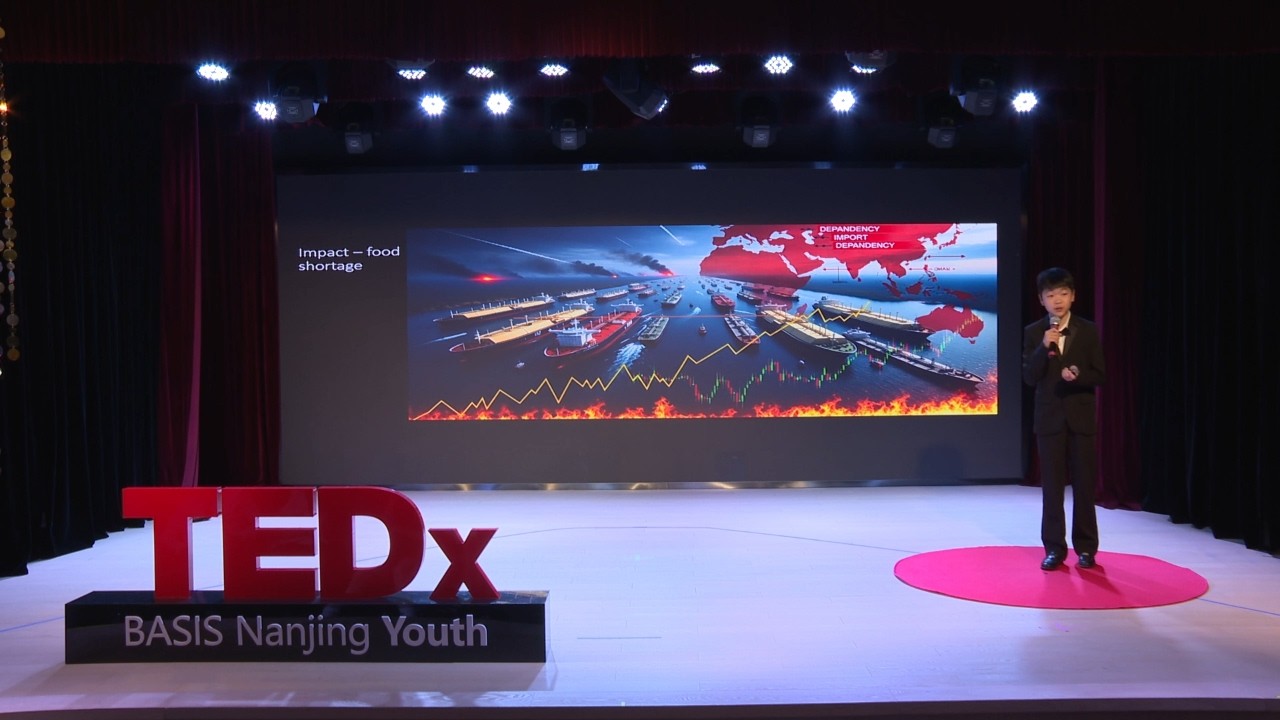
The Blockage of the Strait of Hormuz | Ocean Ding | TEDxBASIS Nanjing Youth
Title history
- The Blockage of the Strait of Hormuz | Ocean Ding | TEDxBASIS Nanjing Youth — observed on 20261109-1737 UTC (YouTube)
Keywords
Summary
123 words
Critical Evaluation
Value of the Information & Strength of the Argument
The talk provides valuable insights into an overlooked consequence of geopolitical conflicts—the fertilizer crisis and its ripple effects on food prices and food security. The argumentation is logical and well-structured, building from the facts of the blockade to its direct impacts on agriculture and daily life. The speaker supports claims with data from reputable international organizations, such as the UN WFP and FAO, and presents the chain of cause and effect clearly. The inclusion of multiple solutions shows a balanced perspective, though the depth is limited due to the short format.
Scientific Rigor, Source Quality, Title Accuracy
The talk demonstrates scientific rigor by referencing authoritative sources like the United Nations World Food Program and the FAO. The data presented appears consistent with known statistics, and the speaker correctly identifies the vulnerability of the Strait of Hormuz as a chokepoint. The title adequately matches the content, focusing on the blockage and its impacts. The only minor issue is that the talk does not provide direct citations or links for the audience to verify, but the sources are named. Overall, the talk is well-grounded, though it simplifies complex issues.
196 words
Title / Content Match
The title accurately reflects the focus on the blockade of the Strait of Hormuz and its consequences.
Quality & Reliability
7/10
The talk relies on credible sources such as UN WFP, UNDP, and FAO reports, and presents data accurately. However, some claims are oversimplified, and the presenter is a seventh-grade student, which may limit depth.
Key Moments
Markers derived by PSI from the transcript: the creator did not define chapters.
- Introduction of the problem with fertilizer trade statistics.
- Description of the Strait of Hormuz geography and vulnerability.
- Impact of blockade on fertilizer prices and global food market.
- How the crisis affects daily life, including meat and soy products.
- Discussion of solutions, precision farming and legumes.
- Advanced solutions and technology, conclusion and appeal for peace.
Cited Sources
- TEDx — Event organizer
- United Nations World Food Programme — Report on food price rises and hunger
- United Nations Development Programme — Warning on poverty and food crisis
- Food and Agriculture Organization — Data on precision farming reducing nitrogen use
Contribution & Novelties
The talk offers a fresh angle on the Iran crisis by focusing on fertilizer shortage rather than oil, highlighting the underreported impact on global food systems. It makes a complex geopolitical issue accessible to a general audience, particularly youth. The speaker connects distant events to personal daily life, fostering awareness.
Pour aller plus loin :
- Strait of Hormuz — Relevant geographical and strategic context.
- Urea — Key nitrogen fertilizer and its market impact.
- Precision agriculture — Techniques to reduce fertilizer use.
- Green ammonia — Sustainable alternative for fertilizer production.
89 words
Radar Profile
The scores indicate a balanced profile, with high quality of information and reliability, moderate quantity and technical level. This suggests a concise, well-sourced talk that is accessible to non-specialists while maintaining scientific credibility.