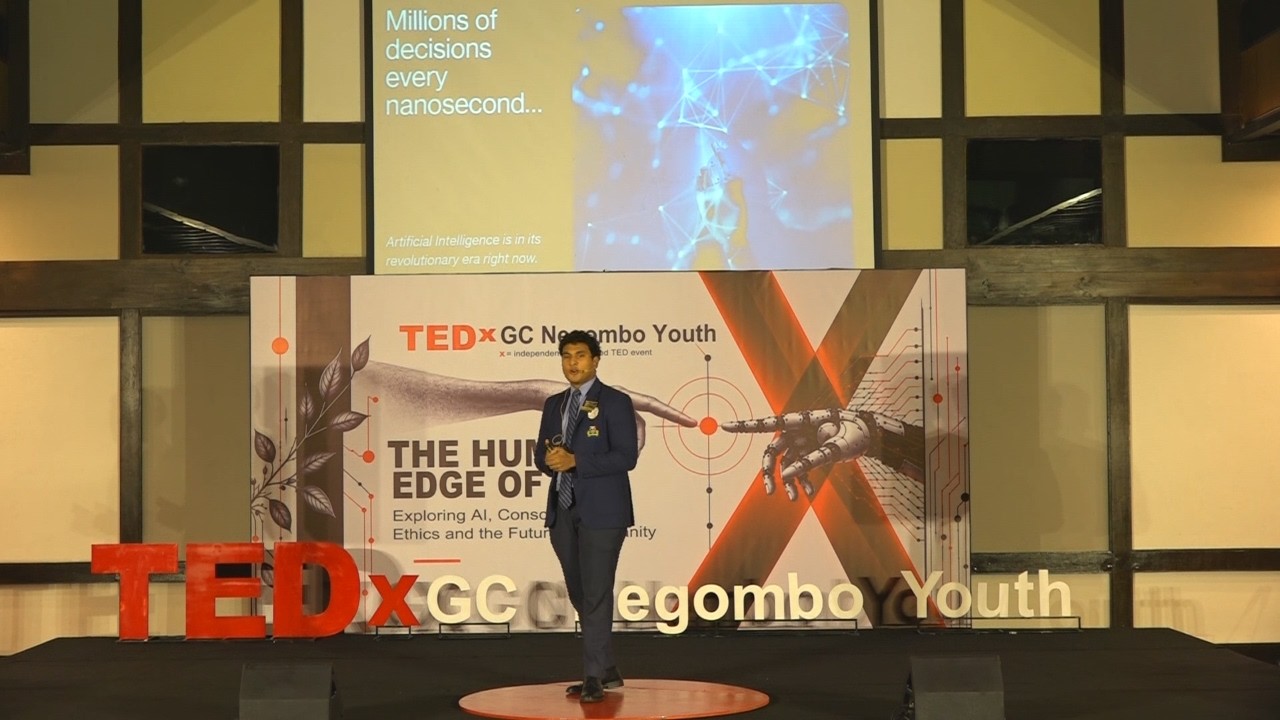
The Bullet Train And The Hiker - Why AI Cannot Be Us | Luqmaan Naazir | TEDxGC Negombo Youth
Title history
- The Bullet Train And The Hiker - Why AI Cannot Be Us | Luqmaan Naazir | TEDxGC Negombo Youth — observed on 20261112-0406 UTC (YouTube)
Keywords
Summary
114 words
Critical Evaluation
Value of the Information & Strength of the Argument
The talk offers a thought-provoking perspective on AI’s limitations, emphasizing the importance of human consciousness, ethics, and emotional authenticity. While the arguments are compelling for a general audience, they rely heavily on personal anecdotes and hypothetical scenarios rather than robust empirical evidence. The speaker’s enthusiasm is clear, but the reasoning often falls into unsubstantiated claims, such as the unspecified Finnish study. The central metaphor of the hiker is effective in illustrating the value of the journey over the destination, but the argumentation could be strengthened by more concrete examples and references. Overall, the value lies in its philosophical reflection rather than scientific rigor.
Scientific Rigor, Source Quality, Title Accuracy
The talk is low in scientific rigor, as it does not cite specific studies or provide verifiable data. The only source mentioned is a vague Finnish study, which is not detailed. The reference to Alexander Fleming is historical but not supported by citations. The title is well-aligned with the content, accurately capturing the central metaphor and the message. The lack of concrete sources undermines the credibility of the claims, but the talk is more of an inspirational speech than a scientific presentation.
200 words
Title / Content Match
The title accurately reflects the central metaphor of speed versus journey, and the overall message that AI cannot replace human experience.
Quality & Reliability
5/10
The talk presents personal philosophical views on AI and human uniqueness, with some anecdotal evidence but lacks rigorous scientific citations.
Key Moments
Markers derived by PSI from the transcript: the creator did not define chapters.
- Introduction and comparison between dinosaurs and human evolution
- Scenario of chatting with AI and the illusion of emotional connection
- Consciousness as the first human edge over AI
- Ethics and discussion of a Finnish study on AI medical decisions
- Warning about humans becoming more like AI and losing creativity
- Final message: use AI as an exoskeleton, focus on human brain capacity
Cited Sources
- TEDx — The talk was given at a TEDx event independently organized by a local community.
Contribution & Novelties
The talk offers a unique perspective on AI limitations by emphasizing the intrinsic value of human experience and the danger of over-reliance. It introduces the bullet train vs. hiker metaphor to argue that the journey of human effort holds more significance than the speed of AI output. The discussion of humans adopting AI traits (precision, speed) as a risk is a notable contribution.
Pour aller plus loin :
- Consciousness — Central to the talk’s thesis about human uniqueness.
- AI ethics — Relevant to the ethical decision-making discussed in the Finnish study.
- Human intelligence — The speaker emphasizes human cognitive abilities and curiosity.
102 words
Radar Profile
The radar profile shows low technical level and moderate information quality, with a slightly higher score on quantity and fiability. This reflects the talk's philosophical and inspirational nature, prioritizing emotional appeal over rigorous technical content.