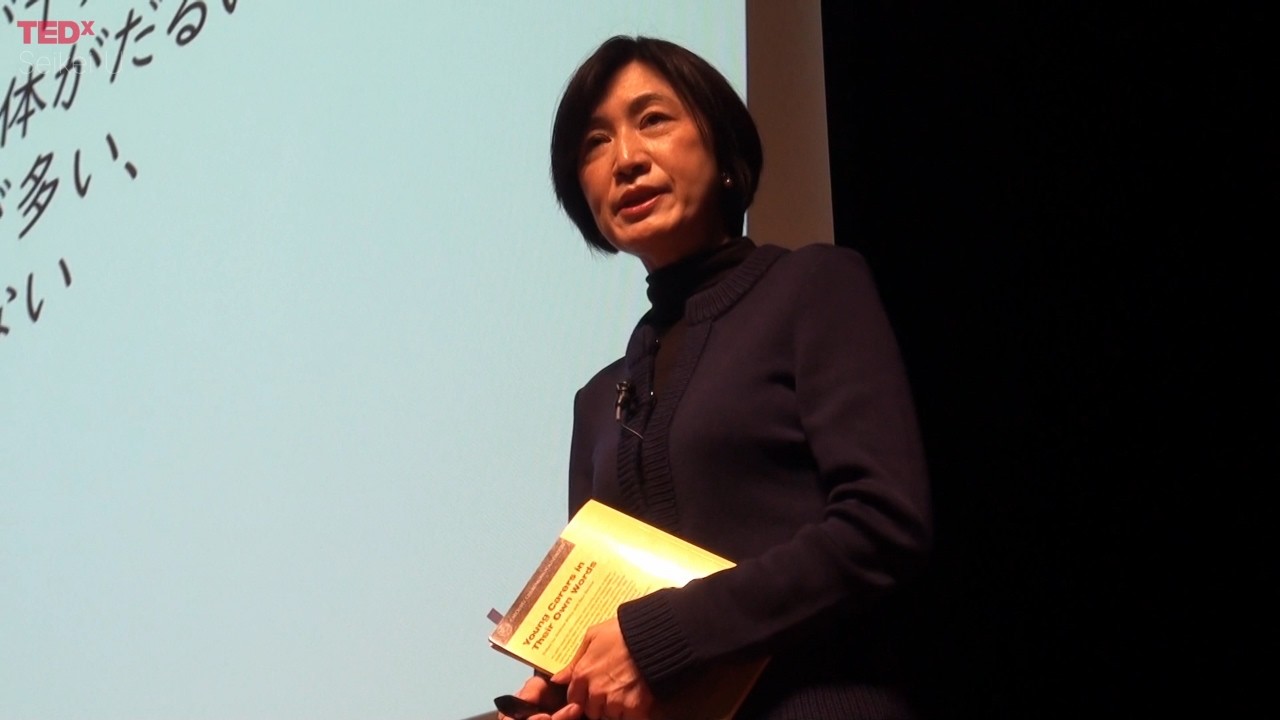
「ケア」の価値を問い直す | Tomoko Shibuya | TEDxSEIKEI U
Rethinking the Value of "Care" | Tomoko Shibuya | TEDxSEIKEI U
Keywords
Summary
245 words
Critical Evaluation
Value of the Information & Strength of the Argument
The talk’s value lies in its personal and research-based perspective, humanizing young carers through real stories and survey data. The argumentation is solid, building from statistical evidence to case examples and logical reasoning. Shibuya skillfully uses the UK example to illustrate severe consequences, then contextualizes with Japanese data. She introduces a process model of how caregiving progressively affects young people, moving from time adjustment to academic and social fallout. The inclusion of parent testimonials adds emotional weight while reinforcing the systemic neglect. Her argument for dual support – balancing care with personal development and ensuring easy access to help – is practical and compelling. The presentation avoids sensationalism, instead offering a nuanced view that care can also be a source of strength and connection.
Scientific Rigor, Source Quality, Title Accuracy
Shibuya relies on her own research, including a study she co-conducted in Saitama Prefecture, and she references academic work, such as the compilation by Saul Becker. The talk is data-informed, but exact citations are not provided on screen, and the only external link in the description is the generic TEDx page. The title precisely matches the content, which indeed focuses on reevaluating the notion of care in society. The talk is delivered with scientific humility, acknowledging the complexity of the issue. While not a formal publication, the information is sourced from legitimate surveys and academic knowledge, lending it a reasonable level of rigor for a general audience.
246 words
Title / Content Match
The title accurately reflects the content, which critically examines the value and societal perception of caregiving, especially for young carers.
Quality & Reliability
7/10
Reliable as a TEDx talk by a researcher specializing in young carers, drawing on national and prefectural surveys and personal research. However, it is a presentation, not a peer-reviewed study, and some statistics are quoted without full references.
Key Moments
Markers derived by PSI from the transcript: the creator did not define chapters.
- Introduction with the statistic that 1 in 17 junior high students care for family members.
- Definition of young carers and mention of the term's origins in 1990s Britain.
- Reading a poignant essay by a 16-year-old British girl who left school due to caregiving.
- Saitama Prefecture survey results among high school students, revealing about 1 in 25 are young carers.
- Discussion of how 2 hours of daily care can impact school life, with a progression of effects.
- Support initiatives such as handbooks for schoolchildren and a young carer festival in Yokohama.
- Shibuya's personal reflections on the dual nature of care and the importance of companionship.
- Conclusion summarizing the need for balance, support, and a society where care is not a burden.
Cited Sources
- TEDx Talks — Official TEDx platform; the talk was given at TEDxSEIKEI U using the TED conference format.
Contribution & Novelties
The talk contributes an intimate, research-grounded perspective on young carers in Japan, linking it to CODA and highlighting a gradual impact process. It challenges stereotypes by showing that even moderate care hours can strain young lives. The personal essay and parent testimonials humanize the issue. The proposal for simple companionship as support is novel and actionable.
Pour aller plus loin :
- Young carer — Overview of terminology and international context.
- Child of deaf adult — Related concept of CODA and its challenges.
- Caregiver — General concept of caregiving and its societal implications.
92 words
Radar Profile
The profile shows high scores in quality and fiability, moderate quantity, and lower technical level, consistent with an accessible yet well-sourced expert talk. The balanced profile reflects a clear, evidence-based presentation accessible to a general audience.