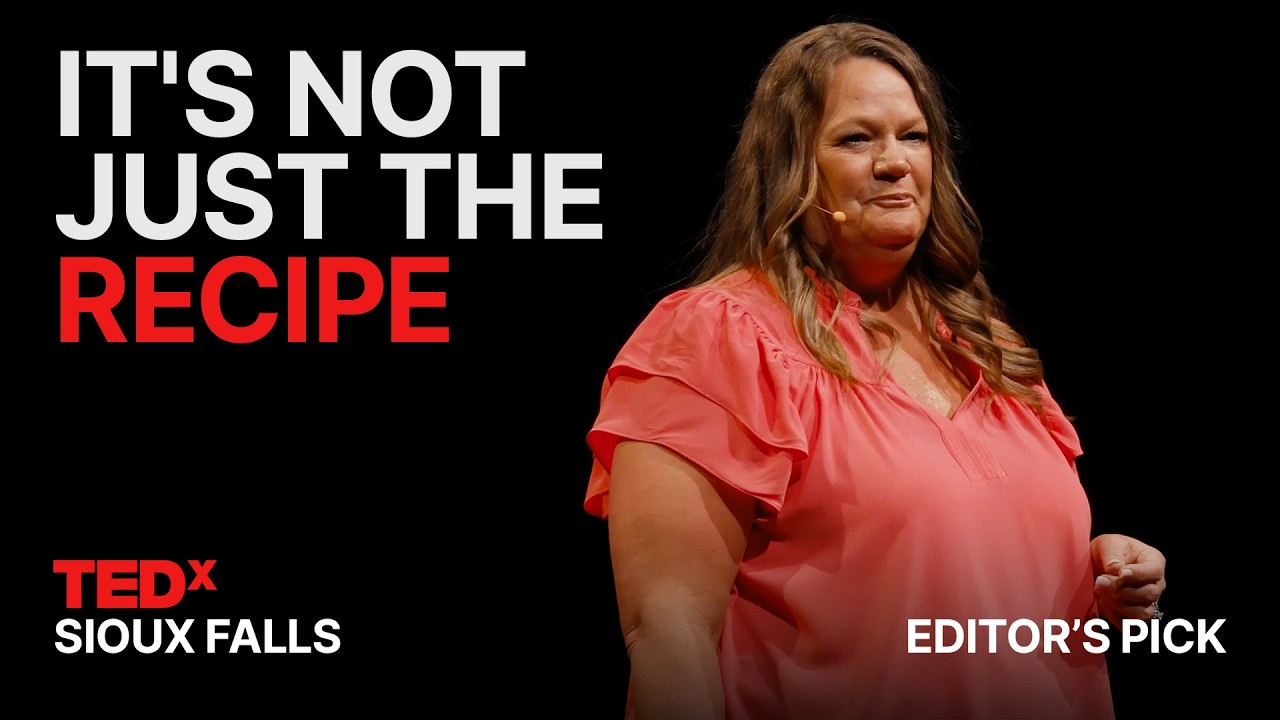
How cooking together preserves more than family recipes | Staci Perry Mergenthal | TEDxSioux Falls
Keywords
Summary
336 words
Critical Evaluation
Value of the Information & Strength of the Argument
The value of the talk lies in the specificity of its central observation: the gap between a written recipe and the operational knowledge required to reproduce it. That gap is well illustrated with concrete, checkable-in-principle details from a single documented session — absent rolling thickness, missing sugar topping, missing time and temperature — and the point is generalisable well beyond baking. The argument is built inductively from one richly described case, then widened by a series of short testimonies the speaker collected at talks and community events. This is a legitimate rhetorical strategy for a persuasive talk but a weak evidentiary one: the testimonies are self-selected, unrecorded, unquantified and reported second-hand, so they can establish that a sentiment exists, not how common it is or what predicts it. The speaker is careful not to overclaim statistically — she describes ‘a pattern’ and ‘versions of the sentiment’ rather than frequencies — which keeps the reasoning honest within its limits. The analytical core, that documentation preserves information while co-presence transmits tacit skill, adjustment and confidence, is a coherent distinction and is applied consistently through the embroidery example as well as the kitchen example. Where the argument thins is at the causal and normative step: the claim that immediacy and digitisation are causing ’everyday wisdom to disappear’ is asserted rather than demonstrated, and the Pinterest remark functions as a joke in place of evidence about retrieval failure. The proposed remedy — ask questions, take photos, invite a non-family member in, be learner or teacher — is sensible, low-cost and actionable, but it is a prescription offered without any account of whether it works, for whom, or under what constraints of time, proximity and family circumstance. The talk’s persuasive force comes from emotional resonance and vivid narrative rather than from the strength of its case; as a stimulus to reflection and behaviour it is effective, as an argument about cultural change it remains a hypothesis.
Scientific Rigor, Source Quality, Title Accuracy
No scientific or documentary sources are invoked at any point. The only link in the description is the general TEDx organisational page, and the talk itself cites no study, author, institution, survey or dataset. The evidence base consists of the speaker’s own family history, one photographed recipe card, an unsourced quotation written on a card handed to her after a presentation, and unnamed individuals identified only by first name. Her professional credentials — podcast host, blog author, contributor to Food Network and Taste of Home — establish her as an experienced storyteller on this subject, not as a researcher, and she does not claim otherwise. The statistical-sounding framing (‘since I first started speaking about this topic in 2017’, ‘I started seeing a pattern’) is not backed by any count, method or sample, so it cannot be assessed. The title and description are faithful: the talk is precisely about what shared cooking transmits beyond the written recipe, and its closing line restates the opening premise without inflation. There is a short interjection near the very end (‘Welcome to the’) suggesting the recording includes an unedited transition, but this does not affect the substance. Overall, this is a well-crafted personal essay with transparently anecdotal foundations, and it should be read as such.
546 words
Title / Content Match
The title promises an argument about how shared cooking preserves more than recipes, and the talk delivers exactly that: a family-cookie story extended into a broader plea about unwritten knowledge. The fit is close, with no misleading framing.
Quality & Reliability
3/10
Anecdotal and autobiographical account delivered in the TEDx personal-narrative format. The speaker's claims rest on her own family experience and on a set of informal testimonies she collected at talks and community events since 2017; no study, dataset, published literature or external documentation is cited or linked. The reasoning is coherent and the message is presented transparently as a personal conviction rather than as a research finding, but nothing in the talk can be independently verified beyond the speaker's own reporting.
Key Moments
Markers derived by PSI from the transcript: the creator did not define chapters.
- Opening premise: the recipe card was never at risk of being lost, but the time to learn it beside her grandmother was.
- The 2013 baking session and the sensory memories of her grandmother's kitchen, including the covered electric mixer.
- Enumeration of what the recipe card omitted: rolling thickness, the sugar topping, oven temperature and bake time.
- The provenance stories attached to the recipe and its objects: great-grandmother Ruth, the applewood rolling pin, the 1950s cookie sheet.
- The last batch: the grandmother's move to assisted living without a kitchen and the dispersal of her recipe cards and cookbooks.
- The central thesis formulated: written knowledge preserves information, learning alongside someone preserves wisdom, tradition and belonging.
- Testimonies gathered since 2017, including the card reading 'her recipe died with her', and counter-examples of successful transmission.
- Critique of the assumption that digitised files guarantee future retrieval, and the claim that meaningful knowledge lives in people.
- The 'grandma and grandpa hobbies' observation: a turn toward hands-on, analog skills that double as learning opportunities.
- The embroidery lessons with 88-year-old Ethel at the local fibre guild, as transmission outside the family line.
Cited Sources
- TEDx — official programme page — Only link provided in the video description; it documents the independently organised TEDx format of the event and is not a substantive reference for the talk's content.
Concurring Sources
- Tacit knowledge — Wikipedia — Conceptual framework that matches the talk's core distinction between what a recipe card records and the embodied skill that must be acquired in person.
- Oral tradition — Wikipedia — General background on the transmission of knowledge and practice by demonstration and speech rather than written record.
- Intangible cultural heritage — Wikipedia — Institutional framing (UNESCO) of culinary and craft practices as heritage that is carried by practitioners rather than documents.
Contribution & Novelties
The talk’s distinctive contribution is not a new finding but a sharp reframing of a familiar domestic situation: the family recipe card is presented as a partial record whose real value is as an index to a relationship that must be enacted in person. By separating what documentation preserves (information) from what co-presence transmits (adjustment, texture, confidence, story, belonging), the speaker gives a memorable name to a specific and widely felt loss — the grief not of a lost recipe but of a lost opportunity to learn. The extension beyond the kitchen, first into the observed revival of hands-on analog crafts and then into a non-familial transmission (an 88-year-old fibre-guild embroiderer teaching an unrelated adult), widens the claim from family heritage to community knowledge transfer. The practical two-role model — be the learner or be the teacher — is a simple, transferable heuristic, and the secondary point that digitised archives are not automatically retrievable is a useful corrective to the assumption that saving equals preserving. Nothing here is empirically established, and the talk presents itself as testimony rather than research; its novelty is rhetorical and conceptual, in the clarity of the distinction and in the bridge it builds between domestic memory-keeping and the broader question of how skill survives between generations.
Further reading:
- Tacit knowledge — The philosophical and organisational concept closest to the talk’s ‘what the card doesn’t say’; useful for formalising the implicit/explicit distinction the speaker works with intuitively.
- Oral tradition — Background on transmission by demonstration and speech, the mechanism the talk describes at household scale.
- Intangible cultural heritage — Institutional and policy framing of culinary and craft practices as living heritage carried by practitioners.
- UNESCO Intangible Cultural Heritage lists and conventions — Relevant reference point for anyone wanting to situate family foodways within formal heritage frameworks; consult the official UNESCO site for the exact current pages.
- Research literature on communities of practice and situated learning (Lave and Wenger) — Directly applicable framework for the fibre-guild episode, where an outsider is inducted into a craft by established practitioners; cite by author name rather than a specific URL.
350 words
Radar Profile
The profile is dominated by a low technical level and moderate informational density, with quality scores held in the middle range by the coherence and specificity of the narrative rather than by any external verification. Reliability sits at the low end because every claim originates in personal testimony and no source is offered. The shape is typical of a well-crafted humanities-style personal essay: high communicative clarity, minimal technical apparatus, and evidential weight carried almost entirely by anecdote.