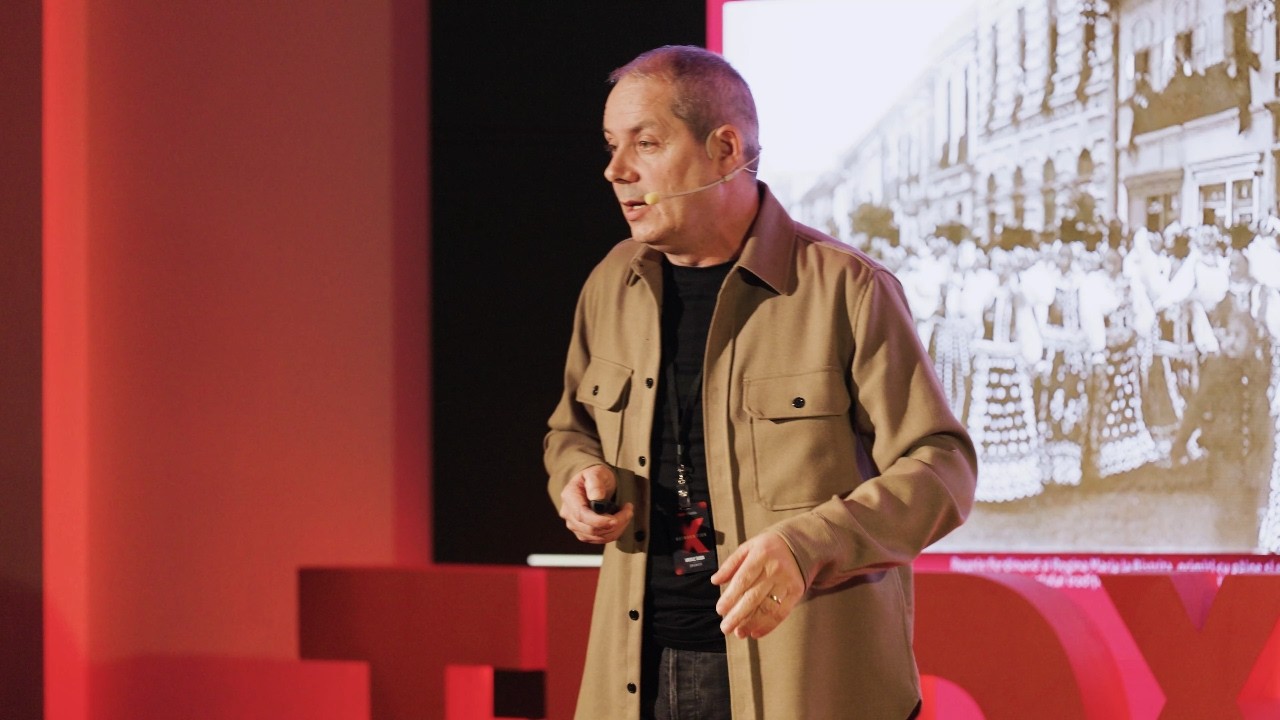
Exercițiu de imaginație: Cum ar putea arăta Bistrița în 2050? | Vasile Duda | TEDxBistrita
An Exercise in Imagination: What Could Bistrița Look Like in 2050? | Vasile Duda | TEDxBistrita
Keywords
Summary
332 words
Critical Evaluation
Value of the Information & Strength of the Argument
The informational value of the talk lies almost entirely in framing rather than in findings. It offers no data set, no budget, no planning document and no scenario for 2050; the only quantitative element, an assertion that more than half of residents did not think Bistrița should look after its heritage, is left unsourced and undated. What it does provide is an insider’s account of a small city’s cultural ecosystem: the production of local colouring books and school materials on the city’s heritage, a high-school elective built around Bistrița, the reuse of existing urban fabric, and the symbolism of the UNESCO Creative Cities designation. These are concrete, checkable institutional facts of a modest kind and they carry the practical weight of the talk. The value is therefore documentary and programmatic rather than analytical: it tells the listener what one local actor has actually done to build a long-term civic outlook, and it proposes criteria (people first, walkability, reuse, narrative identity) that a listener can accept or reject.
On argumentation, the talk is coherent but rhetorical rather than demonstrative. Its spine is a chain of questions, which the speaker repeatedly poses and rarely answers: who writes the strategy, who respects it, will a 20-year plan ever win an election, is a city’s beauty a list of monuments or the poetry between them. The stronger moves are analogies that do real work: the city as one’s home, where planning horizons are naturally long because one invests in one’s children; the Maastricht adviser as an external witness that civil-society pressure outlasts political cycles; Rome versus Paris as evidence that narrative, not inventory, drives attraction. The weaker moves are assertions presented as self-evident: that vision, not money, explains Brâncuși’s Târgu Jiu ensemble or the Transylvanian tower, which conveniently ignores the funding, patronage and political conditions that made those projects possible; that a creative-city label is simultaneously unbelievable and true, a paradox waved through rather than resolved. No counter-argument is engaged — the possibility that heritage protection may compete with housing, mobility or investment is never weighed — and the closing priority order (people, bicycle, car) is stated as a value rather than derived from evidence. The reasoning is honest about its own limits, since the speaker explicitly calls the exercise imaginative, but it remains an argument from experience and conviction, not a demonstration.
Scientific Rigor, Source Quality, Title Accuracy
Sourcing is thin and oral. The talk invokes the Washington Charter as international guidance requiring that solutions for historic centres be built with the residents of those centres — a broadly accurate paraphrase of the 1987 ICOMOS charter on historic towns and urban areas, though it is named without edition, date or issuing body. The UNESCO Creative Cities Network is referred to as a fact about Bistrița, and the Brâncuși ensemble at Târgu Jiu and the medieval tower of Bistrița are used as historical illustrations; all three are identifiable public references, but none is documented in the talk, and no bibliography, report, statistic or archive is cited. The one numerical claim about local attitudes toward heritage is unverifiable as presented, and the 1564 Italian traveller’s ranking of Sibiu, Cluj and Bistrița is introduced by the speaker himself with an explicit reservation about exaggeration, which is honest but leaves the anecdote unsupported. No contradictory literature, no critical assessment of the UNESCO label’s effects and no discussion of heritage-conservation debates are engaged. The result is a talk whose factual claims are mostly low-risk and locally verifiable, but whose evidentiary apparatus is essentially absent.
On title-to-content fit, the advertised question — what Bistrița could look like in 2050 — is answered by principles and values rather than by an image of the city, so the title overpromises relative to the delivered content. The gap is real but not misleading: the speaker states his framing openly in the first minute and returns to the 2050 horizon at the close.
659 words
Title / Content Match
The title promises a concrete picture of Bistrița in 2050; the talk delivers mostly a reflection on civic engagement, heritage education and the values a city should keep. The future is evoked through principles rather than scenarios, so the match is partial.
Quality & Reliability
4/10
Talk is a personal, value-driven plea by a local art historian rather than a documented study. It names a few real institutional references (the 1987 Washington Charter on historic towns, the UNESCO Creative Cities Network, Brâncuși's Târgu Jiu ensemble) but supplies no bibliography, no figures, no planning documents and no scenarios behind its 2050 framing. One quantitative claim about local opinion ('over 50%') is asserted without source, and one anecdote (a 1564 Italian traveller's ranking of Transylvanian cities) is presented as doubtful by the speaker himself. Content is honest about being an 'imagination exercise', which limits both the factual risk and the evidential weight.
Key Moments
Markers derived by PSI from the transcript: the creator did not define chapters.
- Opening: the speaker concedes that the title is a provocation and that an art historian is being asked to look forward rather than backward.
- The Maastricht anecdote: a long-term local development strategy survives electoral cycles because civil society holds the line.
- Local diagnosis: few residents hold clear preferences, and more than half reportedly do not think Bistrița should look after its heritage; citizens cannot vote on what they have never been taught.
- The Washington Charter is invoked: solutions for a historic centre must be built with its residents, so a Bistrița project must belong to Bistrițeni.
- Heritage pedagogy in practice: colouring books, primary and secondary school materials and a high-school elective that ask pupils to depict the Bistrița of tomorrow.
- Continuity of the urban fabric: a street documented around 1300 is still the same width, and human relations matter more than technical change.
- Money versus vision: Brâncuși's Târgu Jiu ensemble and the tallest medieval tower in Transylvania are attributed to collective will rather than to the richest local budgets.
- Rome versus Paris: the number of monuments does not determine attraction; the 'poetry' of the space between buildings and the story a city tells do.
- A work by Vasile Tolan introduces reuse and modest materials as symbols of sustainability, resilience and low-cost urban regeneration.
- Bistrița's UNESCO Creative City status is greeted with disbelief before being reframed as an external recognition locals should also grant themselves.
- Closing priority order — people first, then the bicycle, then the car — and a walkable, story-telling city as the benchmark for 2050.
Cited Sources
- TEDx programme (official link in the video description) — Only link supplied in the description; reference frame for the independently organised TEDx format of the talk.
- Washington Charter — Charter for the Conservation of Historic Towns and Urban Areas (ICOMOS, 1987) — Invoked to support the claim that conservation solutions for historic centres must be devised with the residents concerned; the talk paraphrases it without naming the issuing body or date.
- UNESCO Creative Cities Network — Cited as the programme under which Bistrița is presented as a 'creative city'; the speaker uses it as an external endorsement of local cultural capacity.
- Brâncuși Ensemble of Târgu Jiu — Endless Column — Used as the historical example that interwar funding constraints did not prevent an outstanding monument, supporting the 'vision over money' argument.
Concurring Sources
- Bistrița — city overview — Corroborates the general historical background used in the talk (medieval urban fabric, Saxon heritage, Transylvanian context).
- UNESCO Creative Cities Network — Consistent with the speaker's statement that Bistrița holds a creative-city designation within this network; the programme's public listings allow direct verification.
Contribution & Novelties
The talk’s originality is not documentary but framing: it treats a city’s long-term strategy as a pedagogical problem before it is a budgetary one. The claim that residents cannot arbitrate on a heritage they were never taught at school, and the concrete response of colouring books, local textbooks and a high-school elective asking pupils to draw Bistrița in 2050, is a distinctive and transferable angle rarely heard in urban-strategy discourse. A second contribution is aesthetic: the proposal that the value of a city lies less in its inventory of monuments than in the ‘poetry’ of the space between buildings and in the story it can tell, which converts narrative identity into an economic and political asset. Third, the reading of a contemporary artist’s recycled-material work as a metaphor for low-cost, resilient urban regeneration links cultural practice to sustainability criteria. The talk offers no new data and no verifiable forecast, so its contribution is a set of questions and priorities rather than findings.
Further reading:
- Washington Charter — Charter for the Conservation of Historic Towns and Urban Areas (ICOMOS, 1987) — The international text the speaker paraphrases on involving residents in the future of historic centres; read it for the exact wording and scope.
- UNESCO Creative Cities Network — Official framework behind the ‘creative city’ designation discussed in the talk, with the criteria and reporting obligations Member Cities accept.
- Endless Column, Târgu Jiu — Background on Brâncuși’s ensemble, used by the speaker as proof that vision rather than local wealth produced the monument.
- The Image of the City, Kevin Lynch — Classic study of how inhabitants mentally map and read urban space; the conceptual counterpart to the talk’s ‘poetry of the space between buildings’.
- Concept of urban resilience and adaptive reuse of the existing building stock — The talk’s operational takeaway (use what you already have rather than build anew) belongs to this literature; no single canonical reference is asserted here.
320 words
Radar Profile
The profile is flat and low: modest information density and technical depth, paired with a moderate reliability score that reflects an honest but undocumented argument rather than any factual error. Quality sits slightly above quantity and technical level, indicating a talk whose strength is the coherence of its framing, not the amount of evidence or the sophistication of its methods. The combination points to a civic-advocacy talk rather than an analytical briefing.