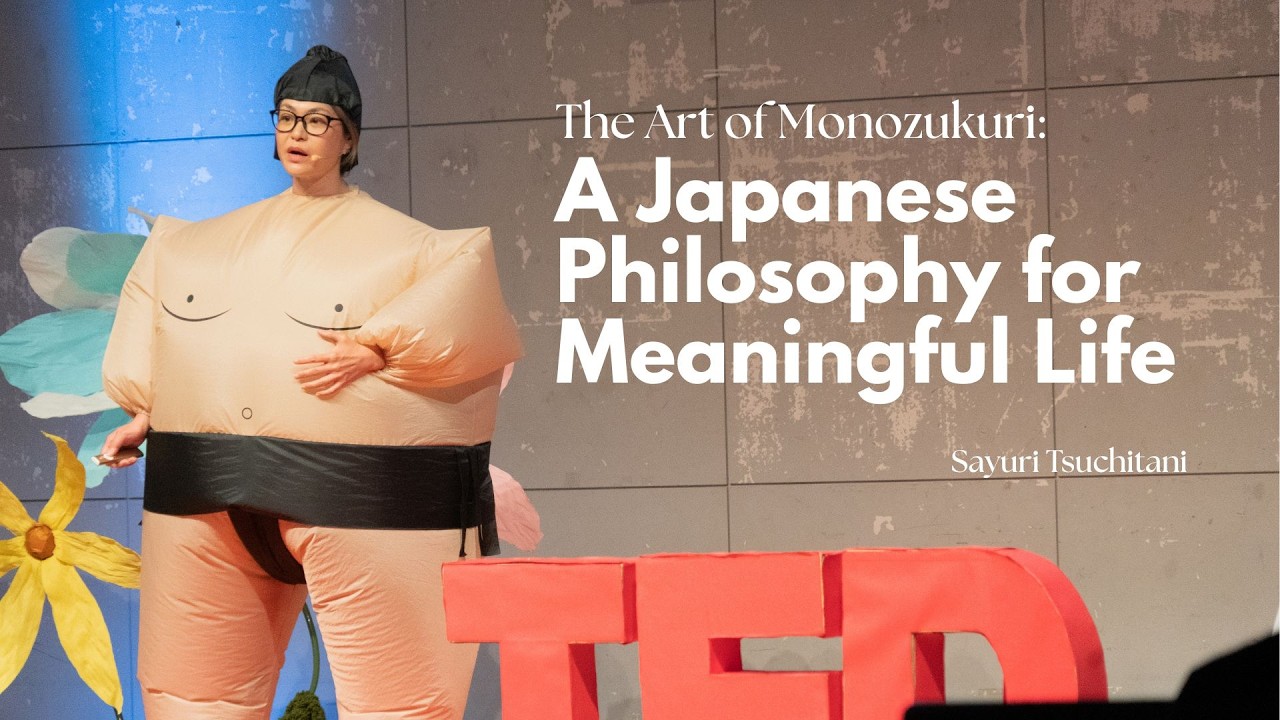
The Art of Monozukuri | Sayuri Tsuchitani | TEDxAPU
Keywords
Summary
176 words
Critical Evaluation
Value of the Information & Strength of the Argument
The talk offers valuable insights into a cultural philosophy that is often misunderstood as mere craftsmanship. The speaker’s arguments are coherent and supported by relatable anecdotes and a few credible references, such as Tal Ben-Shahar’s positive psychology work and the historical testimony of Japanese American resilience. However, the argumentation relies heavily on subjective experience and does not engage with any critical or counter-perspectives, limiting its depth. Still, the core message—that true value in creation comes from the intentional experience it fosters—is well articulated and convincingly linked to broader questions about modern overconsumption and loss of purpose.
Scientific Rigor, Source Quality, Title Accuracy
The talk does not claim to be scientifically rigorous; it is a personal reflection grounded in cultural and historical references. The sources mentioned (Ben-Shahar’s book, the Gaman book, the Manzanar visit) are credible but not formally cited with specific editions or page numbers. The title accurately reflects the content, and the talk is appropriately framed as a TEDx presentation. The single link in the description points to the TEDx program, which is not a source of specific evidence. Overall, the rigor is acceptable for a philosophical talk but would not meet scholarly standards. The title-content alignment is strong, with no misleading elements.
213 words
Title / Content Match
The title perfectly matches the content: the talk is entirely devoted to explaining and illustrating the Japanese philosophy of Monozukuri.
Quality & Reliability
6/10
The talk is a personal and philosophical reflection rather than a scientific study. It references a few sources (Tal Ben-Shahar's book and the Gaman book) and historical events (Manzanar internment), but relies heavily on anecdotal experience. The claims are reasonable but not empirically verified.
Key Moments
Markers derived by PSI from the transcript: the creator did not define chapters.
- Introduction: The speaker presents her unconventional creation, Sumo Yoga, and sets up the question about what the body truly needs.
- Definition of monozukuri: Distinguished from mere craftsmanship, emphasizing value creation through intention, skill, and care.
- Example of a haircut: Explains how a service provides an experience, not just an outcome, illustrating the essence of monozukuri.
- Personal history: Shares her background as a hair stylist and the influence of her farmer family, highlighting the importance of human connection.
- Introduction of ikigai: She describes how the loss of tatami rooms led her to find her purpose in creating meaningful experiences.
- Reference to gaman and Manzanar: Uses the example of Japanese Americans creating beauty from nothing as a powerful form of monozukuri under adversity.
Cited Sources
- TEDx program information — Mentioned in the video description as the official TEDx platform; the talk is independently organized under this format.
- Choose the Life You Want - Tal Ben-Shahar — The speaker references Tal Ben-Shahar's book on happiness and his experience at the barber chair to illustrate the value of human connection in services.
- Gaman - The Art of Perseverance — The speaker refers to a book about Japanese Americans' dignity during internment, and connects the concept of enduring with patience to monozukuri.
Contribution & Novelties
The talk reinterprets the Japanese term monozukuri beyond its usual translation as ‘craftsmanship,’ framing it as a life philosophy centered on creating meaning through intentional care. The personal narrative adds an authentic layer, connecting traditional values with contemporary entrepreneurial spirit. The emphasis on ‘value as experience’ over ‘value as possession’ offers a refreshing perspective in a consumer-driven world.
Pour aller plus loin :
- Monozukuri (Wikipedia) — Explores the concept in industrial and cultural contexts, useful for deepening understanding.
- Ikigai (Wikipedia) — The Japanese concept of ‘reason for being,’ closely related to the talk’s search for purpose.
- Gaman (Wikipedia) — A Japanese term for endurance and patience, illustrated in the talk through internment camp stories.
- Manzanar National Historic Site (Wikipedia) — Provides historical background on one of the internment camps mentioned.
130 words
Radar Profile
The radar shows a low technical score (2) and moderate information quantity (5), while quality (7) and reliability (6) are above average. This profile fits a personal and philosophical talk that is engaging and thoughtful but lacks empirical depth or quantitative evidence. The dominant strength lies in the clarity and resonance of the message rather than in rigorous data.