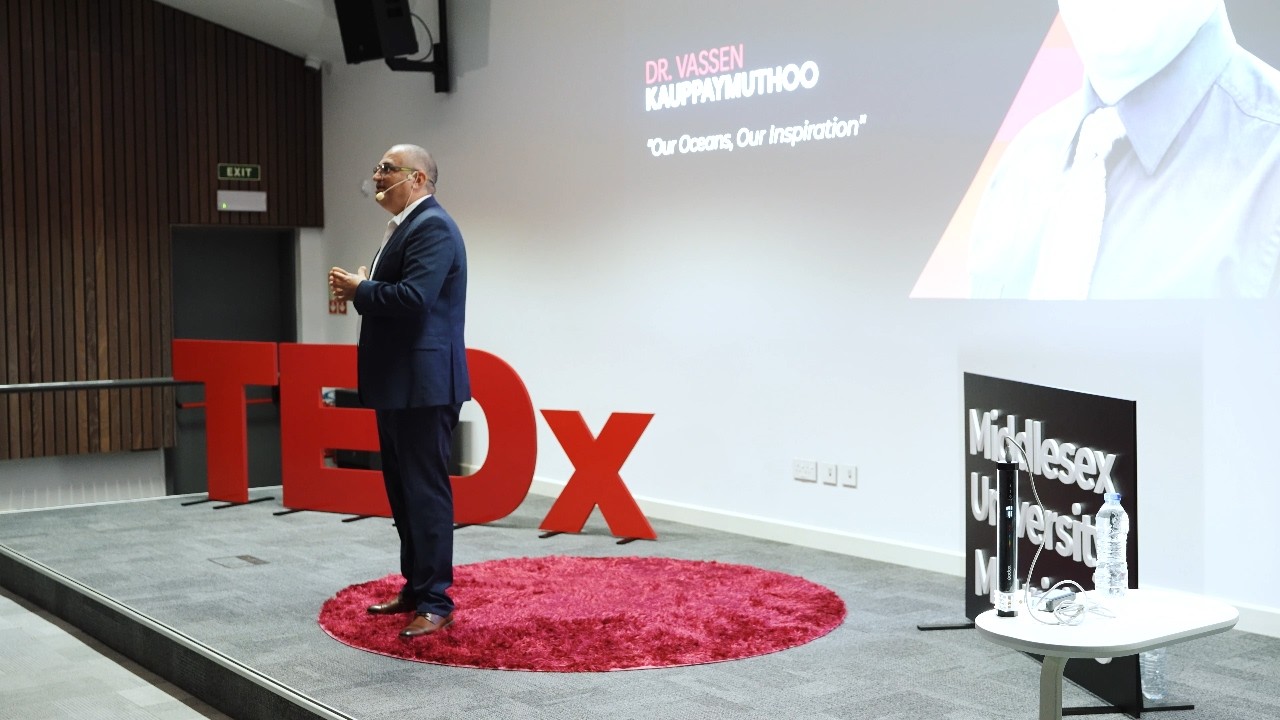
The ocean—our greatest inspiration | Vassen Kauppaymuthoo | TEDxMiddlesex University Mauritius
Keywords
Summary
235 words
Critical Evaluation
Value of the Information & Strength of the Argument
The value of the information lies in its broad, interdisciplinary perspective, synthesizing well-established historical and cultural facts into a coherent and engaging narrative. The speaker effectively connects distinct fields—navigation, biology, law, trade, philosophy, and religion—around the central theme of oceanic inspiration, which is intellectually stimulating. The argumentation progresses logically through the five spheres, each supported by relevant examples (e.g., Polynesian wayfinding, the Challenger expedition, maritime insurance). However, the talk remains at a conceptual level, with limited technical detail or critical analysis; the speaker often relies on generalities and does not delve into mechanisms or nuances. The inclusion of personal anecdote (Mauritius) adds authenticity but does not strengthen the scientific rigor. The overall reasoning is sound, but the depth is shallow, making it more inspiring than instructive.
Scientific Rigor, Source Quality, Title Accuracy
Scientifically, the talk is generally accurate but simplifies historical and scientific facts. The speaker cites no specific scholarly sources during the presentation, relying on common historical narratives. The only external reference is the TEDx website link in the description, which is standard for TED talks. The lack of citations reduces the verifiability of specific claims, but these claims are mostly uncontroversial and widely known. The title–content alignment is strong: the talk delivers precisely what the title promises, with a clear mapping of the five spheres and a coherent conclusion. No contradictions or misleading statements were observed. The speaker’s expertise in oceanography and environmental science adds credibility to his assertions about ocean-related topics, though his foray into philosophy and religion is general. Overall, the episode serves as a high-level overview rather than a rigorous academic lecture, but it maintains reasonable integrity.
281 words
Title / Content Match
The title accurately captures the core message of the talk, which systematically demonstrates how the ocean has inspired human progress across five domains. The promise of exploring the ocean's inspirational role is fulfilled with clear structure and diverse examples.
Quality & Reliability
7/10
The talk presents well-known historical and scientific concepts in a simplified, inspirational manner. The speaker is an expert oceanographer and environmental engineer, lending credibility to the content. However, the narrative prioritizes broad synthesis over technical depth, and some claims, while generally accurate, are presented without specific citations.
Key Moments
Markers derived by PSI from the transcript: the creator did not define chapters.
- Introduction: the first human on the shore, the birth of curiosity.
- Science: Polynesian navigation as early scientific method.
- Science: Darwin's voyage and the Challenger expedition.
- Society: the ocean as connector, Indian Ocean trade, UNCLOS.
- Economy: 80% of trade by sea, maritime insurance, blue economy.
- Philosophy and faith: Thales, sublime metaphor, sacred waters.
- Call to action: return inspiration, protect the ocean.
Cited Sources
- TEDx Program — Official page for TEDx events, providing context for the talk's format and organization.
Concurring Sources
- TEDx Program — The TEDx platform itself is a concordant source, confirming the event's format and the speaker's affiliation.
Contribution & Novelties
The talk offers a unique integrative perspective by linking oceanic inspiration across scientific, social, economic, philosophical, and religious domains, emphasizing the ocean as a unifying thread of human progress. While individual concepts are not new, the synthesis provides a novel framing that encourages cross-disciplinary appreciation. The speaker’s Mauritian background adds a personal dimension, illustrating how oceanic connectivity shapes identity. For deeper exploration, the following references are suggested:
Pour aller plus loin :
- Polynesian navigation — Explores the sophisticated wayfinding techniques of Pacific islanders, a core example of early scientific observation.
- Challenger expedition — Details the first major oceanographic research voyage that established modern oceanography.
- United Nations Convention on the Law of the Sea — Provides insight into the legal framework declaring the deep seabed as the ‘common heritage of mankind’.
130 words
Radar Profile
The radar profile shows a well-rounded presentation with high information quantity and moderate quality, but low technical depth. The balance between quantity and quality indicates a broad but not deeply analytical talk, while the low technical score reflects its accessibility to a general audience. The overall reliability is boosted by the speaker's expertise, resulting in a trustworthy but not highly technical piece.