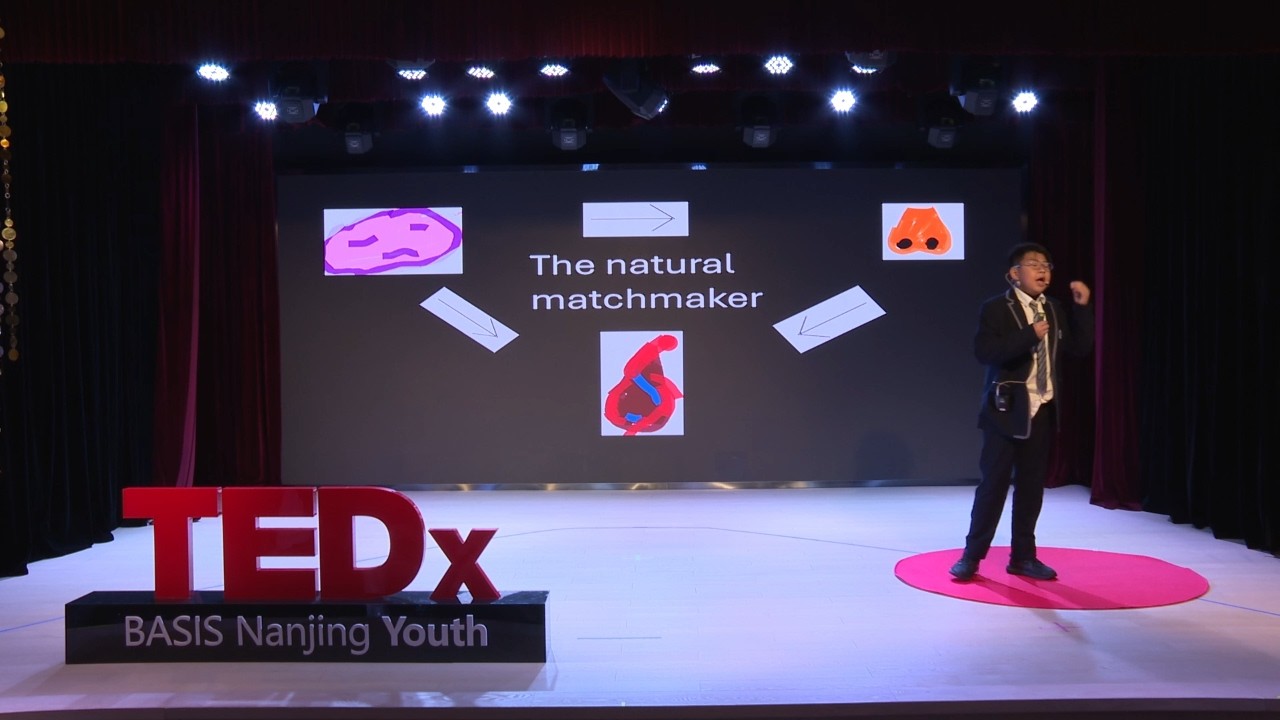
Mate Selection: How Immunology Shapes Our Body | Shawn Zhou | TEDxBASIS Nanjing Youth
Title history
- Mate Selection: How Immunology Shapes Our Body | Shawn Zhou | TEDxBASIS Nanjing Youth — observed on 20261109-1737 UTC (YouTube)
Keywords
Summary
131 words
Critical Evaluation
Value of the Information & Strength of the Argument
The talk offers an intriguing perspective on mate selection, linking immunology to attraction. It uses anecdotal experiments and simplified analogies to convey the role of MHC genes. However, the argumentation is thin: it overstates the correlation between smell and visual attractiveness, misattributes the experiment to Robert Winston (it is usually associated with Claus Wedekind), and makes broad claims about medieval history without citations. The value lies in raising awareness about biological factors in dating, but it does not provide strong scientific evidence.
Scientific Rigor, Source Quality, Title Accuracy
The scientific rigor is weak. No specific studies are cited beyond vague references to ‘scientists at University of Bird’ (likely University of Bern) and the Robert Winston experiment. The only provided source is the general TEDx page. The title is apt but the content does not fully substantiate the claims. There is no mention of sources or further reading. The talk is a personal interpretation rather than a rigorous review.
167 words
Title / Content Match
The title matches the content's focus on immunology and mate selection, though some claims are overly simplified.
Quality & Reliability
4/10
The talk presents simplified biological concepts about MHC genes and mate selection, but contains inaccuracies in attribution and oversimplifications. It is accessible but lacks rigorous sourcing.
Key Moments
Markers derived by PSI from the transcript: the creator did not define chapters.
- Introduction to Robert Winston's sweaty T-shirt experiment.
- Explanation of MHC genes as biological fingerprints.
- University of Bern experiment and women's preference for diverse MHC.
- How MHC affects facial development and body symmetry.
- Medieval inbreeding example and consequences of low gene diversity.
- Critique of modern dating apps and encouragement to trust natural instincts.
Cited Sources
- TEDx Official Page — The talk was given at a TEDx event and this is the general TEDx page.
Contribution & Novelties
The talk provides a youth perspective on mate selection, framing it through immunology in an accessible way. It compiles concepts like MHC, scent-based attraction, and facial symmetry into a coherent narrative. However, it does not present novel research. For further exploration:
Pour aller plus loin :
- Major Histocompatibility Complex (Wikipedia) — Provides detailed scientific background on MHC and its role in immune recognition.
- Claus Wedekind (Wikipedia) — The actual researcher behind the sweaty T-shirt experiment; his study on MHC and body odor is highly relevant.
- Mate Choice (Wikipedia) — Discusses evolutionary biology of mate selection, including genetic diversity preferences.
99 words
Radar Profile
The radar profile shows low to moderate scores across all dimensions, with the lowest in technical level and reliability, reflecting the talk's simplified and occasionally inaccurate content.