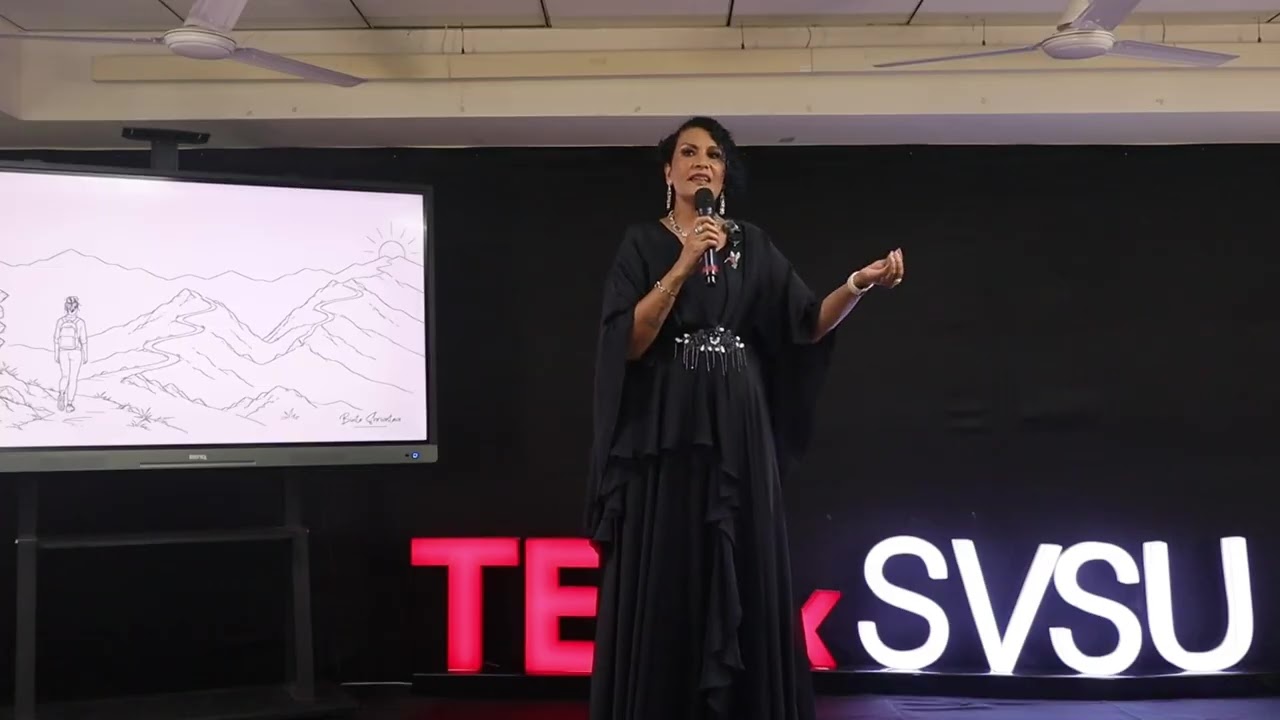
It's Never Too Late to Rewrite Your Story | SVSU | Binita Shrivastava | TEDxSVSU
Title history
- It's Never Too Late to Rewrite Your Story | SVSU | Binita Shrivastava | TEDxSVSU (PSI archive)
- It's Never Too Late to Rewrite Your Story | SVSU | Binita Shrivastava | TEDxSVSU — observed on 20261119-1828 UTC (YouTube)
Keywords
Summary
195 words
Critical Evaluation
Value of the Information & Strength of the Argument
The value of the talk lies in its relatable personal narrative and the accessible framework. The speaker provides a clear step-by-step approach to self-reinvention, which can resonate with people facing identity crises or mid-life transitions. The argumentation is built on anecdotal evidence: her own experience of losing everything and rebuilding from scratch demonstrates resilience but offers no generalizable data. The BILITA framework is presented without empirical validation, yet it serves as a motivational heuristic. The emotional appeal is strong, but the logic is somewhat linear, relying on her success story as proof. The talk would have been more persuasive with references to psychological studies or other successful transformations, but it remains honest and well-structured.
Scientific Rigor, Source Quality, Title Accuracy
The scientific rigor is low as no academic sources are cited. The only provided link is to the TEDx organization, which is generic and not specific to the claims made. The talk is primarily a personal testimony masquerading as life advice, lacking data or citations. However, the title matches the content perfectly—the speaker indeed rewrites her story from invisible to influential. The absence of external sources is acceptable for an inspirational talk, but it limits its scientific credibility. The speaker’s credentials (Amazon bestselling author, founder of Visionara Global) are mentioned in the description, adding some authority, but these are self-reported.
229 words
Title / Content Match
The title accurately reflects the central message of personal reinvention; the speaker literally rewrites her story from an invisible housewife to a public figure.
Quality & Reliability
4/10
Personal testimony with no external evidence, but internally coherent and practical. The framework is original, yet entirely anecdotal.
Key Moments
Markers derived by PSI from the transcript: the creator did not define chapters.
- Opening question: How many feel invisible despite family seeing them?
- Speaker's early life: college president, marriage at 25, and years of playing roles.
- 2017 financial challenge: family loses everything, returns to India with ₹50,000.
- Decision to rebuild: starts beauty pageants in 2019, then becomes author and entrepreneur.
- Introduction of the BILITA framework and explanation of each letter.
- Story of achieving a net worth of 10 crore, emphasizing 'show up' and self-acknowledgment.
- Closing message: Invisibility is not about being unseen by the world, but stopping to see yourself.
Cited Sources
- TEDx Program — Official TEDx page providing general information about the event format, mentioned at the end of the description.
Contribution & Novelties
The talk contributes a personal, lived-experience perspective on identity reconstruction in midlife, with a distinctive acronym framework (BILITA) that is easy to remember and apply. It offers a roadmap for individuals, especially women in traditional roles, to redefine themselves beyond societal expectations. The message that ‘past explains but does not define’ is a useful reframing. However, it does not introduce new scientific concepts, but rather syntheses common motivational themes.
Pour aller plus loin :
- Identity (social science) — Relevant for understanding identity formation and change.
- Growth mindset — Directly linked to the belief in self-improvement and learning.
- Women’s empowerment — Contextualizes the speaker’s mission and audience.
- Self-actualization — The pinnacle of Maslow’s hierarchy, related to the goal of achieving one’s potential.
121 words
Radar Profile
The radar profile shows low levels of technical depth and moderate factual content, balanced by a decent narrative structure. The talk is strong on emotional appeal but weak on empirical support, resulting in a rounded but not scientifically rigorous shape.