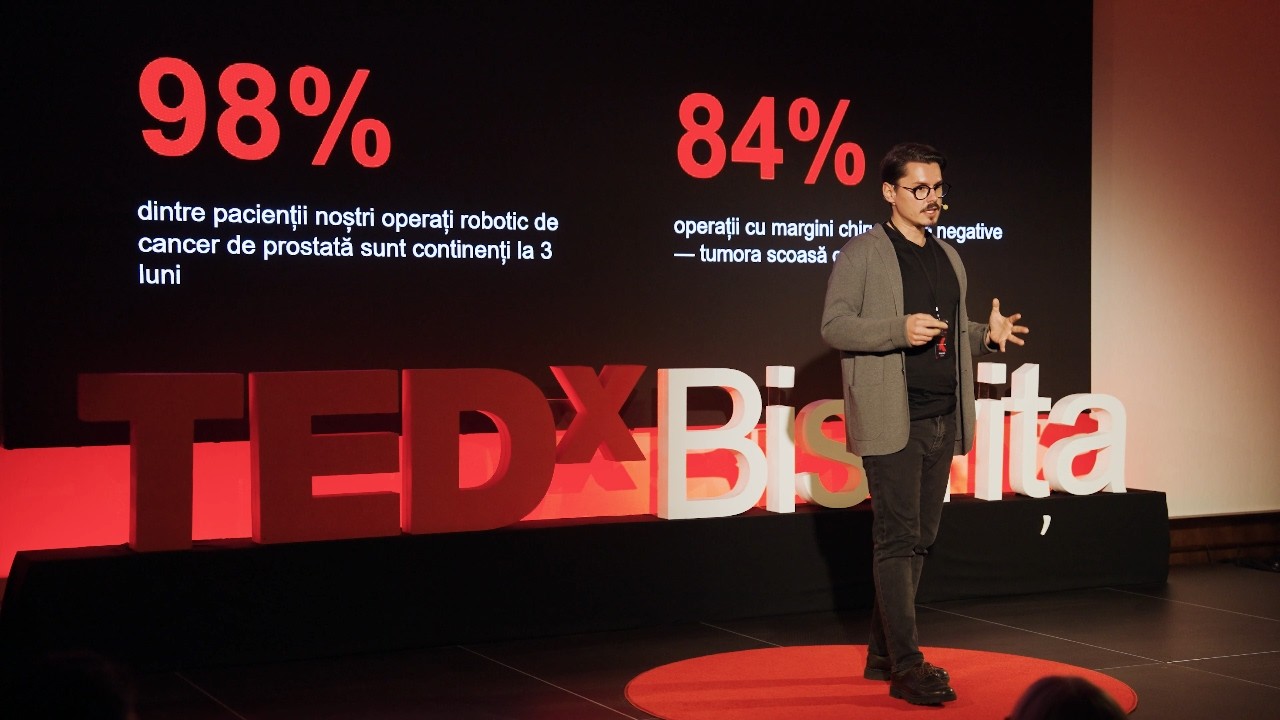
Chirurgul viitorului: om sau robot? | Răzvan Couți | TEDxBistrita
The surgeon of the future: human or robot? | Răzvan Couți | TEDxBistrita
Keywords
Summary
361 words
Critical Evaluation
Value of the Information & Strength of the Argument
The informational value is high for a short format because almost every section carries a concrete anchor rather than a slogan: a dated chronology of surgical eras with incision sizes, a list of measurable machine advantages (magnification factor, percentage of tremor filtered, degrees of freedom), institutional facts (November 2024, first robotic procedure in a Romanian public hospital, a national programme within a year, about 300 operations across five specialties) and two outcome percentages for prostatectomy. The speaker also resists the easiest temptation of the genre by refusing to overstate autonomy: the borrowed five-level ladder is used precisely to say that levels four and five do not exist anywhere, and that the current generation of systems sits at step one, where the novelty is haptic feedback rather than independence. That self-limiting move is the strongest part of the argument, because it converts a promotional subject into a calibrated one. The argumentative structure is itself clean and didactic — a question framed at the start, a historical detour establishing that each technological step redistributes a cost (from patient to surgeon to machine), two live audience polls whose divergence (many accept a robotic platform, very few accept a fully autonomous one) functions as an intuitive demonstration that precision is not the only thing patients value, and a closing answer that reframes the initial binary. Two live polls are rhetorically effective but are not evidence, and the talk treats them as such, which is to its credit. The weaker passages are where assertion replaces reasoning: the claim that ’the unexpected cannot be solved by an algorithm’ is stated rather than argued, and it conflates the current state of the art with a structural impossibility; the assertion that the machine ‘does not assume responsibility’ is a normative and legal position presented as a technical fact; and the pilot analogy, while illuminating for training and flight-recorder-style audit, glosses over how differently aviation autopilots and surgical teleoperators are supervised and certified. The anecdote of the 62-year-old teacher walking the corridor the next day and sending a photograph two weeks later is used as illustrative colour, which is legitimate, but it does more emotional work than evidential work, and the speaker’s own interjection of ‘amazing’ signals the shift in register. Overall the reasoning is coherent, internally consistent and unusually candid about limits; it is an argument from situated experience, built to persuade an audience rather than to settle a question, and it succeeds on those terms.
Scientific Rigor, Source Quality, Title Accuracy
Scientific rigour is uneven. On the positive side, the claims that carry the most weight are hedged and correctly bounded: autonomy is placed at level one with explicit acknowledgement that levels two and three exist only in laboratories, and the speaker states repeatedly that technology matters only if it delivers a real patient benefit, which is the right evaluative criterion. The outcome figures and the institutional milestones are the kind of data a clinician would actually hold, and the chronology of surgical eras is broadly accurate in its sequencing. On the negative side, no source is ever named. The ’large and important international study’ on AI reading prostate MRI is left anonymous, which makes it impossible for a listener to check its design, comparator or endpoint; the 2022 ex vivo intestinal anastomosis and the 2025 demonstration of the steps of a cholecystectomy are described as achievements of unnamed ‘systems’, so their degree of laboratory control, supervision and reproducibility cannot be assessed. The percentages (98% continence, 84% negative margins) come without denominators, follow-up definition, patient selection or comparison group, which matters in a field where the relevant randomised comparisons against laparoscopy have produced more nuanced results on functional outcomes than the figures alone suggest. The five-level autonomy scale is borrowed from vehicular automation without citation, and the talk never mentions cost, maintenance, training requirements, operator learning curves or the evidence base on cost-effectiveness — omissions that are consequential for a subject whose central policy claim is a national programme to widen access. The only link supplied in the description is the generic TEDx programme page, so nothing resembling a bibliography reaches the viewer. On the title: the fit is excellent. The question posed is the question answered, the speaker explicitly declares that question to be wrongly framed, and the whole narrative is organised to support that reframing rather than to postpone it.
734 words
Title / Content Match
Excellent fit: the title poses a binary question that the talk explicitly answers and rejects, arguing throughout that the real configuration is human plus machine. The audience hand-raises and the closing image of the surgeon three metres from the patient but 'never far from him' both serve that framing.
Quality & Reliability
6/10
First-hand testimony from a practising urologist directly involved in building a robotic surgery programme, with concrete figures (98% continence at three months, 84% negative margins, ~300 procedures across five specialties) and a clear, honest placing of current technology at level one of a five-level autonomy scale. However, no study, system or publication is named: the 'large international study' on MRI reading, the 2022 ex vivo anastomosis and the 2025 cholecystectomy demonstration are referred to anonymously, percentages come without denominators, study design or follow-up, and the autonomy ladder is imported from another field without documentation. Reliable as expert testimony, not verifiable as evidence.
Key Moments
Markers derived by PSI from the transcript: the creator did not define chapters.
- Opening scene: the surgeon at the console, metres away from the anaesthetised patient, describing the loss of touch, pulsation and tissue feel that years of open operating had taught him.
- Chronology of surgical eras: 15-30 cm incisions until the late 1980s, the laparoscopic revolution of the late 1990s (2D vision, rigid instruments, difficult learning curve, musculoskeletal toll), robotic platforms from the mid-2000s.
- The pivotal claim after an audience poll: the robot has no hands of its own, it carries the surgeon's hands, and it freezes the moment the surgeon withdraws them.
- List of concrete machine advantages — 3D magnification up to ten times, suppression of up to 100% of physiological tremor, seven degrees of freedom, smaller incisions — leading to the coinage chirurgus augmentatus.
- November 2024: first robotic operation in a Romanian public hospital, at Bistrița; within a year a national robotic surgery programme and roughly 300 procedures across five specialties.
- Patient-centred outcomes in robot-assisted prostatectomy: 98% fully continent at three months, 84% with negative resection margins, plus the anecdote of the teacher discharged the next day.
- Survey of AI capabilities in medicine: MRI interpretation at radiologist level in a large international study, tumour grading, video-based instrument tracking, and autonomous suturing demonstrated in 2022 and 2025.
- The five-level autonomy scale borrowed from self-driving cars: current systems at step one, now with haptic feedback; levels two and three only in laboratories; levels four and five nowhere.
- What the machine cannot do: hold a patient's hand, answer the question 'will it hurt?', change the plan when the unexpected occurs, sign, or tell the waiting family that it went well.
- The surgeon of the future as an airline pilot — simulator training, recorded procedures as a black box, an AI copilot for pre-operative planning and hidden-vessel warnings — and the closing image of responsibility.
Cited Sources
- TEDx — official programme page — Only external link given in the video description; identifies the event format and the independently organised TEDx licence under which the talk was delivered.
- Large international study on AI interpretation of MRI for prostate cancer diagnosis — Invoked by the speaker as showing AI reading MRI 'as well as radiologists, only faster'. Left unnamed in the talk; no author, journal or date is given, so no address is supplied here.
- Laboratory demonstration of a complete autonomous intestinal anastomosis (2022) — Cited as the first ex vivo, laboratory-condition autonomous soft-tissue suturing achievement; the system is not named in the talk.
- Demonstration of all surgical steps of a cholecystectomy by an autonomous system (2025) — Presented as the 2025 milestone toward autonomous surgery; no system name, team or publication is mentioned, so no address is supplied.
Concurring Sources
- Da Vinci Surgical System — Reference description of the master-slave teleoperated platform class the speaker works with: the console, the articulated instruments, the tremor filtering and the absence of any autonomous motion without surgeon input.
- Robot-assisted surgery — General overview corroborating the historical sequence described (open surgery, laparoscopy, robotic teleoperation) and the claimed ergonomic and visualisation advantages.
- Self-driving car — levels of driving automation — Documents the six-level (0-5) automation scale that the speaker explicitly borrows to situate surgical robotics at level one.
- Haptic technology — Background on force and tactile feedback, relevant to the speaker's point that the newest generation of consoles restores tissue-consistency feedback that earlier teleoperated systems lacked.
Dissenting Sources
- Robot-assisted surgery — evidence and cost debate — The same encyclopaedic entry documents the contested side that the talk leaves out: randomised comparisons in prostatectomy have generally shown functional outcomes closer to laparoscopy than the quoted single-programme figures suggest, and cost-effectiveness, maintenance burden and operator learning curves remain actively debated. The speaker's 98% and 84% figures are not placed against any comparator, which makes the benefit appear less conditional than the literature supports.
- Claims of near-term surgical autonomy — Some academic and industry communications frame 2022-2025 autonomous suturing and procedure-step demonstrations as a trajectory toward autonomous operations. The speaker's own five-level ladder contradicts that reading by placing levels four and five nowhere; the tension is worth noting because the milestones he cites are the ones most often used to support the stronger claim. No address is given, as the specific claims were not identified in the talk.
Contribution & Novelties
The talk’s originality lies less in its subject than in its calibration and in its Romanian framing. It brings a public-hospital, non-metropolitan perspective on robotic surgery: the claim worth retaining is not that machines are impressive but that a programme launched in Bistrița in November 2024 scaled within a year to a national initiative and roughly 300 operations across five specialties, which turns an equipment question into an access question. The concept of chirurgus augmentatus is a useful rhetorical device precisely because it is modest: it names a hybrid in which the machine inherits magnification, tremor suppression and articulation while the human retains improvisation, consent and signature. The most transferable contribution is the explicit mapping of surgical AI onto a borrowed autonomy ladder, with the assertion that current practice sits at level one and that levels four and five exist nowhere — a discipline rarely applied in public discussion of medical AI. The restored haptic feedback in the newest console generation is also a detail that inverts the usual narrative of technological progress as sensory loss. The weaknesses are the anonymity of every cited study and the silence on cost, maintenance and learning curves.
Pour aller plus loin :
- Robot-assisted surgery — Overview of platforms, claimed benefits and the cost and evidence controversies the talk omits; useful counterweight to the programme-level figures quoted.
- Da Vinci Surgical System — Describes the master-slave architecture that underpins the speaker’s central point that the robot has no hands of its own.
- Self-driving car — levels of automation — The source scale the speaker borrows to place surgical robotics at level one; reading it clarifies how much of the ladder remains unbuilt.
- Haptic technology — Background on force feedback, the feature the speaker identifies as the real novelty of the newest console generation.
- STAR (Smart Tissue Autonomous Robot) and subsequent autonomous soft-tissue suturing systems — the research lineage behind the 2022 ex vivo anastomosis the speaker refers to without naming; cited by name only, as no verified address is available here.
- Randomised trials of robot-assisted versus laparoscopic prostatectomy (for example the LAP-01 trial) — the comparator evidence against which the quoted 98% continence and 84% negative-margin figures should be read; cited by name rather than by address.
372 words
Radar Profile
The profile is that of a well-illustrated expert testimony rather than a data-heavy review: information quantity and technical level sit in the middle, reflecting a deliberately accessible register built on clinical anecdote and a small number of headline figures. Reliability is above the midpoint thanks to the explicit refusal to overstate autonomy and the precise institutional milestones, but it is capped by the total absence of named studies, comparators and cost considerations.