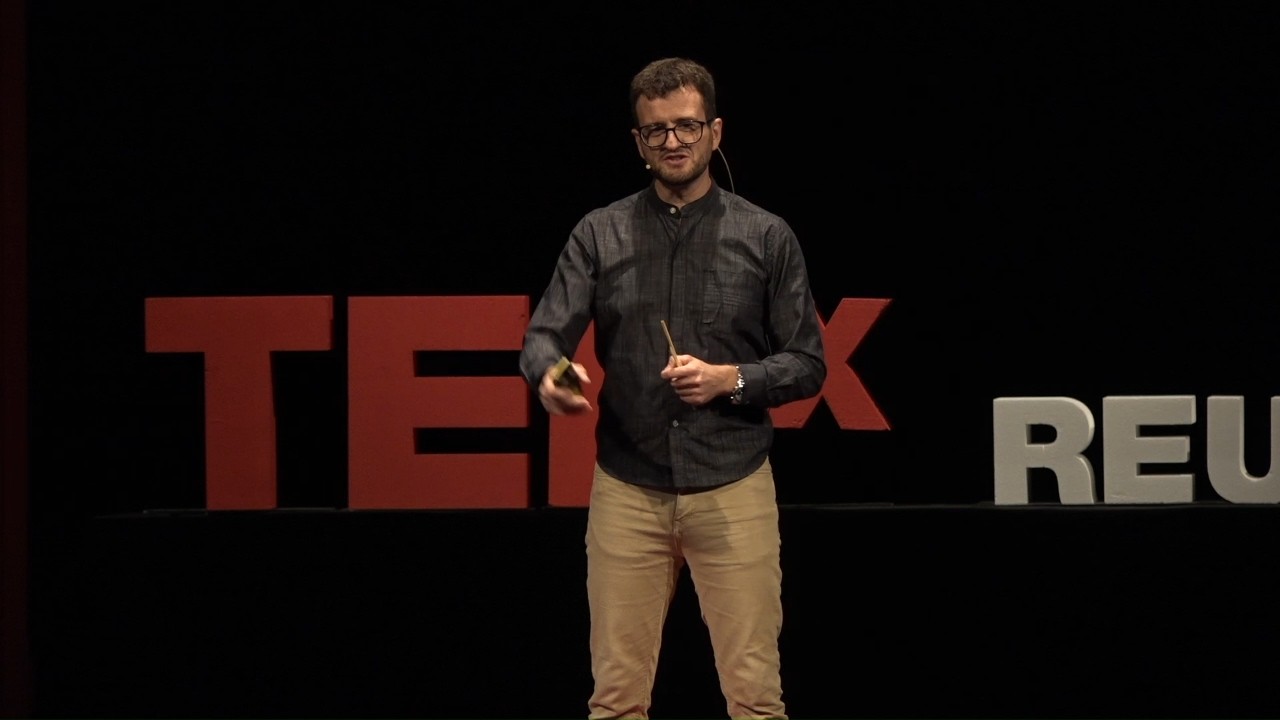
Canvi de freqüència: El soroll que cal travessar | Néstor Catalán | TEDxReus
Frequency change: The noise to cross | Néstor Catalán | TEDxReus
Keywords
Summary
309 words
Critical Evaluation
Value of the Information & Strength of the Argument
The informational value lies almost entirely in the biographical narrative: a career sequence (engineering studies, corporate executive position, leave of absence, first venture in Vietnam, closure, incubator, second venture, relocation) and in a few concrete observations, notably the image of a beach covered with plastic waste but without bottles, because bottles already have collectors and market value. That observation is the most substantive idea in the talk, since it identifies the economic mechanism behind the waste problem: the difficulty is not the existence of plastic but the absence of value for certain fractions. Beyond this, the content is essentially motivational. The reasoning is associative and metaphorical rather than demonstrative: the radio dial, the noise, the chopstick parable and the proverb about going fast alone and far together all serve to structure an emotional progression, not to establish claims. Causal links are asserted rather than argued, for instance that opportunities are always present but invisible unless one tunes to their frequency, or that a small change of direction can transform a life. No counter-examples are examined, no failed hypothesis is analysed in depth, and the closure of the first company is reported in a few sentences without drawing operational lessons. Nothing is quantified: no figures on plastic volumes, recycling rates, employment, turnover, material performance or environmental impact of the upcycling process. The persuasive force depends on the speaker’s personal credibility, on the narrative arc from discomfort to mission, and on the use of a shared cultural metaphor, which is effective rhetorically but leaves the listener with a moral injunction rather than with transferable knowledge. The talk is therefore valuable as a documented testimony of a career pivot and of the creation of a circular-economy venture, and weak as an argument about the environmental problem it claims to address.
Scientific Rigor, Source Quality, Title Accuracy
Scientific rigour is minimal, by the nature of the exercise: this is a TEDx personal story, not a research presentation. No study, dataset, report or expert is cited at any point, and the single link in the description points to the general TEDx page rather than to any documentary support. Environmental claims remain generic; the only quasi-empirical element is the photograph of a polluted beach, described explicitly as a real image and not AI-generated, and interpreted through the observation that bottles are absent because they are already collected. That interpretation is plausible and consistent with what is known about informal waste picking, but it is asserted without any reference that a viewer could verify. The same applies to the material process: the transformation of multi-material plastic waste into sheets and products is described functionally, with no indication of the process, its energy cost, its yield or the fate of the material at end of life. The source base is therefore reduced to the speaker’s own experience, which is legitimate as testimony but cannot be treated as evidence. On the title, the fit is good: the frequency-change metaphor announced in the title structures the entire talk, from the opening questions to the final call to turn the dial and cross the noise, and the talk delivers exactly the personal-transformation narrative that the title implies.
535 words
Title / Content Match
The title's radio metaphor (changing frequency, crossing the noise) is the narrative backbone used from the opening to the closing call to action, so the content matches the announced subject. The title promises a motivational/personal-transformation talk, which is exactly what is delivered, though viewers expecting the technical or environmental side suggested by the speaker's profile will find it only summarised.
Quality & Reliability
3/10
The talk is a first-person narrative built on personal recollection and metaphor rather than on data, measurements or cited literature. Its factual content is limited to verifiable biographical elements (engineering background, residence in Vietnam, founding of a plastic-upcycling company) that are not independently documented in the video. No figures, no study, no external reference are provided; the argument rests on the speaker's authority as founder and on rhetorical devices. As a testimony it is sincere and internally coherent, but it offers no evidential basis that a viewer could check.
Key Moments
Markers derived by PSI from the transcript: the creator did not define chapters.
- Opening metaphor: noise as an unknown territory one dares not cross, and the question of whether it is worth retuning one's current station.
- The 2014 starting point: a comfortable corporate career in a major advertising company, but a station whose music he no longer wants to hear.
- The decision to take a leave of absence and leave for Australia, presented not as following a dream but as responding to a discomfort.
- In New Zealand, he meets the management of his own company, is offered an immediate start, and declines because he still has no answers.
- Reflection while walking: what he is good at is making things happen, and what makes him happy is helping people, which becomes his criterion for choosing projects.
- In Vietnam, the bamboo-and-chopstick bicycle encounter and the chopstick parable about collaboration and collective strength.
- The first venture is closed by his partners, who tell him he works too much and that the project should remain a hobby.
- Discovery of the plastic mission: the image of a beach covered in waste but without bottles, revealing that value is what determines what gets collected.
- Founding in 2019, with an Argentine partner, of a project turning hard-to-recycle plastics into materials for furniture, architecture and social housing.
- Closing call to action: do not wait for all the answers, turn the dial, cross the noise, and let the melody you recognise play.
Cited Sources
- TEDx — official programme page — The only link provided in the video description; it documents the TEDx format and the independently organised local event, not any factual claim made in the talk.
Concurring Sources
- Circular economy — Wikipedia — General framework corresponding to the model described in the talk: turning waste fractions into secondary materials and products rather than discarding them.
- Plastic pollution — Wikipedia — Provides the documented background for the observation made in the talk about waste ending up on beaches in regions lacking efficient collection infrastructure.
Dissenting Sources
- Plastic recycling — Wikipedia — Documents the technical and economic limits of recycling, in particular the difficulty of processing multi-material and low-value plastics, and the low overall recycling rates. This does not contradict the speaker's account but qualifies the optimistic framing: upcycling niche waste streams is a real activity whose scalability and end-of-life material outcomes are constrained, points the talk does not discuss.
Contribution & Novelties
The talk’s original contribution is not conceptual but experiential: it documents, from the inside, the sequence by which a settled corporate professional converts a diffuse discomfort into a concrete mission, and it makes one genuinely useful observation — that the plastic left on beaches is precisely the plastic without market value, so the leverage point is the creation of value for unwanted fractions, not collection campaigns alone. The chopstick parable and the frequency metaphor are effective pedagogical devices for conveying that opportunity recognition depends on attention rather than on luck. The talk also shows the non-linear character of the process, including a venture closure, which is rarely narrated in motivational formats. Its limitation is that the environmental and business dimensions are asserted rather than demonstrated: no data on volumes processed, material properties, economic viability or impact.
Further reading:
- Circular economy — Wikipedia — Background framework for the value-creation-from-waste model the speaker describes.
- Plastic pollution — Wikipedia — Context for the beach waste observation and for the role of informal waste collection in regions without efficient infrastructure.
- Plastic recycling — Wikipedia — Useful counterpoint on the technical and economic limits of recycling multi-material plastics.
- The concept of informal waste pickers and the market value of recyclables — relevant to the speaker’s key observation that only waste with value is collected; no URL given as the exact reference could not be confirmed.
- Extended producer responsibility and material upcycling business models — relevant to assessing whether the described venture is economically viable at scale; no URL given as the exact reference could not be confirmed.
262 words
Radar Profile
The profile is lopsided: technical level and informational density are both low, since the talk is narrative and metaphorical, while the qualitative dimensions are slightly above that floor because the story is coherent and contains a few concrete, checkable observations. Reliability sits at a middling-low level, reflecting a well-structured but entirely self-referential testimony with no external sources. The overall shape is that of a communication-driven, low-evidence format.