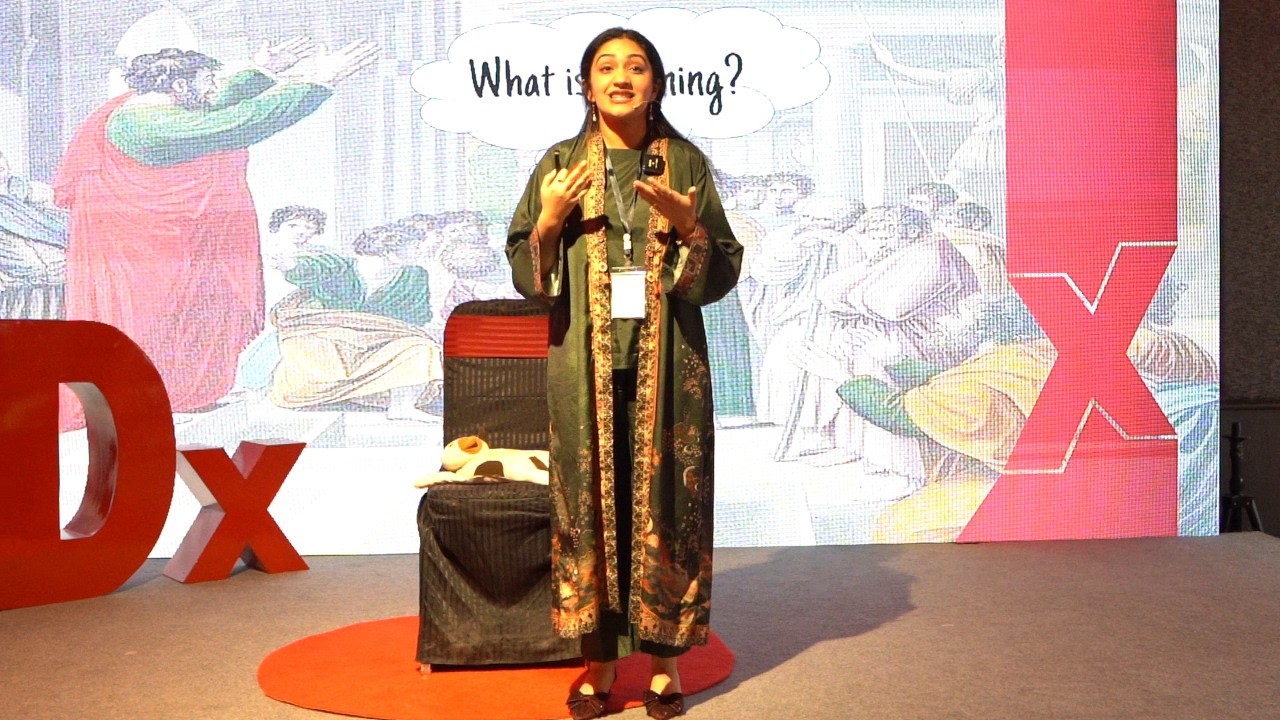
Curiosity Killed the Cat | Raheen Fatima | Raheen Fatima | TEDxThe City School Islamabad Youth
Title history
- Curiosity Killed the Cat | Raheen Fatima | Raheen Fatima | TEDxThe City School Islamabad Youth — observed on 20261112-0406 UTC (YouTube)
Keywords
Summary
138 words
Critical Evaluation
Value of the Information & Strength of the Argument
The talk offers an inspiring perspective on curiosity, intertwining personal anecdotes with a clear message about the importance of mindful inquiry and action. The argumentation is primarily anecdotal, relying on the speaker’s experiences and emotional appeals rather than empirical evidence. While compelling, it lacks rigorous support for its claims about education and curiosity. The speaker presents herself as a role model, but the lack of concrete data or external references weakens the scientific validity.
Scientific Rigor, Source Quality, Title Accuracy
The speaker does not cite formal academic sources, but references personal influences such as the Dalai Lama, the Socratic Experience, and her mentor Rehan Allahwala. The TEDx description provides only the generic TEDx link. The title is appropriately matched to the content, as the speaker directly addresses the proverb at the end, arguing that curiosity, when guided, is beneficial. No comments were provided for analysis.
154 words
Title / Content Match
The title cleverly references the proverb 'curiosity killed the cat,' which the speaker directly addresses at the end, explaining that uncontrolled curiosity can be harmful while guided curiosity is vital. The title is well-matched to the content.
Quality & Reliability
5/10
The talk is predominantly anecdotal, relying on personal experiences and storytelling rather than empirical evidence or formal citations. It offers an inspirational perspective but lacks rigorous scientific backing.
Key Moments
Markers derived by PSI from the transcript: the creator did not define chapters.
- Introduction of the topic of curiosity and the speaker's cat story.
- Story about meeting the Dalai Lama and how it shaped her view on curiosity.
- Discussion on the negative manifestations of curiosity and the need for judgment.
- Climate action work and partnership with Cartoon Network to turn awareness into action.
- Her educational philosophy and influence of Socratic learning and interviews.
- Creation of Elenkus and description of the pilot program in the mountains of Pakistan.
- Reinterpretation of the proverb and call to action, referencing a 2018 TEDx talk.
Cited Sources
- TEDx Talks — The talk was given at a TEDx event; this link provides information about TEDx.
Contribution & Novelties
The talk provides a personal and motivational argument for curiosity as a catalyst for innovation and personal fulfillment. It contributes to the discourse on education by emphasizing the importance of questioning and dialogue. The speaker’s creation of Elenkus illustrates a practical application of these ideas. For further exploration, consider the Socratic method, inquiry-based learning, and the concept of curiosity as a psychological trait.
Pour aller plus loin :
- Socratic method — A form of cooperative argumentative dialogue, relevant to the speaker’s educational approach.
- Inquiry-based learning — An educational method centered on questioning, aligning with the talk’s theme.
- Curiosity — The trait discussed in the talk, with psychological and philosophical dimensions.
110 words
Radar Profile
The radar profile suggests a moderate level of information, with lower technical depth and a moderate reliability score, reflecting the talk's anecdotal nature.