Keywords
Summary
238 words
Critical Evaluation
Value of the Information & Strength of the Argument
The value of the information lies chiefly in the first-hand account of a media episode that is well documented in the press and that illustrates, in concrete terms, how quickly a woman scientist’s competence can be displaced by commentary on her body. The talk supplies a vivid case study of the ‘double bind’ — the impossibility of finding an acceptable appearance — and of the rhetorical use of irony as a way to strip authority from prejudiced statements. It also offers an insider’s view of the commercial pressure that follows virality, including the decision to refuse lucrative offers, which is a useful and rarely discussed data point. The argumentation, however, is rhetorical and narrative rather than empirical. It rests on a single anecdote, with no statistics, no review of research on gender bias, and no attempt to test alternative explanations. The physics is used analogically: the ‘superposition’ of being both feminine and competent, the propagation of waves versus noise. These metaphors are elegant and heuristically useful, but they are not evidence. The speaker acknowledges this limitation with self-deprecating humour, noting that she did not dismantle patriarchy with three Instagram posts. Overall, the argument is coherent and honest, but its solidity is that of a well-told testimony, not of a demonstrated thesis.
Scientific Rigor, Source Quality, Title Accuracy
The talk contains no formal citations, no references to peer-reviewed studies and no data. The sources implicitly invoked are personal experience, press coverage (Corriere della Sera, Repubblica, La Stampa, The Guardian, Clarín, The Times) and cultural references (Einstein, Planck, Schrödinger, Heisenberg, Marie Curie, Hedy Lamarr, The Big Bang Theory). These are mentioned by name but not documented in the talk; the only link provided in the description is the generic TEDx website. The speaker’s claims are for the most part empirically checkable — the ceremony, the viral video and the newspaper articles genuinely exist — but the talk itself does not supply the means to check them. The reasoning is internally consistent and the speaker openly flags the limits of her own intervention. On the title/content relationship, the title is accurate about the central theme, though it slightly oversells the physics: the talk is a reflection on gendered authority in science, with quantum mechanics as a framing device rather than a subject of exposition. The discrepancy is minor and does not mislead about the talk’s real subject.
403 words
Title / Content Match
The title is faithful to the content: the talk centres on the viral dress episode and on the invisible mechanisms of judgement it exposed. The 'physics' in the title is largely a framing device, since the actual physics discussed is minimal.
Quality & Reliability
7/10
First-person testimony from a trained physicist and science communicator, with concrete, in principle verifiable events (a public ceremony, press coverage). The account is coherent and self-critical, but it remains anecdotal: no data, no systematic evidence on gender bias, and the scientific content is mostly metaphorical. Claims about media coverage and commercial offers are plausible but unverified within the talk.
Key Moments
Markers derived by PSI from the transcript: the creator did not define chapters.
- Greison describes being invited as guest of honour to a graduation ceremony in Taormina and writing a speech on quantum physics, responsibility and the future.
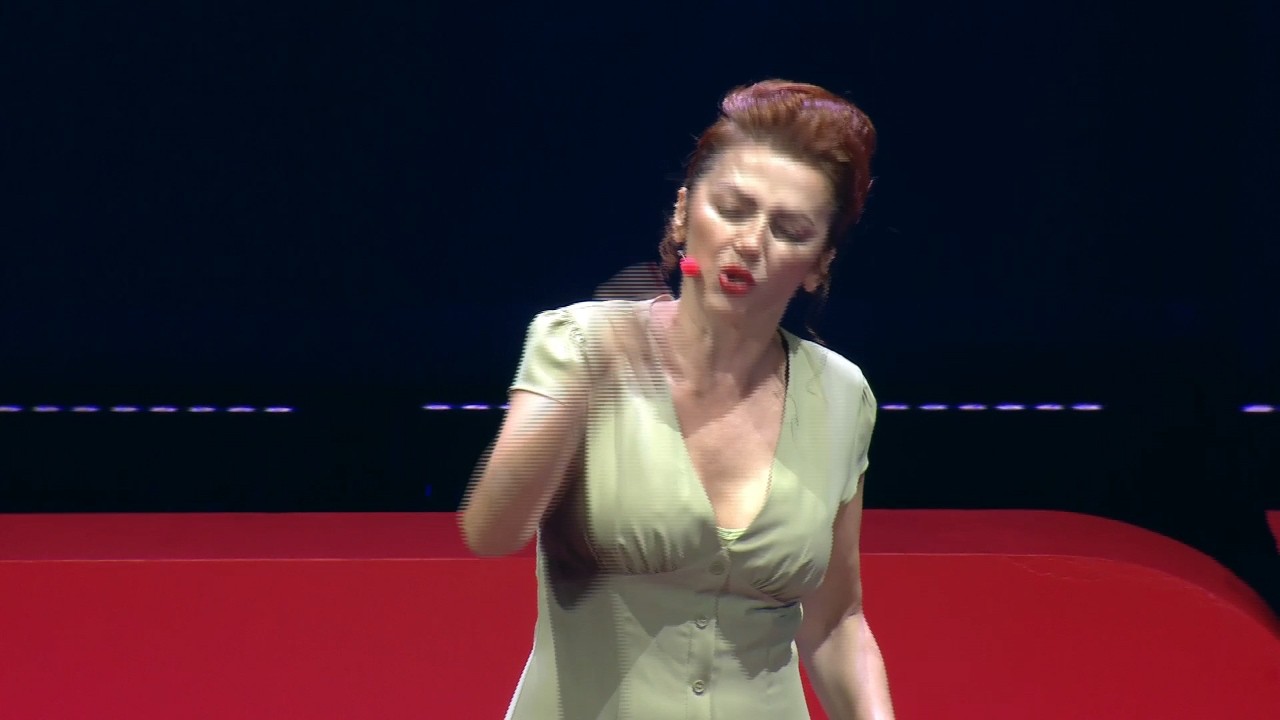
- Preparing for the trip in 44-degree heat: tying her hair back, adding extensions, and choosing a light green dress.
- At Linate airport she records an Instagram video about the ceremony; during the flight, comments about her dress begin to accumulate.
- On arrival she is rushed through a tight schedule and changes into a red dress, which she ironically calls an 'escalation'.
- She delivers the speech to more than six thousand students; it is well received, and she spends over an hour meeting the audience.
- The next morning she discovers she has become a national and international news story, with coverage focused on her neckline rather than her speech.
- She explains her use of irony as a tool that removes authority from things claiming too much, and describes responding to hostile comments.
- A catalogue of absurd commercial offers (beauty treatments, dental care, personal training) illustrates how virality is monetised.
- She reveals that she refused around €200,000 in advertising and media offers, choosing not to remain in the spotlight for the wrong reason.
- Closing metaphor: noise fades while waves propagate; she urges the audience to be waves, not walls.
Cited Sources
- TEDx — official programme page — The only external link provided in the video description; it documents the independent TEDx format under which the talk was given.
Concurring Sources
- Women in science — Wikipedia — Documents persistent structural biases and the gendered image of scientific authority discussed in the talk.
- Matilda effect — Wikipedia — Describes the systematic underestimation of women's scientific work, consonant with Greison's account of credibility being withheld.
Contribution & Novelties
The talk’s originality lies less in its thesis than in its framing: a physicist uses the vocabulary of her discipline — superposition, wave propagation, noise — to describe a social experience, and does so with enough self-deprecation to avoid didacticism. The most distinctive contribution is the public disclosure of the commercial offers refused, which quantifies the pressure to convert a gendered scandal into income and shows a concrete alternative trajectory. The insistence on the ’no’ as an invisible but decisive act is a useful counterpoint to the usual narratives of viral success. The final distinction between noise and waves offers a portable heuristic for responding to online hostility without pretending it does not exist.
Pour aller plus loin :
- Women in science — Overview of the structural and historical context behind the bias described in the talk.
- Matilda effect — Names the mechanism by which women’s scientific contributions are attributed to men, directly relevant to the question of whose authority is recognised.
- Hedy Lamarr — The actress and inventor cited in the talk as an example of a woman combining beauty and technical genius.
- Schrödinger’s cat — The thought experiment used as a metaphor for the demanded ‘superposition’ of femininity and competence.
202 words
Radar Profile
The profile is that of a talk rich in human and media insight but deliberately light on technical content: high on personal testimony and rhetorical skill, low on formal physics exposition. Reliability is supported by the speaker's professional background and by the checkability of the public events described, while the information density remains modest because the argument is carried by a single narrative.