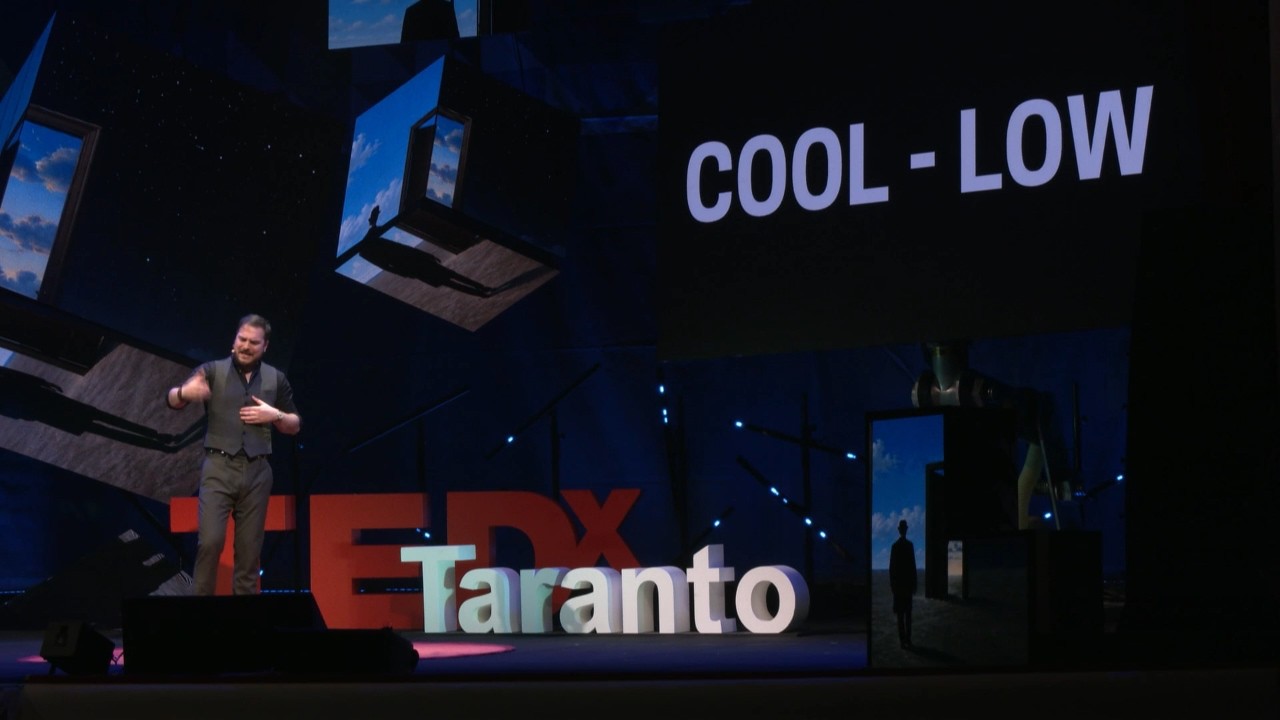
Fa ciò che ami in inglese per imparare senza fatica | Matteo Scarpellini Teo The Teach | TEDxTaranto
Do what you love in English to learn effortlessly | Matteo Scarpellini Teo The Teach | TEDxTaranto
Keywords
Summary
339 words
Critical Evaluation
Value of the Information & Strength of the Argument
The informational value of the talk lies less in facts than in a set of usable distinctions. The separation between strain and commitment is genuinely operational: it gives a name to the difference between study that is abandoned and study that is sustained, and it is offered with a concrete criterion — the presence or absence of a negative charge attached to the activity — rather than as a slogan. The fly metaphor does real analytical work, because it locates failure in the choice of obstacle rather than in the learner’s capacity, and it is applied consistently to the school case, the expatriate case and the case of the learner who succeeds. The diagnosis of the school system is specific enough to be debated: English is taught as a body of knowledge rather than as a motor and articulatory skill, with the guitar-and-tendons analogy carrying the argument. The inversion at the end — do not learn the language in order to reach your passions, reach your passions in the language — is a clean reframing with practical consequences for how practice time is allocated. The argumentation, however, is built almost entirely on biographical anecdote and on one speaker’s teaching intuition. The causal claim that those who studied English at school are worse off than those who did not is a broad generalisation supported by nothing in the talk. The observation that a fly eventually finds the opening is offered as a model of deliberate, planned action and then immediately conceded to have been luck, which weakens the lesson drawn from it. The Dungeons & Dragons sequence and the community-based group classes are described as effective but with no account of who was taught, for how long, or how progress was assessed. The 4-to-8-in-four-months figure is the only quantitative element and arrives without method, sample or baseline. The talk is therefore coherent and persuasive at the level of framing, and thin at the level of demonstration: it convinces as testimony, not as evidence.
Scientific Rigor, Source Quality, Title Accuracy
Scientific rigour is the weakest dimension. The speaker invokes a research literature twice — ’there are plenty of studies about it’ regarding learners who acquired English through music and games — but names no author, no journal and no finding, so the audience has no way to check whether the literature says what he implies. The only external resource referenced is TED itself, cited as a source of well-made subtitles rather than as a body of knowledge, and the description’s single non-promotional link is the generic TEDx programme page, which documents the event format and not any claim made on stage. Nothing resembling a controlled observation is presented: the teaching outcomes are recollections, the progress figures are unmeasured, and the central diagnosis of schooling rests on the speaker’s own experience and on his impressions of former classmates. There is no engagement with the possibility that explicit grammar instruction has documented effects, nor with individual differences in language aptitude, both of which bear directly on the thesis advanced. On the positive side, the talk is intellectually honest in two places: it explicitly credits the teachers who keep the current system working, and it concedes that the fly’s success was partly luck rather than pure method. The fit between title and content is strong — the announced inversion of learning order is precisely what the talk argues and concludes with — and this element supports rather than inflates the overall assessment. The overall impression is of a well-crafted pedagogical manifesto with no apparatus behind it.
600 words
Title / Content Match
The title promises a method for learning 'without effort' by doing what you love in English, and the talk delivers exactly that inversion as its closing thesis. The match is direct and honest.
Quality & Reliability
3/10
The talk is a personal narrative built on pedagogical conviction rather than evidence. No study is named, no figure is dated or sourced, and the one quantitative claim (learners moving from 4/10 to 8/10 in four months) is presented without any measurement protocol, sample or control. The framework itself — comprehensible input, intrinsic motivation, language anxiety — is consistent with an existing research literature, but the speaker only alludes to it ('there are plenty of studies about it') and the sole link supplied is the generic TEDx programme page. The reasoning is internally coherent and the metaphors are well constructed, but nothing in the talk is externally corroborated, which caps credibility.
Key Moments
Markers derived by PSI from the transcript: the creator did not define chapters.
- Opening: the speaker introduces himself as an English teacher who could not speak English until 21 and jokes that he has no business being on the stage.
- The 'frontier' metaphor: a border to be crossed, perceived as a wall, with a toll that learners believe must be paid in suffering.
- The key conceptual distinction: 'fatica' (strain — actions you resent and rarely finish) versus 'impegno' (commitment — the same actions without the negative charge).
- The fly at the half-open window: it sees the light, aims for it, and hits the glass, a stand-in for the learner attacking the wrong obstacle.
- London: he loses his first two jobs because he cannot understand customers or make himself understood, and cries under a waterfall.
- Critique of schooling: pupils conclude 'I am hopeless at languages' after bad marks, while he claims those who never studied English at school often cope better abroad.
- Core thesis: English is taught as a theoretical subject when it is a physical skill, to be trained like karate or a musical instrument; the guitar-versus-fast-typing analogy.
- The 'other fly': the classmate who sang songs and translated Final Fantasy VI with a dictionary, accumulating input through passion rather than through study.
- Adult learners: fear of judgement dominates, so he changes tone on social media and turns group classes into a community where learners discuss their passions with each other.
- Closing inversion: do not learn English in order to do what you love — do what you love in English.
Cited Sources
- TEDx programme — official event format page — The only non-promotional link in the description; it documents the TEDx format under which the talk was given, not any of the pedagogical claims made on stage.
Concurring Sources
- Input hypothesis — Wikipedia — Supports the talk's central mechanism: that large volumes of comprehensible, personally relevant input drive acquisition more than formal study of rules.
- Self-determination theory — Wikipedia — Provides the theoretical grounding for the speaker's claim that intrinsically motivated engagement is sustained where externally imposed effort collapses.
Dissenting Sources
- Research on instructed second-language acquisition (e.g. Norris & Ortega, 2000, meta-analysis of instruction effectiveness) — This body of work finds measurable, durable effects of explicit and form-focused instruction, which qualifies the talk's framing of grammar study as simply the wrong category of activity. The speaker presents classroom teaching as structurally broken without engaging this evidence; the cited address is omitted because no single stable link is supplied here.
- Individual differences and language aptitude research — The talk attributes the belief 'I am hopeless at languages' almost entirely to schooling and to fear of judgement. Work on aptitude, phonological working memory and phonological awareness documents stable individual variation in second-language attainment that is not reducible to teaching method, and the talk does not address it.
Contribution & Novelties
The talk’s originality is rhetorical and pedagogical rather than empirical. It contributes a compact vocabulary for a familiar problem: the distinction between strain and commitment, which reframes the dropout learner as someone who was paying the wrong toll rather than as someone lacking talent, and the fly metaphor, which relocates failure from the person to the chosen obstacle. The practical inversion at the end — reach your passions in the target language instead of waiting to master the language before reaching them — is a genuinely usable instruction that reverses the usual sequencing of study and use. The teaching devices described, notably the role-playing game that lets a teenager speak through a character rather than in his own name, are concrete and transferable design ideas for reducing the fear of judgement. What the talk does not contribute is new evidence: the mechanisms it describes are largely convergent with established thinking on comprehensible input, intrinsic motivation and language anxiety, and it presents them as a personal discovery rather than as a position within that literature.
Further reading:
- Second-language acquisition — Overview of the research field the talk gestures toward without ever citing.
- Input hypothesis — Krashen’s comprehensible-input model, the closest theoretical backbone to the claim that exposure through passion does the work.
- Language immersion — The literature on immersion, which is effectively what the speaker’s London years amounted to informally.
- Self-determination theory — Framework on intrinsic versus external motivation, directly relevant to the strain/commitment distinction.
- Communicative language teaching — The mainstream approach that already formalises much of what is presented here as a discovery.
- Deliberate practice (Ericsson) — cited by name only, as the ’train it like karate’ claim is closer to skill-acquisition research than the talk acknowledges.
287 words
Radar Profile
The profile is asymmetrical: accessibility and conceptual framing are high, while technical depth, sourcing and evidential quality sit low. This is the signature of a persuasive personal-manifesto talk rather than of a research-based presentation — strong on usable ideas and memorable metaphors, weak on anything the listener could independently verify.