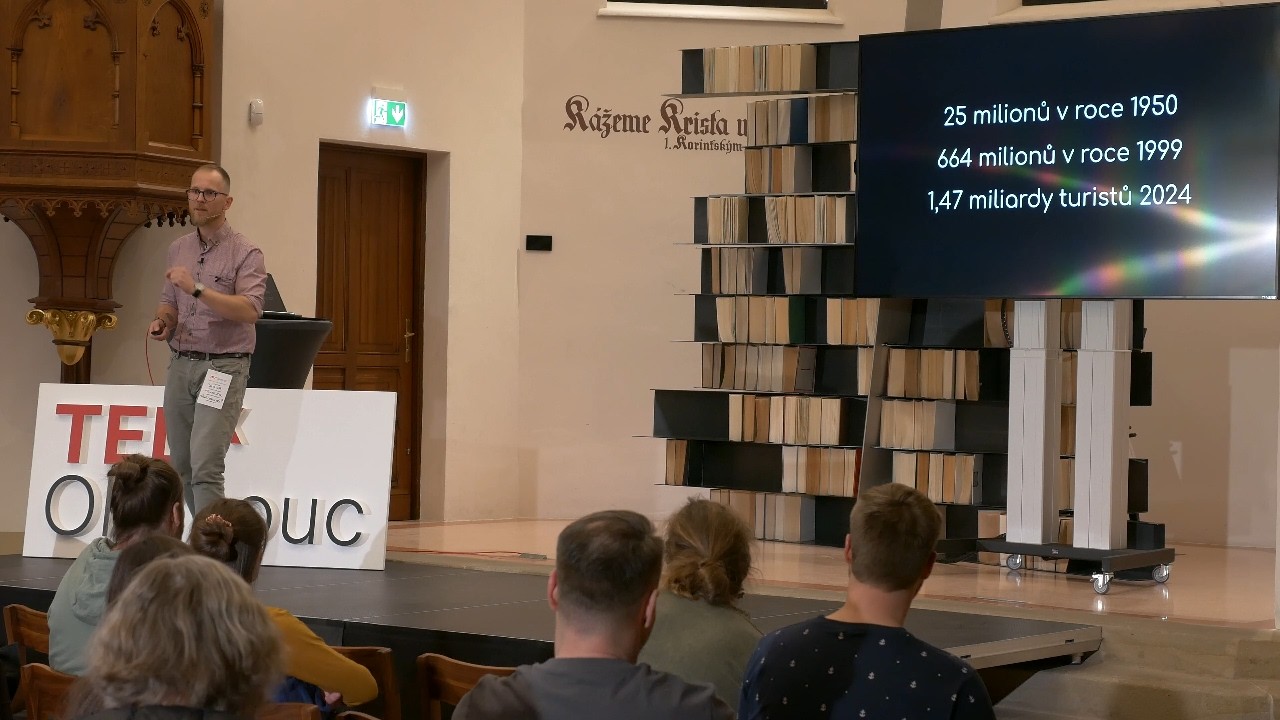
Etická rovnováha cestování | Jiří Kalát | TEDxOlomouc
Ethical balance of travel | Jiří Kalát | TEDxOlomouc
Title history
- Etická rovnováha cestování | Jiří Kalát | TEDxOlomouc — observed on 20261101-0409 UTC (YouTube)
Keywords
Summary
147 words
Critical Evaluation
Value of the Information & Strength of the Argument
The talk offers valuable practical advice on sustainable travel based on the speaker’s extensive personal experience. The argumentation is coherent and well-structured, moving from a critique of overtourism to positive, actionable solutions. The speaker’s passion and concrete examples strengthen the credibility of his message, though the reasoning is largely anecdotal rather than data-driven. The emphasis on the economic benefits of local spending and the negative impacts of mass tourism is compelling and aligns with broader discussions on sustainable development.
Scientific Rigor, Source Quality, Title Accuracy
From a scientific standpoint, the talk does not present original research or cite academic literature; it is an expert opinion informed by real-world observations. The only source referenced is the TEDx platform itself. The statistical figures mentioned (e.g., tourist numbers from 1950 to present) are plausible but not attributed to specific studies. The title accurately matches the content, focusing on the ethical balance of travel. The speaker’s authority comes from his teaching background and travel experience rather than formal credentials in tourism studies.
177 words
Title / Content Match
The title 'Ethical Balance of Traveling' accurately reflects the content, which focuses on achieving a balance between the benefits and negative impacts of travel.
Quality & Reliability
6/10
The talk is an opinion-based reflection on ethical travel, mixing personal anecdotes with some general statistics (e.g., tourist numbers). No formal scientific sources are cited; the argumentation relies on practical experience and common sense. The statistical figures are plausible but unverified.
Key Moments
Markers derived by PSI from the transcript: the creator did not define chapters.
- Introduction: contrast between large tourist venues and intimate spaces in Olomouc.
- Reflection on happiness in sparsely populated places like Greenland and the hike from Beroun to Aš.
- Focus on Morocco: example of cheap flights leading to overcrowding and negative effects.
- Differentiation between tourism and travel, emphasizing that mass tourism exploits local communities.
- Practical rules: choose local guides, eat where locals eat, avoid tourist traps, and travel at off-peak times.
- Encouragement to buy local crafts and support NGOs like Mines Advisory Group; emphasize leaving a positive legacy.
- Conclusion: quote by Steve Jobs about changing the world, and a call to adopt an ethical travel mindset.
Cited Sources
- TEDx Talks — The talk was given at a TEDx event; the link provides general information about the TEDx program.
Concurring Sources
- TEDx Talks — The official TEDx platform is consistent with the talk's context, though it does not provide scientific validation.
Contribution & Novelties
The talk brings a personal, hands-on perspective to sustainable travel, bridging classroom teaching and real-world practice. It offers simple, memorable rules that travelers can implement immediately, such as seeking ‘second-best places’, supporting local businesses, and choosing ethical souvenirs. The originality lies in the emphasis on the ethical dimension of travel and the responsibility of individual travelers to leave a positive impact.
Pour aller plus loin :
- Overtourism — Provides a broad overview of the phenomenon and its impacts, directly relevant to the talk’s critique.
- Sustainable tourism — Discusses principles of sustainable tourism, aligning with the talk’s recommendations.
- Local multiplier effect — Explains how spending locally benefits the host community, a core argument in the talk.
- Community-based tourism — Offers further reading on tourism models that involve local communities, echoing the talk’s advocacy.
132 words
Radar Profile
The radar profile shows moderate scores in information quantity and quality, reflecting the talk's rich anecdotal content but limited scientific depth. Technical level is low, indicating accessibility. Reliability is moderate, as the arguments are based on personal experience and common sense rather than cited research. Overall, the talk is inspiring but not a rigorous academic source.