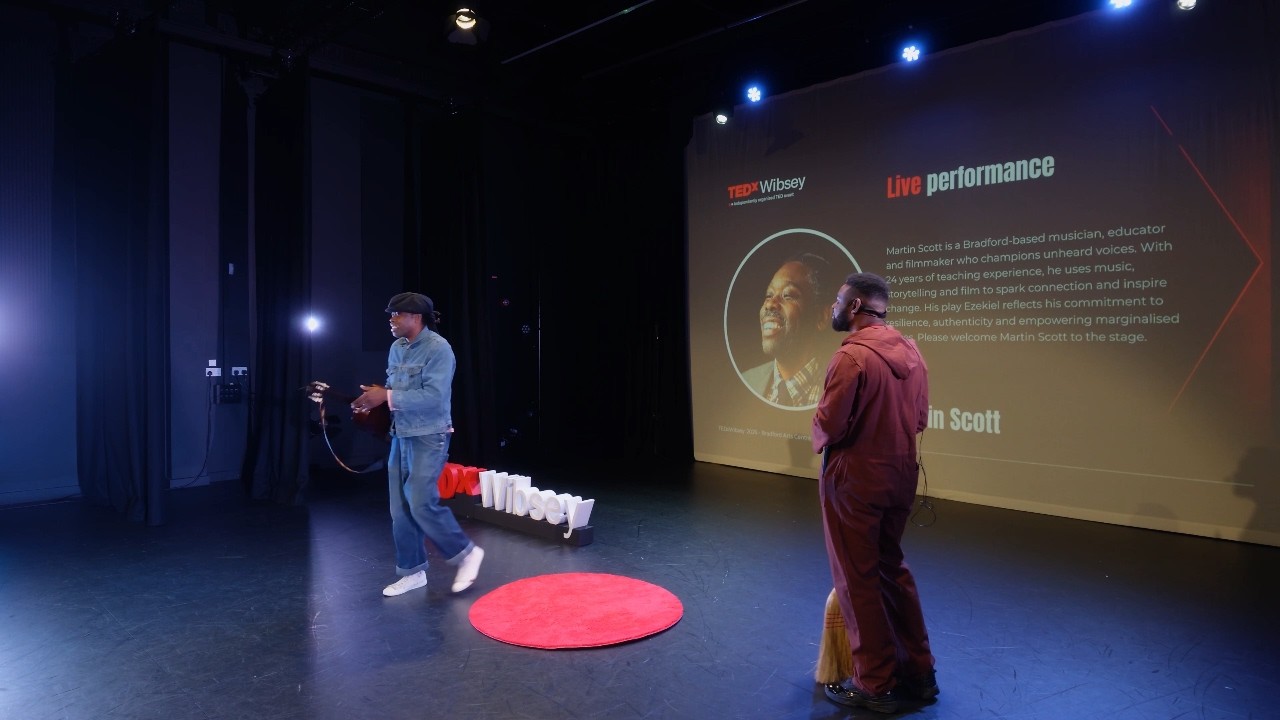
Ezekiel | Martin Scott | TEDxWibsey
Keywords
Summary
309 words
Critical Evaluation
Value of the Information & Strength of the Argument
The informational yield is deliberately modest: over roughly eleven minutes the viewer receives a handful of narrative propositions - a child sold at five, a manumission revoked by a court, a preacher who intervened, a hymn sung in a public hall - none of which is dated, localised, attributed or sourced. These are the standard furniture of antebellum slave narrative, and their plausibility rests on genre familiarity rather than on documentation; nothing in the performance allows a listener to distinguish a documented case from a composite. What the piece does supply is a structure of feeling: the mechanics of inheritance are made concrete through naming (Eliza choosing ‘Isaiah’ over the calendar months ‘Juno’ and ‘Augustus’, so that ‘my story is history’), through the transfer of a song from one body to another, and through the shift of the addressee from the stage to the room. The argument is therefore enacted rather than stated, and its central claim - that a freed person’s descendants and a historical captive can form a coalition across time, and that ’the songs of the free are the stories of the dead’ - is carried entirely by rhetorical means: stichomythic exchange in rhymed couplets, anaphora, a Socratic prompt (‘what song did you sing that night?’), the deliberate quotation of Hamlet’s ’to be or not to be’ transposed into ’to rise or to kneel’, and a repeating chorus that does the work a conclusion would do in an argumentative talk. The reasoning is internally coherent and emotionally efficient, and the dramatist’s craft is real; but as an argument it is circular in the way art may legitimately be circular: the song is shown to free because the singing is shown to move, and no independent warrant is offered. There is effectively no counter-argument, no alternative reading of the historical record, and no discussion of the evidentiary problems the material raises - notably that the narrator describes being owned by a Black master, a genuine and under-discussed feature of the record, which is asserted in passing and never examined. The performance is best assessed as a well-made piece of affective public history whose value lies in the transmission of memory and in the invitation to identify, not in the production of knowledge that could be checked, contested or built upon.
Scientific Rigor, Source Quality, Title Accuracy
No source is invoked anywhere in the segment: no archive, no bibliography, no historian, no statute, no location or date accompanies the events recounted, and the single external link in the description is the generic TEDx format page. The historical material is therefore presented on the authority of the performer alone, which is legitimate for a devised play but leaves the factual status of every claim unspecified. Two borrowings deserve note: the refrain ‘stand by me … in the standing’ is built on a well-known twentieth-century song, and the character’s meditation on ’to be or not to be’ quotes Shakespeare directly; both are used without attribution, which is unproblematic on stage but blurs further the boundary between document and composition. The names themselves advertise their constructedness - ‘John Cale Martin’ is the author’s own name, softened by a middle initial, and the mother’s alternative name ‘Freeman’ is a transparent allegorical device - so the audience is not, in fairness, being invited to read the piece as testimony. On the relation between label and content, the heading matches what is delivered: ‘Ezekiel’ is the protagonist, the ‘haunting of freedom’s song’ is literally the sung motif that recurs at the opening, the midpoint and the close. The only friction is generic, since a viewer arriving for a TEDx talk will find a performed excerpt with no framing remarks, no contextualisation of the play, and no statement of sources, meaning that the most informative elements - the play’s provenance, the historical basis for the Reed episode, the reason for choosing St George’s Hall as the setting - remain outside the video.
665 words
Title / Content Match
The title 'Ezekiel' names the central character, and the sung motif of a haunting freedom song is indeed the spine of the piece, so the label is accurate. It should nonetheless be read as an excerpt of a stage play rather than a conventional talk.
Quality & Reliability
5/10
The talk is an explicitly imaginative, artistic reconstruction rather than a documentary or academic account: no dates, locations, statutes, archives or historians are cited, and the protagonist-narrator is presented as an invented voice ('John Cale Martin ... my mama called me Freeman'). The historical backdrop (auction of a five-year-old child, a freedman re-enslaved after a court upheld a family's claim, a Reverend McCabe intervening) is broadly plausible for antebellum America but remains unverified and unattributed within the video. There is no factual error of the misinformation kind, but the evidentiary value is very low: the register is theatrical and the truth-claims are emotional and symbolic, not empirical.
Key Moments
Markers derived by PSI from the transcript: the creator did not define chapters.
- Opening a cappella lament: 'I was a poor boy born in captivity', which sets out the freedom motif in song.
- The visitor materialises and introduces himself as John Cale Martin, adding that his mother called him 'Freeman'.
- Exchange on identity and the song in the heart; Ezekiel is invited to speak his own name and story.
- Ezekiel recounts his mother Eliza and the naming of the three brothers, Juno, Augustus and Isaiah.
- Sold at five on the auctioneer's block to Backus Reed; manumitted on his master's death, then reclaimed by the family.
- The court upholds the family's claim and he is returned to bondage: 'freedom is a fragile thing'.
- The arrival of Reverend McCabe, described as the turning point that taught him what freedom's name meant.
- Transposition of 'to be or not to be' into 'to rise or to kneel', leading into the hymn.
- The 'stand by me / in the standing we are free' chorus begins, answered between the two voices.
- Closing address to the room - 'I am free because you believe' - and the final reprise of the refrain.
Cited Sources
- TEDx - official programme page (format reference given in the video description) — The only link supplied with the video; it documents the independently organised TEDx format in which the performance was given and carries no historical or factual reference.
Concurring Sources
- Stand by Me (song) — Confirms that the closing refrain used in the performance is an adaptation of an existing, widely recorded song rather than an original composition, supporting the reading of the piece as layered borrowing.
- Book of Ezekiel — Confirms the prophetic resonance of the protagonist's name and the scriptural register on which the dialogue's imagery of dry bones and restoration draws.
Contribution & Novelties
The distinctive contribution is formal rather than factual: a working teacher and playwright uses the TEDx slot not for an explanatory talk but for an extract of his own devised musical drama, staging the intergenerational transmission of a freedom song instead of describing it. The two-hander structure - a contemporary visitor who knows the archive meeting a nineteenth-century captive who knows only the song - turns historiography into dialogue, and the insertion of a hall (St George’s Hall, Bradford) as the scene of the singing binds the performance to a real local venue with its own concert history. The piece also gives room to a detail rarely foregrounded in popular treatments of American slavery: the narrator’s owner is himself a Black man born free, a complication the play states without commentary. Originality lies in the fusion of rhymed verse, spiritual-derived refrain and direct address, and in the decision to let the audience’s belief be named as the condition of the protagonist’s freedom.
Pour aller plus loin :
- Stand by Me (song) — The refrain reworked in the closing chorus derives from this well-known song; the page documents its composition and its long history of adaptation.
- Book of Ezekiel — Source of the prophetic name given to the protagonist and of the ‘dry bones’/‘valley of shadows’ imagery the dialogue alludes to.
- Spirituals — Genre context for the idea that a religious song functions as a coded vehicle of endurance and hope; useful to assess how the invented hymn relates to documented repertoire.
- The antebellum slave narrative genre (Douglass, Jacobs) and its conventions of naming, auction scenes and revoked manumission — a comparison point for judging which elements of the play are inherited topoi and which are inventions.
- The history of St George’s Hall, Bradford, as a concert and assembly venue — relevant to the play’s choice of setting and to the local framing of the performance.
315 words
Radar Profile
The profile is that of a crafted artistic performance rather than an informational talk: technical density and informational yield sit low, while the assessed quality of the content and its overall reliability sit mid-range because the piece is coherent and honest about being imaginative but offers nothing checkable. The shape is therefore flat on the quantitative axes and slightly raised on the qualitative ones, reflecting a well-executed work with a thin evidentiary base.