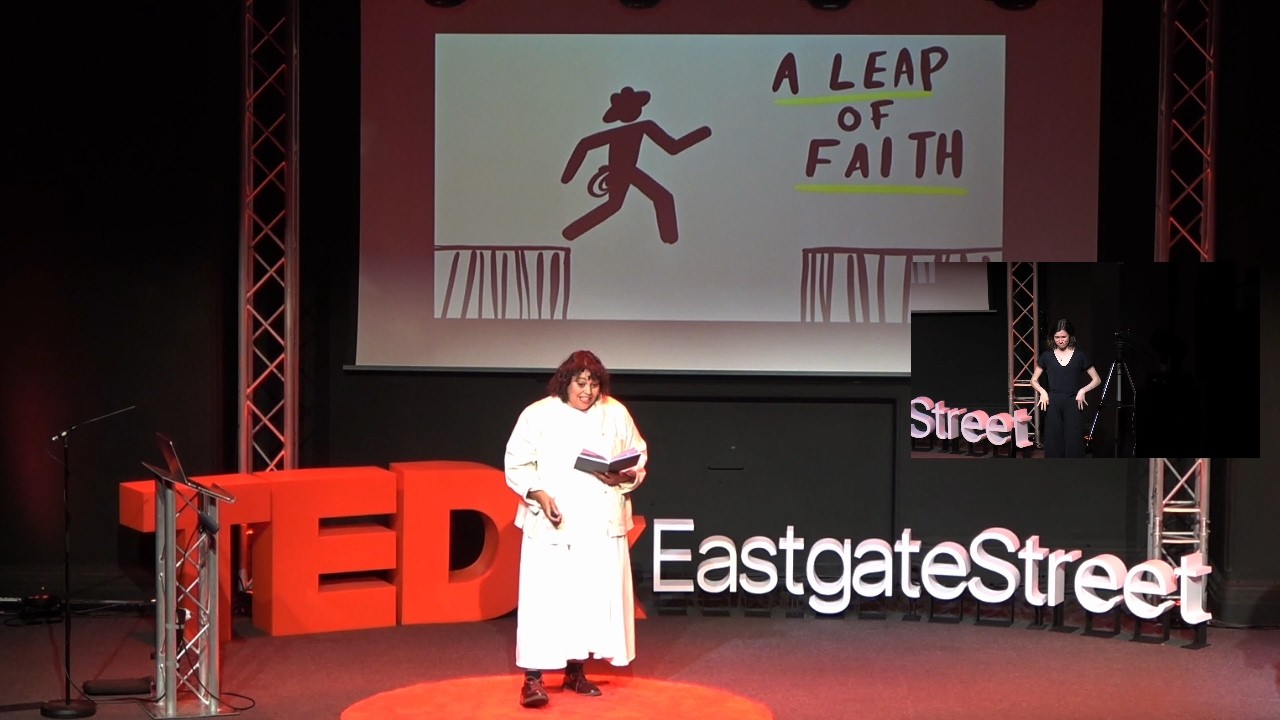
How Unremarkable Artists can Reimagine Arts Funding(with BSL) | Jemma Skidmore | TEDxEastgate Street
Title history
- How Unremarkable Artists can Reimagine Arts Funding(with BSL) | Jemma Skidmore | TEDxEastgate Street — observed on 20261117-1643 UTC (YouTube)
Keywords
Summary
163 words
Critical Evaluation
Value of the Information & Strength of the Argument
The talk provides a compelling personal testimony that illustrates the real-world challenges of arts funding. Skidmore’s use of the ‘snakes and ladders’ board game effectively represents the unpredictable nature of a creative career, making abstract structural issues tangible. She supports her narrative with a few statistics (e.g., 8% working class artists, 47% income decline) and references the Ireland UBI pilot to propose a concrete solution. However, the argumentation is primarily anecdotal; she does not deeply analyze counterarguments or alternative funding models, and her proposed ‘radical idea’ is not new but echoes existing discussions about basic income in the arts.
Scientific Rigor, Source Quality, Title Accuracy
The talk references the 2024 DAX report and the Ireland basic income pilot but does not provide direct citations or URLs within the video. The sole external link provided in the description is to TEDx’s general page, which is not specific to the data mentioned. The title accurately captures the theme, and the content stays focused on rethinking arts funding, though the lack of verifiable references limits its scientific rigor. The inclusion of a BSL interpreter indicates an inclusive production but does not affect the content quality.
201 words
Title / Content Match
The title accurately reflects the talk's focus on how ordinary artists can influence arts funding, though the word 'reimagine' is more aspirational than prescriptive.
Quality & Reliability
6/10
The talk relies on personal anecdotes and a few reported statistics (e.g., 8% working-class artists, 47% income decrease, 80% unstable earnings) without direct citations to primary studies. The inclusion of the 2024 DAX report and the Ireland basic income pilot adds credibility, but most claims are unverifiable within the video itself.
Key Moments
Markers derived by PSI from the transcript: the creator did not define chapters.
- Introduction: The world of unremarkable artists and the joy of making.
- Story of artist Alan Jack and his welded sculptures inspiring the speaker as a child.
- Introduction of the 'snakes and ladders' metaphor for artistic career instability.
- 2009 financial crisis and moving to London with £50; scraping by with housemates.
- Experience in film production; reveals that only 8% of artists and film workers are working class.
- Move to Vancouver, financial stability, but burnout and loss of creative spark.
- Return to the UK, restarting as a children's book illustrator; falling into debt and mental health struggles.
- Discovery of Jolt Studios and the support that helped restore creativity; mention of 2024 DAX report stats.
- Mentions the low grant acceptance rates and the inefficiency of pitching; calls for systemic change.
- Discussion of Ireland's basic income pilot for artists and the positive outcomes; closing call to action.
Cited Sources
- TEDx Program — The talk was delivered at a TEDx event, and this link is the only external reference provided in the video description.
Concurring Sources
- TEDx Program — The talk is part of the TEDx series, which promotes ideas worth spreading; this context aligns with the speaker's aim to advocate for arts funding reform.
Contribution & Novelties
The talk offers a personal, accessible narrative about the structural barriers in arts funding, using the ‘snakes and ladders’ metaphor to illustrate the precariousness of creative work. It argues that stability is a prerequisite for creativity, citing the Ireland basic income pilot as evidence. While the ideas are not entirely original, the speaker’s concrete experiences and local perspective (Gloucester) ground the discussion in real-world realities. The invitation to support ‘unremarkable’ artists as a way to foster innovation is a valuable reframing of cultural value.
Pour aller plus loin :
- Basic income for artists: The Irish pilot programme (2022) is referenced in the talk; more information can be found via Irish government sources or articles on basic income experiments. No stable URL provided.
- DAX report (Design and Artists Copyright Society) on artist incomes: The 2024 report mentioned is a key source, but its exact URL is not available; search for ‘DAX report 2024 artist income UK’.
- Jolt Studios (Culture Trust): The charity that supported the speaker; their website is likely joltstudios.co.uk but not verified.
- Creative economy statistics: The UK creative industries contribution of £145 billion is often cited by DCMS; check gov.uk for official figures.
- Indiana Jones’ leap of faith — A cultural reference used to metaphorically describe freelancing risks.
209 words
Radar Profile
The radar profile shows a moderate level of information quantity and quality, with a relatively low technical depth. The speaker's personal story and advocacy are strong on relatability but weaker on rigorous empirical backing, resulting in a balanced but not exceptional profile for a TEDx talk.