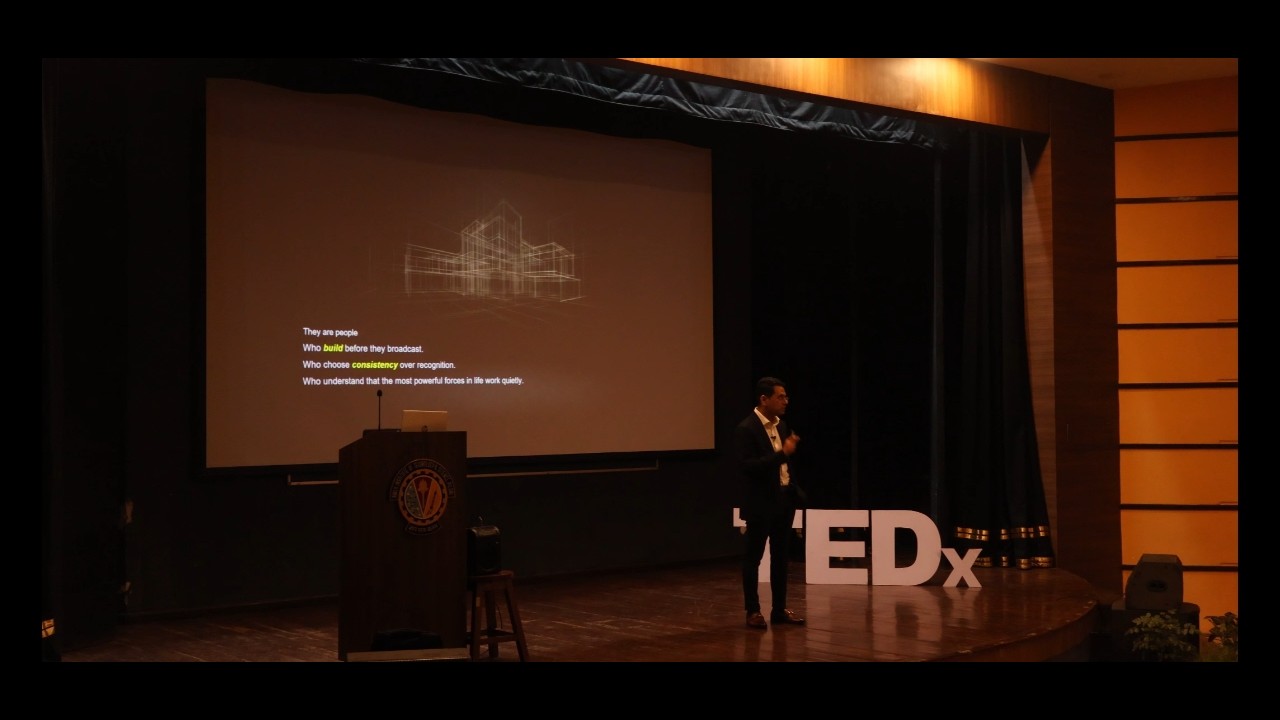
The Power of Silent Foundations | Silent Architects | Anup Gupta | TEDxBITSPilani
Keywords
Summary
158 words
Critical Evaluation
Value of the Information & Strength of the Argument
The talk’s value lies in its relatable, experience-based advice rather than novel or data-driven insights. The argumentation is built on analogies (gravity, character, compounding) and personal narratives, which make it emotionally resonant but not scientifically rigorous. The speaker’s claim that success is a result of quiet, consistent effort is convincing from a common-sense perspective, but the lack of empirical examples or citations weakens its authority. The argumentation is logically steady, using contrasts (noise vs silence, outcomes vs process) to reinforce the central thesis. However, the reasoning sometimes jumps between points, and some digressions (e.g., about family, sibling comparisons) may dilute the focus. Overall, the talk excels in delivering practical, motivational wisdom but falls short of a robust scientific or analytical framework.
Scientific Rigor, Source Quality, Title Accuracy
The talk does not cite any external sources; the only reference is the TEDx platform itself. The speaker references general concepts like gravity, compounding, and character building but does not provide books, studies, or authoritative references. This absence of sourcing is consistent with its nature as an experiential expert opinion rather than a literature review. The title, ‘The Power of Silent Foundations’ and the subtitle ‘Silent Architects’, aligns well with the content, which repeatedly emphasizes invisible forces and quiet effort. However, the title might imply a more abstract or scientific exploration than what is delivered, as the talk is primarily anecdotal. The speaker’s credibility is based on his entrepreneurial success (he runs MathonGo) and his ability to connect with the student audience, but without verifiable citations, the scientific rigor is limited.
267 words
Title / Content Match
The title accurately reflects the talk's emphasis on quiet, consistent effort as the foundation of success. The speaker elaborates on this theme through personal stories and motivational advice, though the title is abstract and the content is more prescriptive than analytical.
Quality & Reliability
5/10
The talk is primarily an anecdotal expert opinion with no cited scientific sources. The speaker draws on personal experience and references general concepts like character and compounding, but lacks empirical evidence or external references. The reasoning is logically coherent but relies on rhetorical persuasion rather than rigorous data.
Key Moments
Markers derived by PSI from the transcript: the creator did not define chapters.
- Introduction: The speaker frames the topic of 'Silent Architects' and asks about failures in exams, establishing a personal, relatable tone.
- Discussion of success as being loud, and introduction of concepts like gravity and character that work silently.
- Personal story: The speaker describes his introverted nature and school behavior, contrasting with typical success narratives.
- Critique of 'unicorn' culture and discouragement of outcome-driven mindset, advocating for process-oriented habits.
- Advice on daily routine: Starting at 5:30 AM and continuous work, emphasizing consistency over intensity.
- Reflection on family comparisons and the role of personal belief, with an analogy to stock market candles.
- Final message on integrity and the importance of building character, concluding the talk on a note of self-reliance.
Cited Sources
- TEDx Talks — Official TEDx platform where the talk was published, providing context on the TEDx event format.
Contribution & Novelties
The talk offers a personal, motivational perspective on success, but does not introduce novel concepts. Its originality lies in the speaker’s unique journey and the emphasis on ‘silent’ factors like character and consistency, which are often overshadowed by public achievements. The talk is a synthesis of common self-improvement themes applied to the student context.
Pour aller plus loin :
- Habit — Relevant to the talk’s emphasis on daily routines and consistent actions.
- Extraversion and introversion — Directly related to the speaker’s discussion of being an introvert and its role in success.
- Moral character — Connects to the talk’s focus on character building as a foundational element of long-term success.
109 words
Radar Profile
The radar profile indicates a talk that scores moderately on quality of information but low on technical depth and sourcing. The metrics reflect a motivational speech that relies on anecdotal evidence rather than rigorous analysis, typical of a TEDx talk focused on personal growth.