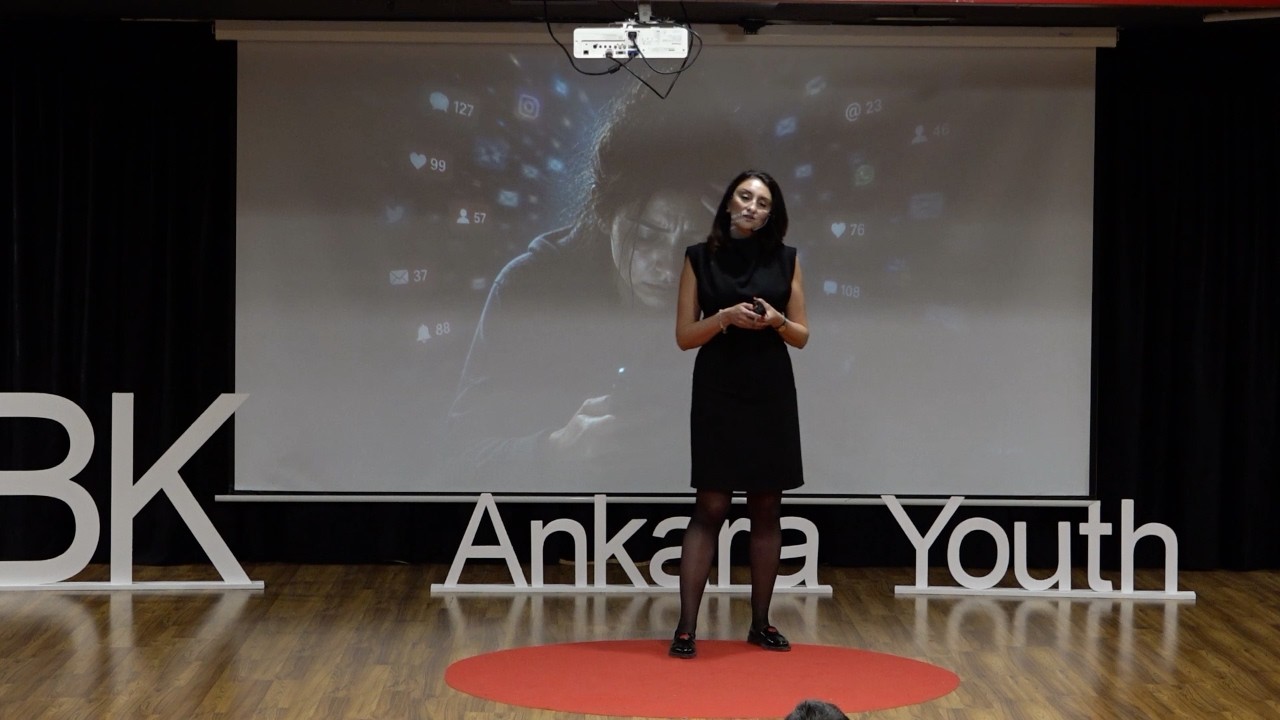
Dijital Gürültüde Kendini Duymak | Begüm Yıldız | TEDxBK Ankara Youth
Hearing Yourself in Digital Noise | Begüm Yıldız | TEDxBK Ankara Youth
Keywords
Summary
170 words
Critical Evaluation
Value of the Information & Strength of the Argument
The talk provides practical, actionable advice wrapped in personal experience, making it relatable and applicable. The speaker’s argumentation is earnest and grounded in her professional background in counseling psychology. She cites general research findings about the effects of social media on attention and mental health, which adds academic weight, though specific studies are not named. The ‘3K rule’ offers a memorable framework that is easy to adopt in small increments. The argument that digital noise interferes with prefrontal cortex functions and self-awareness is compelling and ties into established neuroscience concepts. However, the talk could have been stronger with evidence-based citations and more structured data to support the claims.
Scientific Rigor, Source Quality, Title Accuracy
The rigor is moderate: the speaker references research on social media and wellbeing but does not provide specific sources, making independent verification difficult. The description offers no additional scholarly references beyond the general TEDx link. The title accurately captures the core message, and the content aligns with the stated theme without digression. The talk is an expert opinion rather than a systematic review, so its strength lies in the credibility of the speaker and the coherence of the argument, not in exhaustive sourcing.
206 words
Title / Content Match
The title accurately reflects the central theme of listening to one's inner voice amidst the overwhelming digital noise.
Quality & Reliability
6/10
The talk presents personal experiences and references to studies on social media use and mental health, but without specific citations. The claims are plausible and align with general psychological research, but the lack of precise sources limits full verification.
Key Moments
Markers derived by PSI from the transcript: the creator did not define chapters.
- Introduction: Speaker introduces herself and her background in counseling psychology.
- Personal story: Encountering early computers and eventually adopting digital tools, highlighting her gradual integration.
- Turning point: Realization of excessive screen time and the decision to adopt small steps.
- Introduction of the 3K rule: Kapat (Close), Koru (Protect), Kendini Dinle (Listen to yourself).
- Conclusion: Emphasizing the importance of psychological resilience and turning inward.
Cited Sources
- TEDx Talks — General TEDx program information and talk description.
Contribution & Novelties
The talk’s original contribution lies in the practical ‘3K rule’—a simple mnemonic for digital self-regulation, focusing on small, sustainable steps rather than radical digital detox. It integrates psychological concepts like inner voice and resilience with everyday digital habits. The speaker’s personal journey makes the advice authentic and approachable.
Pour aller plus loin :
- Digital minimalism — A philosophy of reducing digital overload to improve focus and well-being.
- Attention economy — Understanding how platforms compete for our attention, central to the problem discussed.
- Prefrontal cortex — The brain region responsible for executive functions, which the speaker mentions as vulnerable to digital noise.
- Psychological resilience — The capacity to recover from adversity, which the speaker argues is essential in a digital world.
120 words
Radar Profile
The radar profile shows balanced but modest scores across all dimensions, with information quantity slightly higher than technical level. This indicates a talk that provides substantial personal narrative and general advice, but with limited depth in technical or scientific detail, typical of a TEDx-style motivational presentation.