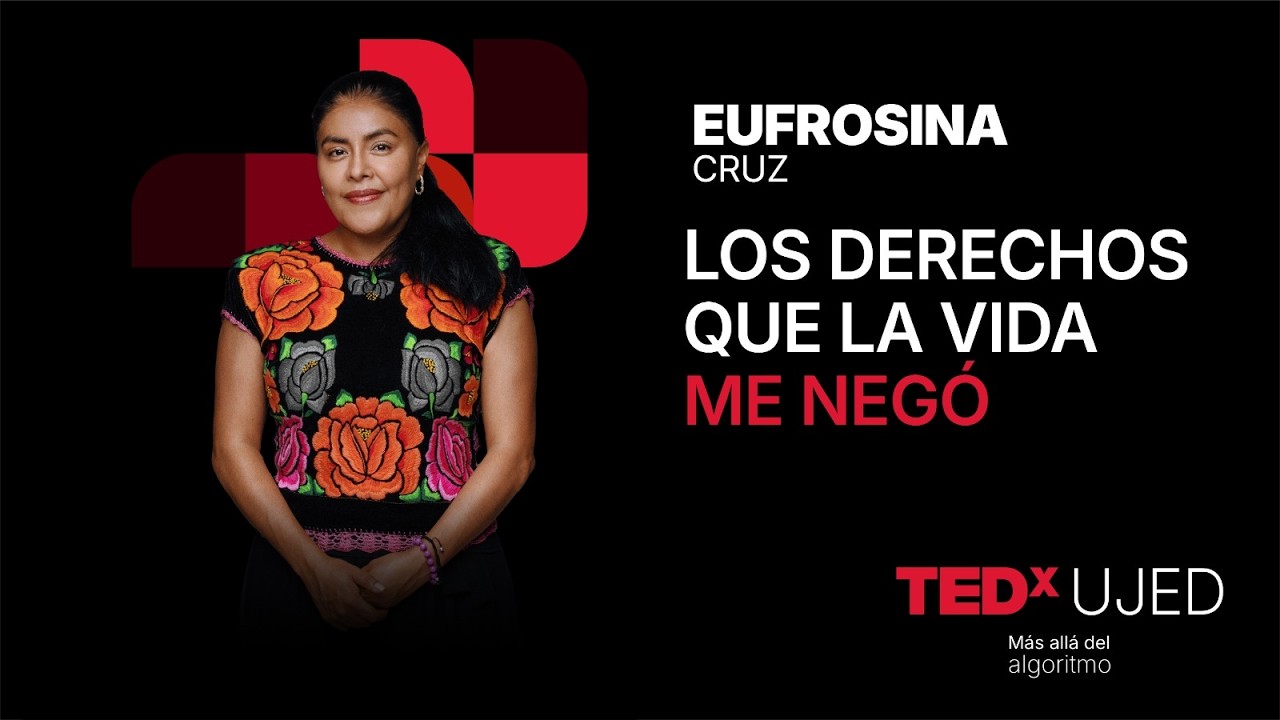
Los derechos que la vida me negó | Eufrosina Cruz | TEDxUJED
The rights that life denied me | Eufrosina Cruz | TEDxUJED
Title history
- Los derechos que la vida me negó | Eufrosina Cruz | TEDxUJED — observed on 20261111-1825 UTC (YouTube)
Keywords
Summary
100 words
Critical Evaluation
Value of the Information & Strength of the Argument
The talk provides a compelling and authentic testimony of overcoming adversity. The argumentation is based on personal experience and moral appeal, rather than statistical evidence. She effectively uses rhetorical devices and personal anecdotes to illustrate systemic inequalities. The call to question norms and take responsibility for change is powerful and persuasive. However, the lack of empirical data weakens the scientific rigor, though the emotional impact is strong.
Scientific Rigor, Source Quality, Title Accuracy
The talk does not cite any scientific sources or external references, relying solely on personal story and testimony. The description provides a link to TEDx’s general page, which is not a direct source. The title is appropriate and matches the content. The speaker’s credibility as an activist and politician adds weight, but the content is not research-based. No comments were provided for analysis.
145 words
Title / Content Match
The title accurately reflects the content, which focuses on the rights denied to the speaker due to gender, ethnicity, and poverty, and her fight to claim them.
Quality & Reliability
7/10
The talk is based on personal experience and advocacy, lacking empirical data or citations. However, the speaker is a recognized activist and politician, lending credibility. The narrative is coherent and addresses systemic issues.
Key Moments
Markers derived by PSI from the transcript: the creator did not define chapters.
- Eufrosina tells her mother and grandmother were married at age 12.
- Teacher Joaquin introduces her to the power of words and questioning.
- She decides to leave her village at age 12, without speaking Spanish.
- She describes her struggles with poverty and education.
- She decides to run for president of her village, facing opposition.
- She becomes the first female president of the Congress of Oaxaca and speaks at the UN.
Cited Sources
- TEDx Talks — General TEDx resource providing information about the TEDx program.
Contribution & Novelties
This talk offers a personal and emotional account of an indigenous woman’s fight for rights, highlighting the intersection of gender, ethnicity, and poverty in Mexico. It provides a compelling narrative that humanizes systemic issues such as child marriage and political exclusion. While not novel in its concepts, it brings a first-hand perspective that can inspire and raise awareness.
Pour aller plus loin :
- Zapotec peoples - Background on the indigenous group to which the speaker belongs.
- Indigenous peoples of Mexico - Overview of the legal and social status of indigenous communities in Mexico.
- Women in Mexico - Discussion of gender equality issues and legal reforms in Mexico.
- Child marriage - Global context on the practice discussed in the talk.
119 words
Radar Profile
The profile shows low technicality, moderate information quantity, and high quality in terms of personal credibility and emotional impact. The fiabilité is moderate due to lack of external sources.