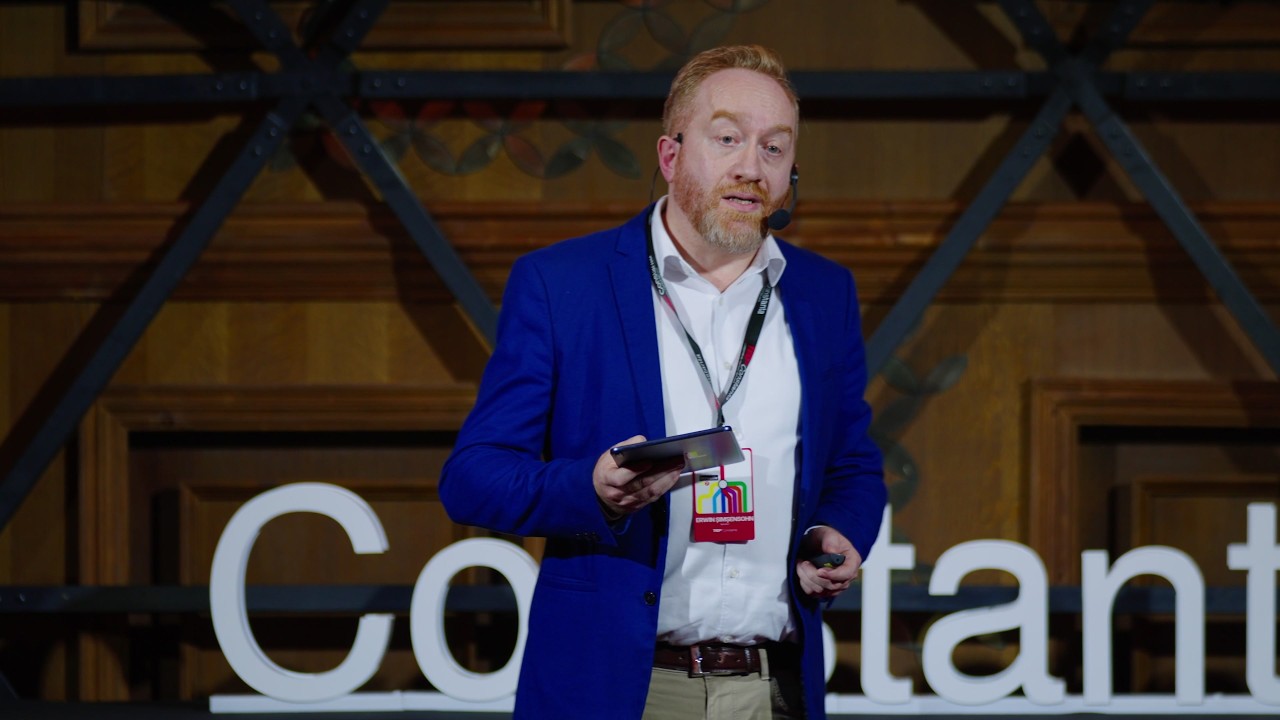
Bariere invizibile: teatre, orașe și cei care rămân pe dinafară | Erwin Șimșensohn | TEDxConstanta
Invisible barriers: theaters, cities, and those left behind | Erwin Șimșensohn | TEDxConstanta
Title history
- Bariere invizibile: teatre, orașe și cei care rămân pe dinafară | Erwin Șimșensohn | TEDxConstanta — observed on 20261114-0306 UTC (YouTube)
Keywords
Summary
246 words
Critical Evaluation
Value of the Information & Strength of the Argument
The presentation excels in translating a complex sociotechnical problem into accessible and relatable narratives. The ‘10-second sign language’ experiment is a powerful empathetic hook that grounds the core argument. The speaker clearly articulates the distinction between the medical and social models of disability, which serves as a robust scientific and ethical framework. The argumentation progresses logically from personal stories to systemic statistics, then to concrete solutions implemented in his theater. He convincingly frames the city itself as the entity with the ‘disability’, shifting responsibility from individuals to collective planning. The value is high as it provides actionable, simple recommendations for everyday citizens and institutional actors, effectively bridging awareness and practical change.
Scientific Rigor, Source Quality, Title Accuracy
Scientific rigor is satisfactory: the speaker accurately describes the evolution of terminology (from ‘mimico-gestural language’ to recognized ‘Romanian Sign Language’ in 2020), and correctly outlines the legal obligations regarding public accessibility in Romania. He cites general official statistics and strategic documents. The major limitation is the total absence of direct source links in the video description; only the general TEDx homepage is provided, making it difficult to trace the cited figures (such as the 1 in 4 prevalence or the exact number of interpreters) to their primary documents. The title accurately encapsulates the broad discussion of invisible barriers in both theaters and cities. The visual and oral quality is solid, adhering to the TEDx presentation format.
242 words
Title / Content Match
The title perfectly reflects the content: the speaker systematically details the invisible barriers faced by people with disabilities in urban spaces and institutions, using the theater as a model for social inclusion.
Quality & Reliability
7/10
The talk is grounded in official Romanian statistics and legislation (recent recognition of sign language in 2020, national disability strategy), and the conceptual framework (medical vs social model) is scientifically robust. However, the speaker relies heavily on anecdotes and personal experiences without providing direct URLs or institutional references in the video description, limiting immediate verifiability of specific figures.
Key Moments
Markers derived by PSI from the transcript: the creator did not define chapters.
- The speaker presents his 10-second experience in Romanian Sign Language, highlighting the audience's initial confusion and discomfort.
- Introduction of the two possible answers to the problem of a wheelchair user at a staircase: the medical model (the problem is the person) vs the social model (the problem is the environment).
- Story of Ana, in a wheelchair, facing a 15cm curb, a parked car, and an inaccessible public building entrance.
- Story of Mihai, who is deaf, needing his mother or child to interpret medical diagnoses due to the lack of professional interpreters in healthcare.
- Story of Elena, who is blind, unable to read public transit information and encountering inaccessible scanned PDFs on institutional websites.
- Presentation of key statistics: nearly one million certified disabled people in Romania, the 1-in-4 prevalence, and the severe shortage of Sign Language interpreters (~100 interpreters for 23,000 deaf people).
- Details of the theater's accessibility initiatives: 'Focus Acces' section, tactile tours for the blind, Sign Language interpretation, and relaxed performances for neurodivergent audiences.
- The speaker presents his vision of theater as a laboratory for the city and the principle of 'Nothing about us without us'.
- Three concrete requests: raise awareness of curbs and info gaps, ask 'who cannot enter?' in institutions, and never park on lowered curbs or in accessible spots.
- Final call: the audience applauds in Sign Language to envision an inclusive welcome.
Cited Sources
- TEDx program (official context) — The only link provided in the video description. It contextualizes the talk as an independently organized TEDx event, but does not provide direct references to the specific laws or statistics cited in the speech.
Concurring Sources
- Social model of disability — Corroborates the talk's core dichotomy between the medical and social models, providing a recognized scientific classification of disability.
- Convention on the Rights of Persons with Disabilities — Confirms the international legal framework mentioned by the speaker, reinforcing his assertions about Romania's obligations and the principle of 'Nothing about us without us'.
Contribution & Novelties
The talk offers a fresh and intuitive angle on disability by using the theater as a practical laboratory for accessibility. It successfully demonstrates that cultural institutions can serve as testbeds for urban planning, moving beyond theoretical discourse. The specific framing of the ‘scanned PDF’ and ‘sign language interpreter shortage’ in Romania provides contemporary, localized data points. The call for applauding in Sign Language provides a memorable participatory conclusion that reinforces the message of lived experience.
Pour aller plus loin :
- Social model of disability — Provides the foundational framework distinguishing impairments from disability caused by social and environmental barriers.
- Romanian Sign Language — Details the linguistic status and recognition of the language central to the talk.
- Convention on the Rights of Persons with Disabilities — The main international treaty that Romania has ratified, anchoring the legal obligations for accessibility.
- Universal design — Explores the design principles that make environments usable by all people, aligning with the speaker’s call to build better cities.
162 words
Radar Profile
The profile is relatively balanced, with strong emphasis on the volume of information and its emotional/practical quality. The technical level score is notably lower, reflecting the talk's focus on social narratives and common-sense solutions rather than engineering or medical specifics. The high global reliability score suggests a coherent, well-argued presentation that could benefit slightly from more detailed external citations.