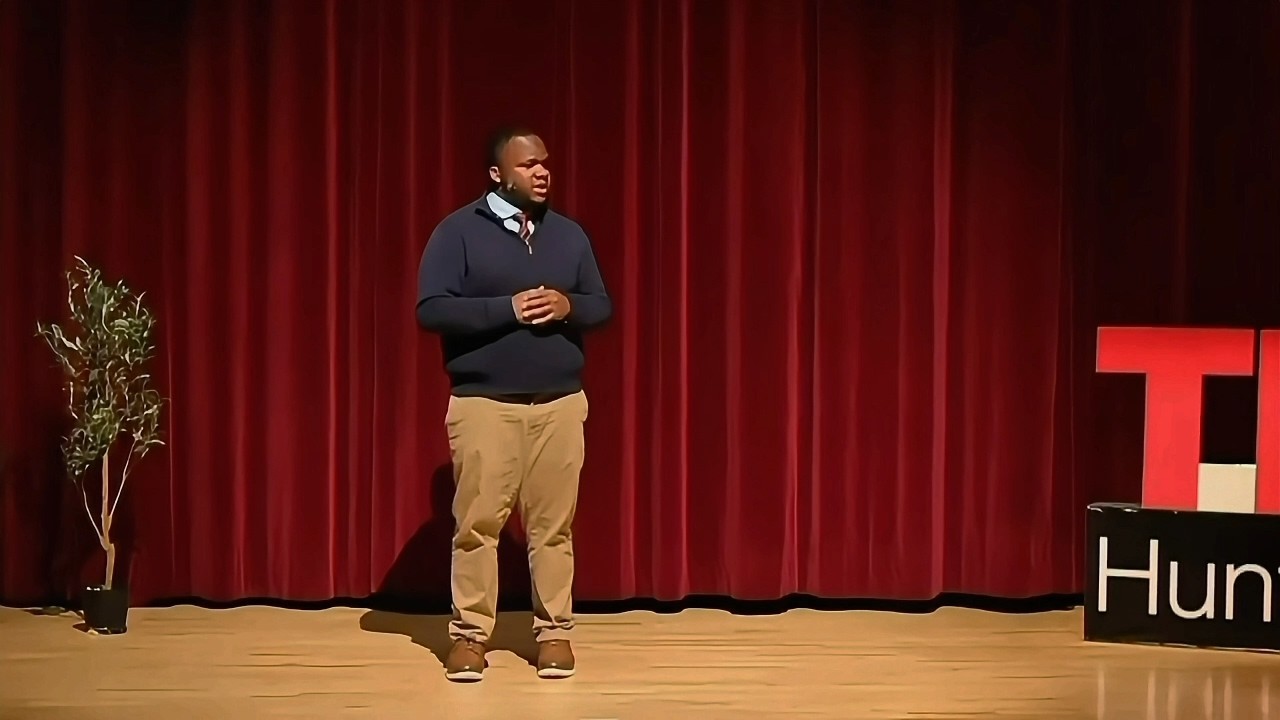
It’s About What You Say, Not How You Say It | James Mason Jr. | TEDxHunting Valley
Keywords
Summary
158 words
Critical Evaluation
Value of the Information & Strength of the Argument
The talk’s value lies in its personal narrative that illustrates the abstract concept of code switching. Mason effectively uses a relatable anecdote to introduce a complex sociological idea. His argument gains strength from referencing Du Bois’s double consciousness, giving historical weight to his thesis. The distinction between adaptation and conformity is a nuanced point that adds depth. However, the argument relies primarily on personal experience and one cited source, so its generalizability might be limited. Nevertheless, the talk is compelling and well-structured.
Scientific Rigor, Source Quality, Title Accuracy
The talk accurately references W.E.B. Du Bois’s 1903 work ‘The Souls of Black Folk’ and the concept of double consciousness. The title is perfectly matched to the content, as the entire talk builds toward a redefinition of the phrase. The description provided only includes a link to the TEDx platform, which is not a substantive source. No external scientific references are cited beyond the book, but the talk is intended for a general audience and does not claim to present new research. The reasoning is coherent, though it would benefit from more robust evidence.
191 words
Title / Content Match
The title perfectly captures the talk's central argument, which flips the common phrase to emphasize substance over style.
Quality & Reliability
8/10
The talk is well-argued, references a credible scholar (W.E.B. Du Bois), and maintains internal consistency. However, it is primarily anecdotal and relies on a single cited source.
Key Moments
Markers derived by PSI from the transcript: the creator did not define chapters.
- Opening with the common phrase 'It's not about what you say, it's about how you say it'
- Ninth grade English class story: first day with sophisticated vocabulary
- Definition of code switching and its everyday practice
- Reference to W.E.B. Du Bois and double consciousness in 'The Souls of Black Folk'
- Distinction between adaptation (connects) and conformity (erases identity)
- Call to action and final flip of the phrase: it is about what you say, not how you say it
Cited Sources
- TEDx Talks official page — Link provided in the video description
Contribution & Novelties
The talk offers a personal perspective on the sociological concepts of code switching and double consciousness, making them accessible to a broad audience. It adds a contemporary angle by discussing how these ideas manifest in everyday interactions, particularly for young people of color. The speaker’s call to action to reframe how we evaluate communication is a meaningful contribution to discussions on diversity and inclusion.
Pour aller plus loin :
- Code-switching — Provides a comprehensive overview of the linguistic practice.
- Double consciousness — Explores the concept as defined by W.E.B. Du Bois.
- The Souls of Black Folk — The full text and context of Du Bois’s influential 1903 book.
108 words
Radar Profile
The profile shows a talk that is high in qualitative reliability and moderate in quantity and technicality, suggesting a well-crafted narrative that prioritizes depth over breadth.