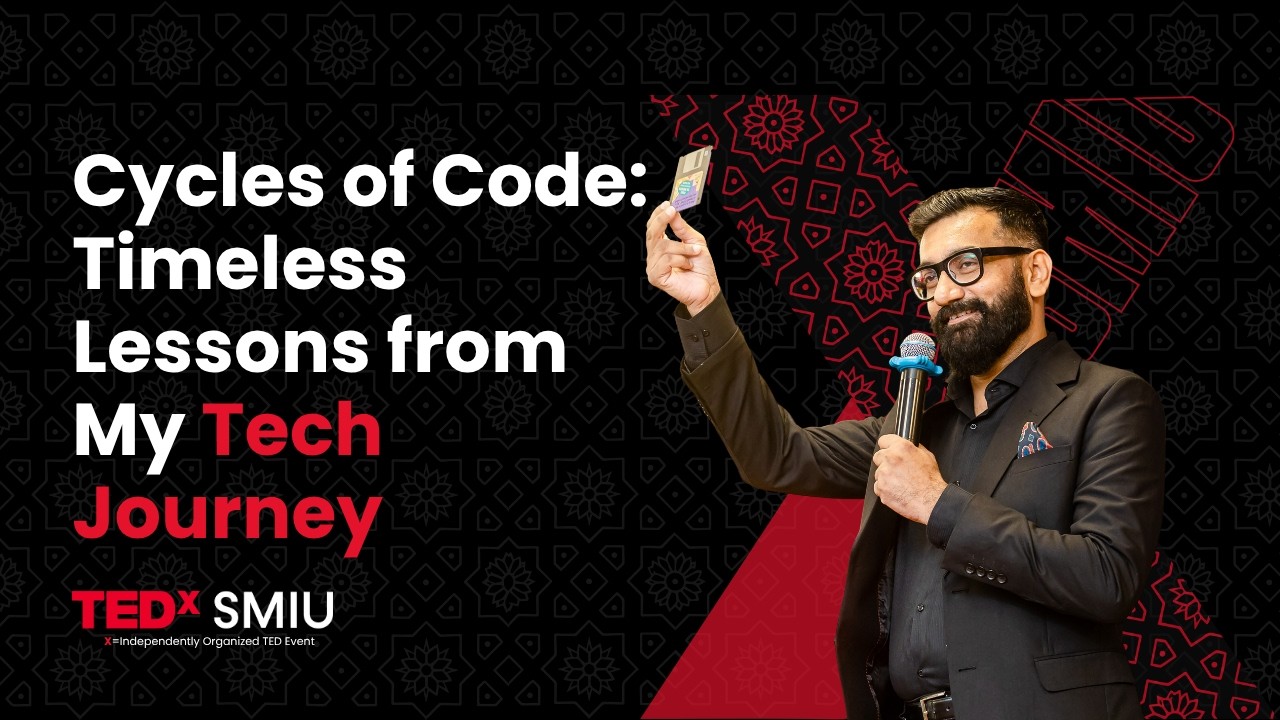
Cycles of Code: Timeless Lessons from My Tech Journey | Muhammad Shahid Sheeraz | TEDxSMIU
Title history
- Cycles of Code: Timeless Lessons from My Tech Journey | Muhammad Shahid Sheeraz | TEDxSMIU — observed on 20261027-0211 UTC (YouTube)
Keywords
Summary
162 words
Critical Evaluation
Value of the Information & Strength of the Argument
The talk offers a valuable perspective on technology adoption, particularly in healthcare, highlighting the human factors often overlooked. The speaker’s argument that technological evolution is circular rather than linear is well-illustrated with concrete examples (server rooms to cloud, DOS to AI prompts). The point that 80% of transformation is about people, not machines, is practical and grounded in his experience. However, the argumentation is largely anecdotal and lacks empirical evidence. The claim that AI will not replace jobs is oversimplified and not backed by data. While the talk is persuasive and engaging, it provides a high-level overview without deep technical or scientific rigor, making it more motivational than analytical.
Scientific Rigor, Source Quality, Title Accuracy
The talk does not cite specific studies or sources, relying instead on the speaker’s career experiences and common historical events (Y2K, ATM introduction). The only external reference is the TEDx organization itself, which lends credibility to the format but not to the content specific claims. The title accurately captures the theme, and the content stays on topic, though the lack of rigorous evidence prevents it from being highly authoritative. The speaker mentions Al-Khwarizmi but does not provide detailed historical context. Overall, the talk is a personal thought piece rather than a scholarly analysis, so scientific rigor is moderate.
222 words
Title / Content Match
The title accurately reflects the central theme of recurring technology patterns; the speaker illustrates this with several examples, making the title well-aligned with the content.
Quality & Reliability
5/10
The talk is a personal narrative with anecdotal evidence and general observations about technology cycles. It lacks formal citations or empirical data, but the speaker's professional experience lends some credibility. The historical references (e.g., Y2K, ATM adoption) are plausible but not rigorously sourced.
Key Moments
Markers derived by PSI from the transcript: the creator did not define chapters.
- Speaker shows a floppy disk and asks audience recognition; only a few raise hands.
- Introduces the concept that technology changes form but the underlying concept persists (save icon).
- Describes centralized server rooms and transition to personal computers, then back to cloud (centralization cycle).
- Compares DOS command-line programming to modern AI prompts, noting the return to conversational interfaces.
- Discusses historical fears of technology replacing jobs (calculators, ATMs, Y2K) and contrasts with reality.
- Shares a healthcare digital transformation story where a doctor prefers paper prescriptions, emphasizing trust issues.
- Highlights that 80% of technology transformation is about people, not machines, and the importance of change management.
- Mentions Al-Khwarizmi and the origin of algorithms, connecting historical math to modern computing.
- Concludes with advice to focus on problems, ask good questions, build trust, and build locally.
Cited Sources
- TEDx Program — The talk was given at a TEDx event, organized independently under the TEDx license.
Contribution & Novelties
The talk provides a personal, experience-based synthesis of recurring patterns in technology, emphasizing that technological evolution is cyclical. Its original contribution lies in bridging the speaker’s 23-year career in healthcare IT with broader observations, particularly the human-centric challenges of digital transformation.
Pour aller plus loin :
- Algorithm — The term originates from Al-Khwarizmi, foundational to computing.
- Cloud computing — Represents recent centralization of data and services.
- Change management — Critical for technology adoption, as emphasized in the talk.
78 words
Radar Profile
The radar profile shows moderate scores across information quantity, quality, technical level, and reliability, indicating a balanced but not deeply rigorous talk. The talk is strong in providing personal insights and practical advice, but weaker in formal evidence and technical depth.